IFRS Reporting Requirements for ESOS
Introduction to IFRS Reporting Requirements for ESOS
Employee Stock Option Schemes (ESOS) have emerged as one of the most effective methods of aligning the performance of employees with the shareholder value. Any company, particularly a listed one or one that wants to attract investors, in the modern global market, has to consider such share-based payment arrangements as required by International Financial Reporting Standards (IFRS). It is difficult not just to appreciate the options but also to identify, quantify, and report them correctly in the financial reports. Since regulators and investors require more transparency, compliance with the principles of the IFRS would guarantee that the financial impact of stock options are well reflected. Earnings misstatements, compliance risk and reputational harm may result due to missteps in the reporting. This paper is specifically interested in the accounting and reporting of ESOS according to the IFRS 2, and gives a comprehensive advice to companies that use and issue such plans, including guidance on ESOP valuation services Singapore.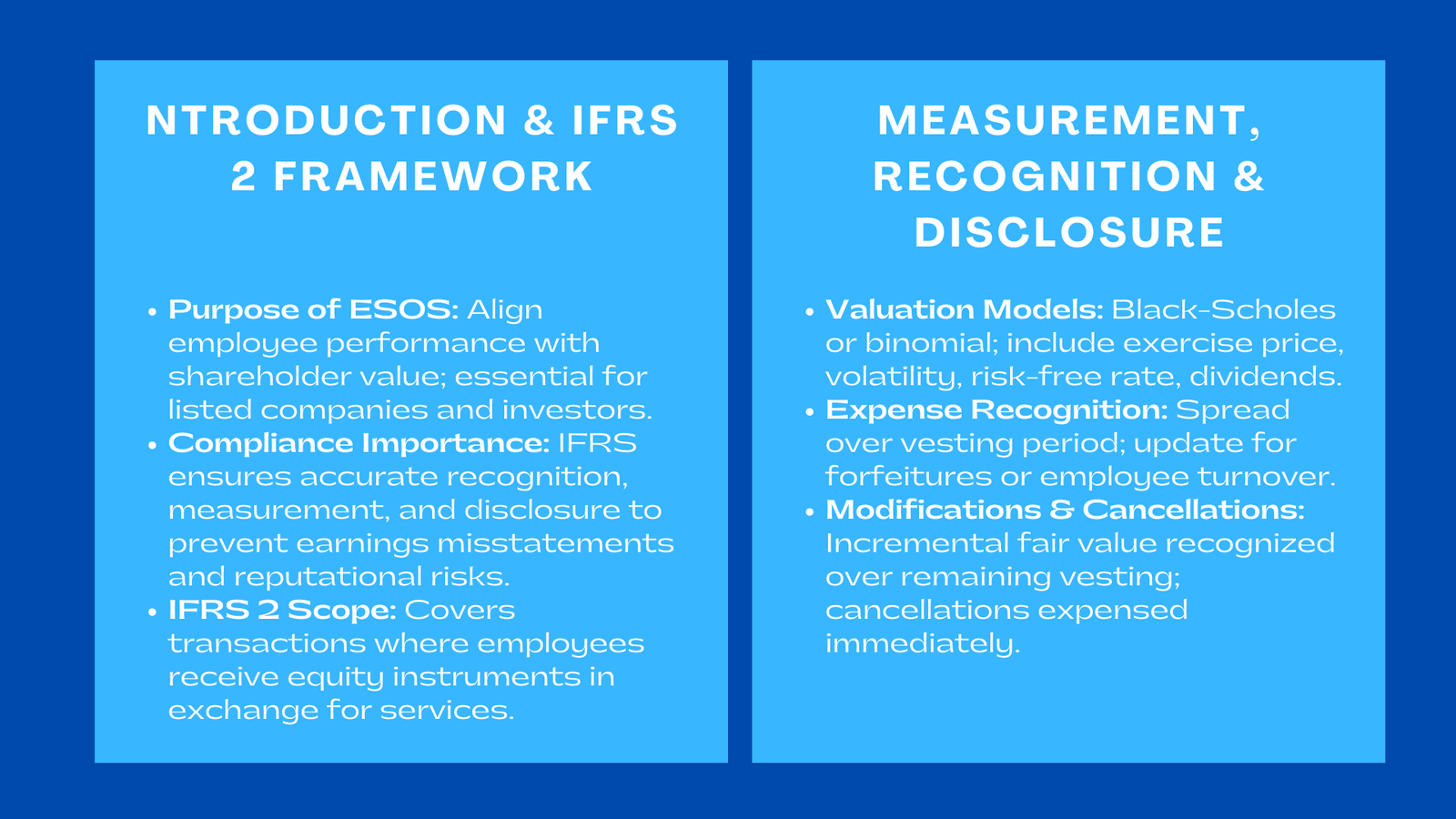
1. The IFRS 2 Singapore Framework of ESOS.
1.1 Scope and Core Objective
The IFRS 2, share-based payment, defines how to treat all the transactions where an entity is being provided with goods or services in consideration of equity instruments. In the ESOS, share options are given to employees who give them services within a set of time. The requirement of the standard is that the fair value of such options be calculated at the date of granting and must be charged as an expense during the time of the vesting period. This will take care of the fact that the cost of the staffs compensation using stock options is reflected in the systematic way that reflects the time that employees have given their services. Thus, financial statements give a true account of the economic cost of equity-based rewards.1.2 Making the difference between Equity-Settled and Cash-Settled Plans.
One of the key requirements of IFRS 2 Singapore is that between a cash-settled and equity-settled transaction, there is a need to differentiate between these two. In the case of ESOS, the general classification is that of equity-settled schemes because employees are given shares on the exercise. Nevertheless, there are also other organizations that provide tax or liquidity reasons to use cash equivalents, which form hybrid structures and demand special accounting treatment. Equity settled ESOS are determined based on grant-date fair value whereas cash plans are remeasured at the reporting date. This distinction in itself influences the volatility in earnings and the presentation of the balance sheet making classification a highly important initial compliance step.2. Principles of Measurement and Recognition.
2.1 Two steps are necessary to determine Fair Value at Grant Date.
An option-pricing model, whether the Black-Scholes or the binomial model, is normally used to determine the fair value of a stock option. Such models take into account the exercise price, anticipated volatility, the interest rate which is risk free and anticipated dividends. The IFRS 2 Singapore stipulates that only market and non-vesting terms should be reflected in the fair value measurement at the time of grant whereas, service and non-market terms of performance influence the number of options to be vested. To illustrate, a technology start-up company assigning alternatives to engineers may operate a forecasted volatility relying on analogous traders in the market in case its trading track record is inadequate. This is a cautious projection that will see that the recorded cost actually represents what is anticipated in the market as opposed to making a wild guess.2.2 Expense Recognition over the Vesting Period
When fair value is ascertained, the overall cost of the ESOS has to be identified as an employee benefit cost during the time of the vesting. The gradual use of employee service is reflected in the accounting entry. Companies have to re-evaluate the estimates of vesting on a regular basis and revised the cumulative expense. An example of this is in case 10 percent of the workforce is supposed to turnover prior to being vested and this expectation later changes to 5 percent, then the cumulative interest should also be updated to represent the new expectation. This dynamic recognition process would make the financial statements to be up to date and innovative over the vesting period.2.3 The Process of Modifications, Cancellation and Settlements.
Practically, the firms tend to alter ESOS plans to alter the price of the exercises, lengthen the period of vesting or speed up the process of vesting in the occasion of a merger. In the IFRS 2, incremental fair value due to such modifications has to be recognized throughout the remaining period of the vesting. In case of cancellation of the plan, all unrecognized expense should be recognized in profit or loss. These regulations make sure that the firms cannot change the amount of profits through the strategic manipulation of the terms of options. It also instills uniformity and comparability over the reporting periods enhancing investor confidence.- Disclosure and Presentation Requirements
3.1 Financial Statement Disclosures
Transparency is central to IFRS reporting for employee stock options, and companies must disclose detailed information about their ESOS plans. Required disclosures include:- The nature and size of share-based payment plans in the period.
- The determination of fair value.
- The outstanding options, granted options, exercised options and forfeited options based on the number of options and the weighted-average price of the options at the time of exercise.
- All costs that have been identified to be paid to the share owners.