ESOS Accounting Best Practices
Introduction to ESOS Accounting Best Practices
Employee Share Option Schemes (ESOS) have emerged as part of the new compensation policy, and companies have been able to align the interest of employees with the corporate value over long-term scope. Not all is rosy behind their inspirational call though: there is an intricate accounting issue involved as to how to be compliant with IFRS 2 Singapore and at the same time be truthful about the cost of share-based payments in financial statements. Proper ESOS Accounting Singapore is not only a regulatory obligation but it is also a strategic need. Unrecognized expenses, inappropriate models of valuation or poor disclosed information may undermine investor trust and expose themselves to audit questioning. With an increasing number of companies in Singapore and the wider Asian region implementing ESOS in their bid to recruit and retain the most talented people, the need to set best practices in the accounting and reporting field has never been more imperative, especially for those following an accounting firm valuation Singapore step‑by‑step guide. The next sections will describe a logical and realistic method of ESOS Accounting Singapore – not only valuation and recognition but also compliance monitoring and disclosure excellence.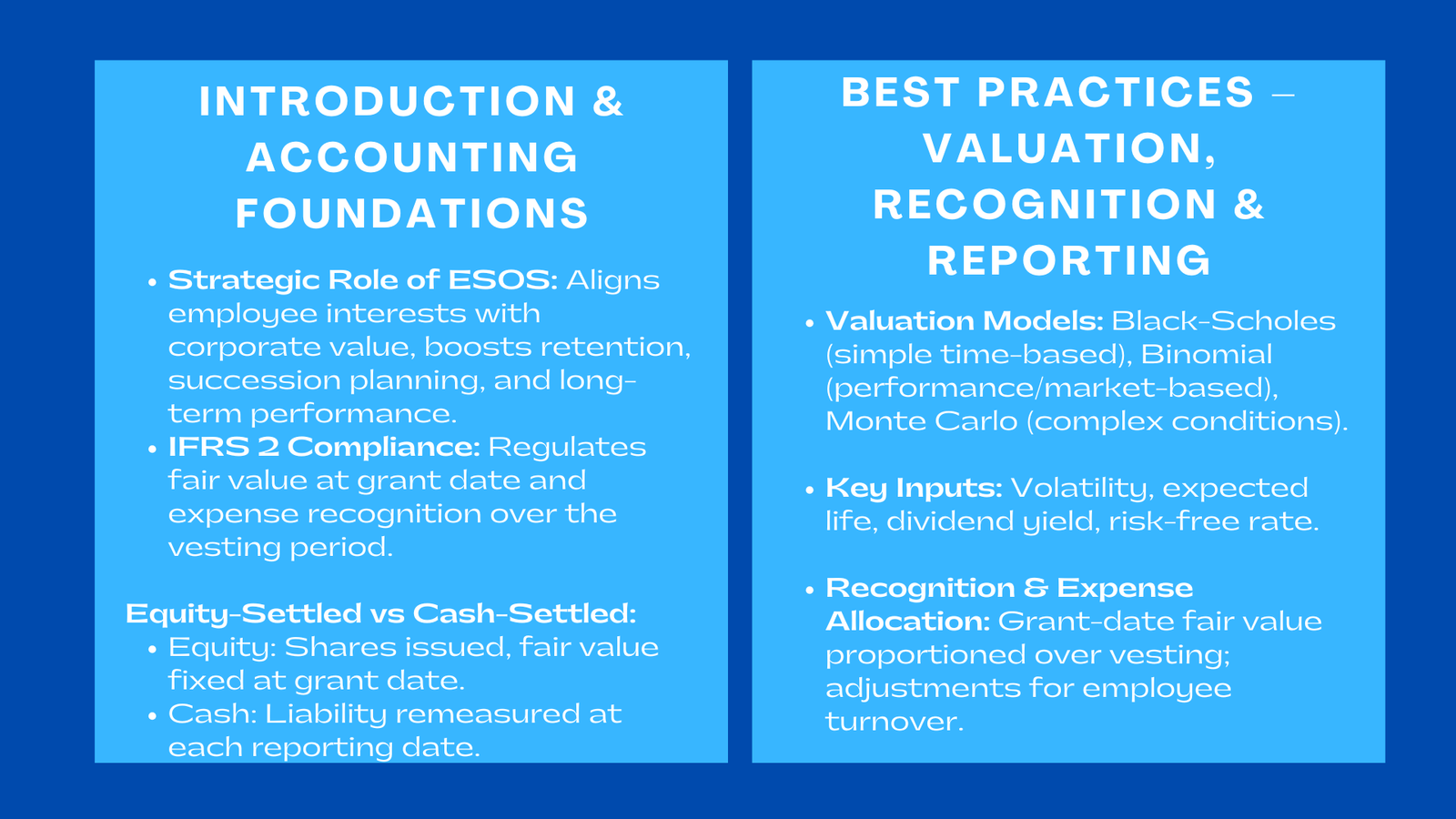
1. Learning the Accounting Foundation.
1.1 The IFRS 2 Singapore Framework
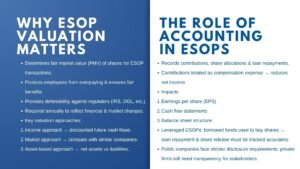
The international financial reporting standards (IFRS) 2 regulate the accounting of the share-based payments such as the ESOS. It involves the record keeping of fair value as of the grant date and expenses during the vesting period. This will guarantee that the cost of compensation as reported is based on the economic benefit that employees get. Most companies tend to initially underestimate the bureaucracy that can arise when harmonizing the needs of a number of tranches, performance requirements or market-based vesting requirements. Adhering to employee stock options accounting IFRS guidelines ensures consistency across reporting periods and comparability with peer companies.1.2 Equity-Settled vs. Cash-Settled Options
Under the IFRS 2, ESOS transaction may be equity-settled or cash-settled. Equity-settled: It is where the company issues shares or options and fair value is determined on the date of grant and a remeasurement is not made after that date. Cash-settled: The company pays cash, which is as big as the share value and liability should be remeasured at each reporting date. This difference will be the determinant of how the accounting entries, disclosures, and expense recognition will be organized within the lifetime of the plan.2. Valuation and Measurement Practices.
2.1 Selection of the appropriate valuation model is
To make proper financial reports, selection of proper model is essential. The Black-Scholes or binomial models are used by most organizations. Simple, time-based vesting is typical of the Black-Scholes model, whereas more flexible performance or market based models can be found using the binomial (lattice) model. In case of complex ESOS structures, Monte Carlo simulations are used to provide sound modeling of probability-weighted results. Regardless of the model selected, the management should report its explanation, and prove the assumptions every year.2.2 Key Inputs and Assumptions
The accuracy of valuation is based on volatility, risk free, expectations of life and expected dividend yield assumptions. An example is a firm where the share price history is volatile in nature, so combined historical and implied volatility is used, and a private firm is likely to refer to similar listed firms. There is a risk of audit adjustments and reputational risk in case the assumptions are not justified. Proper estimation ensures compliance with IFRS reporting for employee stock options and provides transparency to shareholders.2.3 Independent Valuation Reviews
The involvement of an independent valuer would increase objectivity and credibility. External specialists have the ability to assist in the process of validating modeling techniques, benchmarking, and fair value estimates that are in line with the prevailing market conditions. Third party valuation reviews are regarded as best practice in most jurisdictions, especially those companies going to the IPO.3. Recognition and Expense Allocation.
3.1 Grant-Date Recognition
On the grant date, fair value total of options that will be vested is settled. This will be divided by the vesting period at a proportionate share to the service that the employees render. The only adjustment that can be made is not the adjustment in the market value but the adjustment in the number of options that are likely to be vested. To illustrate, in the event that it is estimated that 5 percent of the employees would leave the company before the vesting period, then the expense should be recognized on the percentage amount that is expected to be vested. The re-evaluation of these estimates on a reporting date maintains the correctness of expenses and up-to-date status.3.2 Processing Amendments and Payment cancellations.
Incremental fair value should be recognized when the terms are changed (e.g., reduction of the exercise price or acceleration of the vesting). Any unamortized expense is recognized immediately in case of cancellations or settlements. This is where many companies fail; with proper documentation and regular enforcement of the policies mistakes are eliminated.3.3 Deferred Tax Implications
The accounting treatment is often different to the tax treatment. Deferred tax assets can be a result of differences in book deductions versus the tax deductions. Conciliation is done on a regular basis which is a guarantee of proper recognition and not the unexpected surprises when auditing.4. Disclosure and Transparency Disclosure and Transparency Information
4.1 Compulsory disclosure in terms of IFRS.
Full disclosure enhances transparency and confidence of the investor. Companies must report:- The essence and conditions of ESOS arrangements.
- The price of options in terms of its number and weighted-average.
- Fair value assumptions (volatility, expected life etc.)
- Reconciliation of options outstanding, exercised or expired.