IFRS Reporting for Share-Based Compensation

IFRS Reporting for Share-Based Compensation

Introduction to IFRS Reporting for Share-Based Compensation

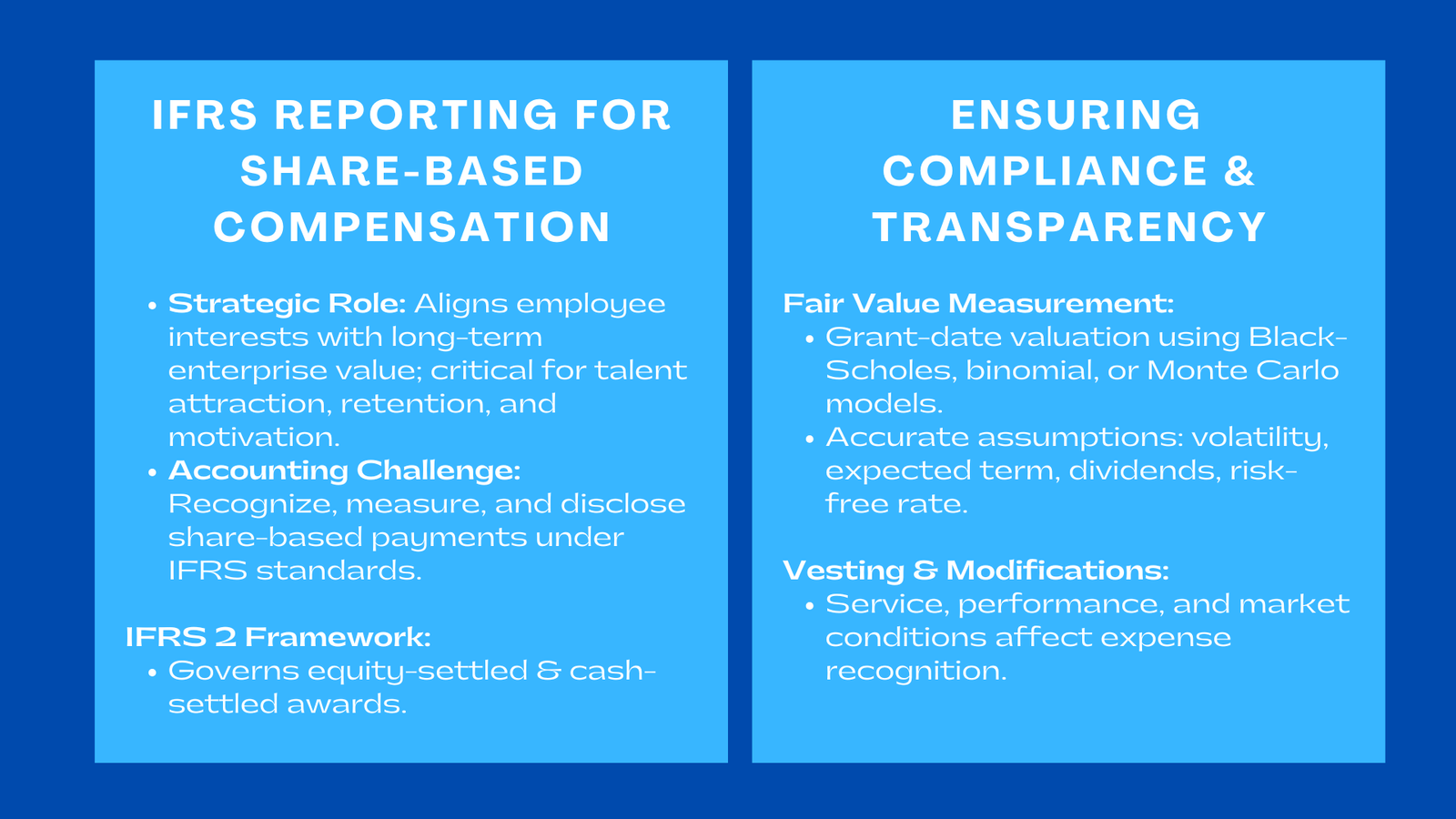
The share-based compensation has emerged as one of the most effective strategic options in attraction, retention and motivation of talent; and more so in high-growth sectors where organizations are using equity compensation to compete to secure skilled workers. Although share awards and stock options serve to align the employee interests with long-term enterprise value, they present a complicated accounting issue, including how to recognise, measure, and disclose the transactions according to the IFRS standards.

With increased regulatory oversight in the modern business climate, open and aligned reporting of share-based compensation has ceased to be a discretion. It has a direct effect on the attitude of investors, audit findings, and even valuation in the course of fundraising or IPO preparation. This paper covers one of those critical areas, that is the employee share-based compensation under the IFRS reporting requirements and what the best practices are to implement in order to ensure accuracy, compliance and comparability, especially for organizations understanding IFRS fair value measurement Singapore.

IFRS Reporting for Share-Based Compensation

1. Basic IFRS Reporting Principles on Share-Based Compensations.

1.1 The IFRS 2 Framework

The IFRS 2 regulates the accounting of equity-settled and cash-settled share-based payment. This standard is aimed at ensuring that the companies measure fair value at the time of grant and recognise the expense associated with the said grants over the vesting period. This makes the financial statements represent the actual economic cost of using equity instruments to compensate employees.

The requirements of IFRS 2 are not as shallow as underestimated by many companies. In addition to mere acknowledgment of costs, the standard requires specific valuation assumptions, ongoing re-evaluation of the prospect of vesting and extensive disclosures. This framework forms the backbone of employee stock options accounting IFRS, requiring both precision and consistency from the finance team.

1.2 Equity vs. Cash-Settled Awards

Equity-settled awards must be settled by the issuance of shares or options, and the fair value of these options must be determined at the date of issuance, and not remeasured subsequent to that date, regardless of how the price of the shares moves. Conversely, cash-settled awards have to be remeasured at every reporting date, which presents volatility in the income statement.

It is important to understand the classification because incorrect classification may result in restatements which are one of the most harmful in the financial reporting.

2. Valuing Fair Value of Share-Based Compensation.

2.1 The Grant-Date Valuation Requirement.

Under IFRS 2, fair value is to be measured at grant date as opposed to vesting or exercise. It is an intellectual change that companies used to intrinsic values calculations. The reason is that fair value is more accurate in reflecting the economic value represented by optionality and upside potential.

The companies should as such, choose valuation models that are in line with the design of their awarding. As an example, plain-vanilla ESOS awards might be based on Black-Scholes, but a multinational with performance-based vesting terms will have to use a binomial or Monte Carlo model.

2.2 Significant Fair Value Projections and their challenges.

Fair value estimation is subject to reliability contingent upon the defensibility of assumptions- volatility, expected term, dividend yield and risk-free rate. This is one of the areas that most organisations experience problems.

An individual technology company, such as one, might not be able to do volatility because of its history. The IFRS permits similar publicly listed companies to be used, but this has to be demonstrated and transparently reported. Overly aggressive assumptions can trigger audit queries, while weak documentation creates compliance gaps under IFRS reporting share-based compensation requirements.

2.3 Independent Valuations as Best Practice

The external valuation professionals are very essential especially to pre-IPO companies. Independent reviews enhance the management, maintain uniformity over time periods, and decrease the chances of audit issues. In certain markets, especially in Asia, all material transactions of share-based compensation will also require independent valuation by the regulators.

3. Identification and Revenue Recognition.

3.1. Learning about Vesting Conditions.

The IFRS 2 makes a distinction of service conditions, performance conditions, and market conditions. Treatment varies between the category of accounting.

A technology company that offers employees choices based on three-year service and meeting of EBITDA goals must reexamine the quantity of awards that are anticipated to make at each reporting period. In the case of market-based conditions, such as the share price targets, the impact is already reflected in fair value on grant date and is not revisited in the future.

Organisations that do not distinguish such conditions usually distort these costs which results in inaccuracies in the audit process or the due diligence.

3.2 Any alterations, cancellations, and replacements.

In cases where conditions of a compensation award based on shares are changed, then IFRS 2 requires the incremental fair value to be recognized. Withdrawing exercise, increasing the speed of vesting or replacing awards after corporate restructuring, are all causes of modification accounting.

3.3 Real-world example

 When a Singaporean listed company was faced with a market downturn, option exercise prices were lowered to retain employees. Though the change had a positive effect on the benefit of the employees, the incremental fair value was required to be recognised in the profit and loss- a huge effect that initially the management did not expect.

3.4 Deferred Tax Treatment and Tax Effects.

Share based comp compensation is tax deductible depending on jurisdictions. In cases where there is a variance of tax deduction and accounting expenses, there is a deferred tax asset or a deferred tax liability.

When local taxation rules are based on exercised value as opposed to grant-date value, companies operating in more than one market have to balance such differences with care.

4. Transparency and Disclosure Requirement.

4.1 Mandatory IFRS Disclosures

The nature and the terms of share-based compensation arrangements, the fair value assumptions, and a reconciliation of option movements must be disclosed by companies. It is not just a compliance exercise, investors will carefully analyze these notes to determine the dilution risk and the long-term compensation cost.

Poor or partial disclosures usually give causes of alarm to analysts, though the accounting may be of good quality in substance.

4.2 Increasing Investor and Employee Transparency.

Best practising organisations add the necessary disclosures with narrative descriptions, sensitivity analysis, and vesting conditions summaries. It is becoming critical due to the requirement of ESG-oriented investors to see the compensation governance and equity.

4.3 Reporting Trends in 2025

The companies are shifting towards more transparent and easier to use disclosure format. A number of Singapore-based listed companies are currently offering graphical consolidation timetables, situation examination, and annual comparisons of share-based compensation expenses. This transparency gives more credibility and is now a trend in the industry.

5. The Incorporation of Technology and Controls in the IFRS Reporting.

5.1 Automated Share-Based Compensation Systems 

Spreadsheets that are handled manually put the companies at risk of errors, version control problems, and loss of data. The current equity administration systems are automated to input valuation, vesting plans, and modifications to forfeiture and calculations of expenses.

In firms that are audited on an annual basis, automation enhances internal control and minimizes the use of manual reconciliation.

5.2 Enhancing Internal Control.

Finance teams need to implement transparent approval processes, regular recounts and separation of HR and finance roles. Share-based compensation procedures are audited internally annually to provide a chance to detect areas of weaknesses before causing misstatements.

5.3 Continuous Training and Conformance Culture.

Under the complexity of IFRS 2, constant training of workers will be necessary. Annual IFRS workshops, audit briefings, and valuation refresher courses are part of the finance training programs of many companies.

Conclusion

With the growth in the application of equity incentives as an organisational strategy to attract talented employees, accurate reporting under the IFRS becomes a main pillar of financial integrity. Knowledge of valuation methods, discipline of recognition, and high-quality disclosures can make the share-based compensation in line with the regulatory standards and investor trust.

In the future, organizations that combine automation and enhance their governance as well as ensure that there is a high level of alignment between HR and finance will dominate the market in providing transparent, reasonable, and compliant reporting of share-based compensation.

Related Posts

Everything You Need to Know About ESOP Valuation with Valueteam

Valueteam provides expert ESOP valuation services to ensure fairness, compliance, and value optimization for employees and shareholders.