
Certified ESOP Compliance Training Program
ESOP Compliance Checklist for Companies
Introduction to Certified ESOP Compliance Training Program
The ESOPs have ceased to be the fads used as a retention strategy but are now being integrated as a key element in the contemporary corporate pay structures. In the current business world and more so in Singapore and other IFRS-reporting states, compliance in ESOP design, its implementation and associated reporting has never been as significant as it is presently.
Although it is well known that allowing employees to have a share in the business is a motivational tool that assists in encouraging them to work harder, not all companies have understood the sophisticated regulatory, accounting and disclosure provisions that come with such plans. Failure to comply could not only lead to misstatements of financial results, but it would also spoil the reputation of investors and the company.
This paper provides a detailed discussion of how companies can address the requirements under the IFRS regarding compliance with ESOPs – the controls, documentation and governance practices that are required to make companies transparent, accountable, and accurate.
Knowledge of ESOP Compliance in the IFRS.
The ESOPs Regulatory Backbone.
The central compliance in ESOP is the IFRS 2 – Share-based Payment which is an international standard that regulates the recognition, measurement and reporting of the equity based compensation. According to this standard, firms are required to recognize the fair value of options or shares awarded to employees and this can be recognized as an expense during the period of the vesting.
The compliance goes much further than the legal acceptance of an ESOP scheme. It involves coordination of the financial, human resource, and legal departments in order to make accurate valuation and appropriate accounting statements and reporting to the stakeholders.
The situation is complicated by the fact that the companies make changes in the previous plans, provide options in various jurisdictions, or introduce performance-related vesting terms, in any of these cases, it is crucial to evaluate the situation under IFRS 2 to eliminate possible misstatements.
The reason an ESOP Compliance Framework is important.
A developed compliance system has three major benefits. First, it reduces the risk since the ESOP of a company complies with the corporate law and financial reporting standards. Second, it facilitates a consistency in governance, which enables auditors and investors to assess equity compensation in a transparent manner. And third, it is scalable, a strong ESOP is capable of growing with the company regionally or at IPO.
It is especially applicable to companies that are on the growth stages where new share grants, employee mobility, fundraising events often impact the share-based payment reporting.
Major elements of ESOP Compliance.
Accuracy of valuation and Fair value measurement.
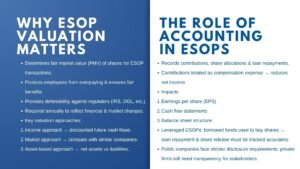
One of the most challenging, though important, compliance issues is determining the fair value of ESOP grants. IFRS 2 obligates companies to determine the fair value at the time of granting through acceptable valuation procedures, which may be the black-scholes model or Monte Carlo simulations.
Driven inputs that include share price, volatility, risk-free interest rates, and anticipated option life have to be defended and recorded. Financial reporting should always be consistent in terms of reflecting any changes, particularly those that are brought about by changes in the plan.
Independent valuers are now involved in the management of many organizations so that they can achieve impartial values and to increase the favorable impression of their ESOP valuations – a best practice of companies that want their shareholders to have confidence or that anticipate audit review.
Governance, Approvals and Documentation.
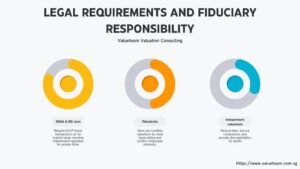
An obedient ESOP commences with appropriate corporate sanction. The plan should be approved by the board of directors and establish eligibility and maximum number of shares which should be issued. An individual grant should be recorded by way of a grant letter detailing the terms of vesting, exercise price and expiry date.
In addition to documentation, there must be regular in-house communication. The HR departments are expected to have detailed information on the employees and the finance departments to balance the movements of the options to the general ledger. A well-structured ESOP plan compliance under IFRS process ensures these elements remain coordinated and auditable.
Treatment of Accounting and Expenses Recognition.
ESOPs incur non-cash costs that are recognized as paying share-based compensation in an accounting perspective under fair value. The IRS 2 dictates that these costs be amortised over the period, bringing the service and the reward of the employees into the same level.
When an employee leaves prior to the vesting period, the company will have to unwind unvested expenses, and the change of terms can also need a reassessment of fair value. The integrity of the financial statement depends on making sure that these calculations and journal entries are accurate.
Recurring balance between the HR database and valuation reports and accounting records will eliminate discrepancies and subsequent adjustments to audit later in the year.
The IFRS Share-Based Payment Checklist.
Step 1: Modify ESOP Objectives to corporate Goals.
All the conforming ESOPs start with strategic clarity. Firms need to state the goals of the plan, be it the retention, motivation of performance, or aligning the management interests with shareholders. These objectives affect the accounting design of the plan as well as the disclosure narrative in the financial reports.
Step 2: Meet a Fair Value Examination.
Valuation must be self-verified and recorded as it must be transparent and audit ready. Alterations in assumptions or fluctuation in the market should be well justified. External valuation experts are important in ensuring objectivity and compliance.
Step 3: Putting in place Internal Controls and Reporting.
Any compliant ESOP is based upon internal controls. The approvals of grants, vesting schedules and proper postings of finances must be controlled. Co-ordination among HR, financial and legal departments minimises risk of misstatements.
More so, these controls can be tested by internal audits regularly to find loopholes prior to end of year reporting. These audits strengthen fiscal integrity and show active good governance.
Step 4: Make Detailed Preparation of IFRS disclosure.
The IFRS 2 demands companies to reveal a lot of information such as fair value assumptions, outstanding number of options, and expense being incurred in the period. Openness and fullness of such disclosures promotes transparency and helps the investors to have confidence in it.
Depending on their jurisdiction of listing, the cross-border entities might have other disclosure requirements, so centralized documentation is of greater importance in this case.
Step 5: Checking and Revising on a regular basis.
Compliance is not static. As a firm matures, by financing round, acquisition, or pre-IPO preparations, the ESOP conditions and valuation will also be renegotiated. The frequent reviews help to keep the plan in line with the regulatory requirements and the financial status of the company.
Establishing a structured IFRS share-based payment checklist helps standardize this process, ensuring that compliance is maintained even as business operations scale or diversify.
Implementing Technology to comply in ESOP.
Automation of Tracking and Reporting.
The use of digital platforms is important in the management of complex ESOP structures. Automation saves on human errors, proper calculation of vests, and easiness in integrating with accounting systems.
Such platforms are also able to produce pre-audit reports within the system so that finance teams could achieve the IFRS disclosure requirements effectively. To multinational organizations, technology makes it easy to consolidate the data on share-based payment activities across the subsidiaries.
Improving Financial Reporting and Workforce Correspondence.
It is not just about compliance so that the auditors will be satisfied, but also the employees have to trust the organization. Transparency is an aspect that is achieved by giving employees access to transparent and updated information on their vested and unvested shares.
Secure portals are utilized by many major companies, where employees are able to manage their holdings, tax implications, and access historical grants, where there is a correlation between employee perception and corporate reporting.
Using Analytics to make Strategic decisions.
Finally, workforce planning and incentive planning can be informed by analytics based on ESOP data in addition to compliance. Exercise behavior, attrition, and use of options are measures that are used to fine tune future compensation plans based on share options.
Application of such understanding to corporate performance management will make ESOP administration, as opposed to a mandatory compliance cost, a strategic benefit.
Conclusion
Compliance with ESOP should not be the matter of clicking regulatory boxes but a sign of integrity, precision and strategic vision in the way companies should reward their individuals. The standards of valuation, reporting and disclosure under IFRS are strict and this has a clear set of standards that are beneficial to both investors and employees.
When the organizations put emphasis on good documentation, frequent reviews and incorporated governance mechanisms, they gain trust among all the stakeholders. A compliant ESOP enhances the trustworthiness of the company, inspires the employees, and promotes the financial excellence unquestionable of sustainable corporate development.