Employee Stock Options Reporting Tips
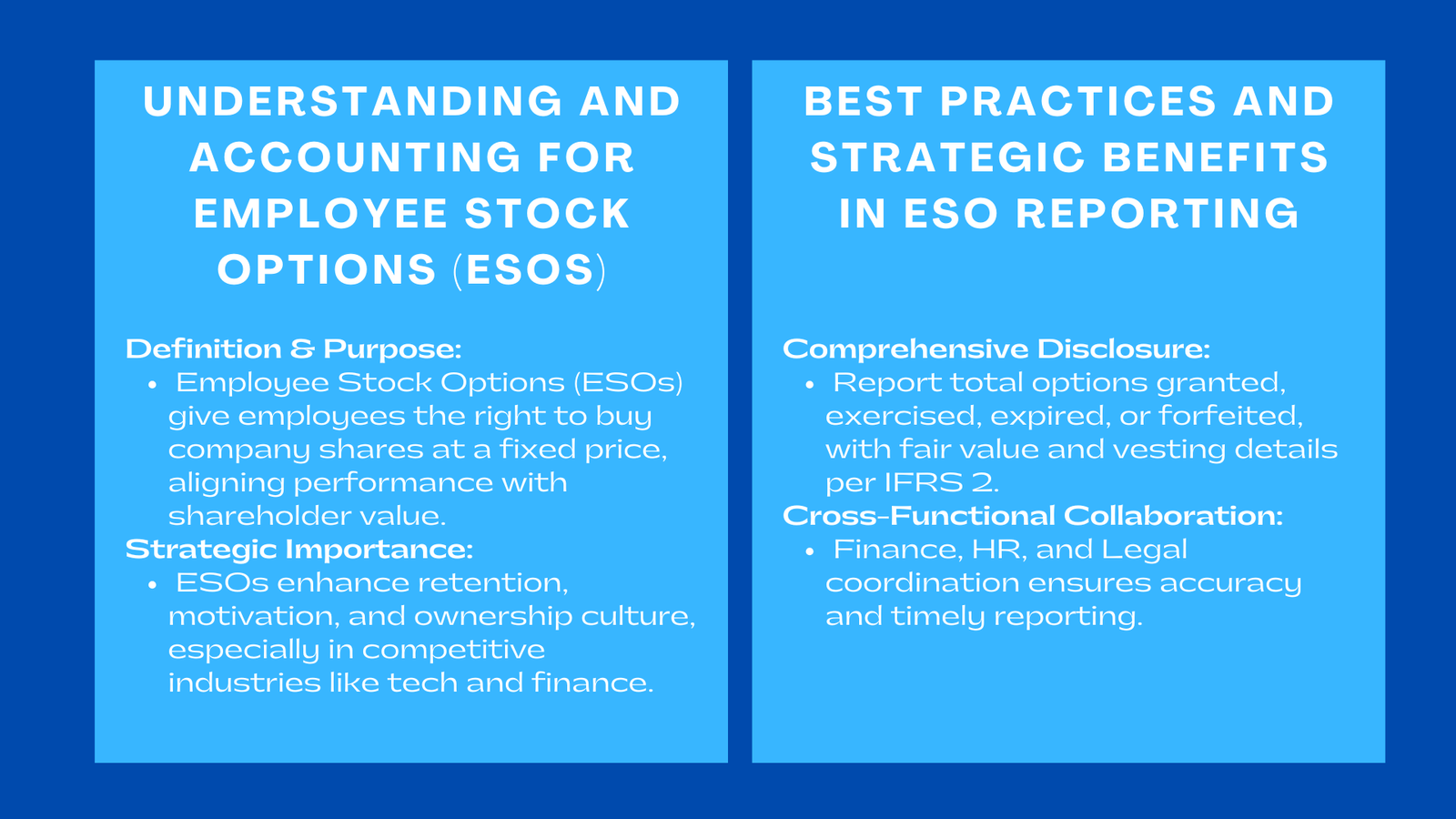
Reporting Employee stock options IFRS have emerged as a widely used compensation mechanism for attracting, retaining, and motivating key talent. By giving employees the right to purchase company shares at a predetermined price over a defined period, ESOs directly link employee performance and commitment with the company’s long-term growth and shareholder value. This alignment fosters a culture of ownership, accountability, and motivation, especially in competitive sectors such as technology, fintech, healthcare, and finance.
However, while ESOs provide significant strategic and motivational benefits, they also introduce substantial accounting and reporting complexities. The contingent nature of stock options, volatility of the underlying stock price, and various vesting conditions require careful compliance with IFRS 2, “Share-based Payment.” Missteps in ESO accounting can result in financial misstatements, audit complications, regulatory scrutiny, and even reputational damage.
In Singapore and other global markets, where equity-based incentives are prevalent in both startups and multinational corporations, implementing robust reporting practices is not only a compliance requirement but also a strategic advantage. Accurate and transparent ESO reporting ensures that employees are rewarded fairly, financial statements reflect economic reality, and investors can make informed decisions.
Key Considerations in ESO Accounting
Grant Date Fair Value Determination
The grant date fair value is a central concept in ESO accounting. IFRS 2 requires companies to measure the fair value of stock options at the date of grant, incorporating all relevant terms and conditions.
Common valuation methodologies include Black-Scholes, binomial option pricing models, and Monte Carlo simulations. These models account for variables such as expected stock price volatility, risk-free interest rate, expected life of the option, dividend yield, and employee behavior patterns, which are also crucial in understanding purchase price allocation advantages Singapore M&A Valueteam practices for accurate valuation and reporting.
Accurate grant date valuation requires collaboration across finance, legal, and HR departments. Legal teams verify contractual terms, HR provides data on employee eligibility and expected retention, and finance performs valuation calculations. Properly valuing ESOs at grant date ensures that expenses recognized in financial statements reflect the true economic cost of these instruments.
Vesting Conditions and Expense Recognition
ESOs often include service-based or performance-based vesting conditions. Service-based conditions require employees to remain employed for a specific period, while performance-based conditions may link vesting to revenue targets, market share growth, or other KPIs.
Companies must allocate the fair value of options systematically over the vesting period, recognizing the expense gradually rather than all at once. Adjustments are needed for forfeitures or modifications. For example, if an employee leaves before completing the vesting period, the company should adjust the recognized expense to reflect the unearned portion of the award.
Transparent documentation of vesting schedules, underlying assumptions, and allocation methods is essential to ensure IFRS compliance and audit readiness. It also allows management and investors to clearly understand the cost of equity compensation over time.
Adjustments for Modifications or Cancellations
ESOs may be modified after issuance, for instance, by changing the exercise price, extending the expiry date, or altering performance conditions. IFRS 2 requires that any incremental fair value arising from such modifications be recognized as additional expense.
Similarly, cancellations or voluntary surrenders must be reflected appropriately. Accurate adjustment prevents overstatement or understatement of expenses, maintaining the integrity of financial statements. Companies should develop clear policies for tracking, documenting, and reporting modifications to ensure consistency and compliance.
Classification: Equity vs Cash Settled
It is crucial to determine whether an ESO is equity-settled or cash-settled, as the accounting treatment differs significantly. Equity-settled options are recognized in equity, while cash-settled options create a liability that is remeasured at each reporting date.
For example, a startup offering equity-settled options to employees records the fair value as an increase in equity, without creating a liability on the balance sheet. In contrast, a multinational corporation offering cash-settled stock appreciation rights must remeasure the liability based on current share price at each reporting date, with changes recognized in profit or loss. Correct classification ensures accurate financial reporting and compliance with IFRS 2.
Best Practices in ESO Reporting
Comprehensive Disclosure
IFRS 2 mandates detailed disclosure of stock options in financial statements. Companies should report the total number of options granted, exercised, expired, or forfeited, the fair value at grant date, vesting conditions, and accounting treatment.
Transparent disclosure allows investors, analysts, and regulators to assess the impact of ESOs on equity, profitability, and potential dilution. It also demonstrates governance excellence and reinforces confidence in the company’s reporting practices.
Cross-Functional Collaboration
Effective ESO reporting requires collaboration among finance, HR, and legal teams. Finance teams calculate fair value and record expenses, HR tracks employee eligibility and vesting, and legal ensures contractual compliance. Cross-functional alignment reduces errors, improves timeliness, and ensures consistent application of IFRS 2 principles.
Leveraging Technology for Accuracy
Automation and centralized reporting systems can significantly improve the accuracy and efficiency of ESO reporting. Advanced software solutions track grants, exercises, cancellations, and forfeitures in real time, calculate fair values using integrated valuation models, and generate IFRS-compliant reports.
For companies with large employee populations or multiple jurisdictions, technology adoption reduces administrative burdens, ensures consistency, and strengthens audit readiness. Automated dashboards also enable management to simulate the impact of future grants, vesting outcomes, or changes in market conditions on reported expenses.
Regular Audit and Review
Periodic audits, reconciliations, and reviews of assumptions, valuation models, and internal controls ensure ongoing compliance. Audits can highlight discrepancies, identify areas for improvement, and enhance confidence in reported financial statements. Well-documented policies, procedures, and audit trails also support transparency for regulators and stakeholders.
Strategic Implications of Effective ESO Reporting
Enhanced Investor Confidence
Transparent ESO reporting allows investors to assess the company’s compensation policies, potential equity dilution, and alignment of management incentives with long-term performance. Companies that clearly communicate stock option plans and their financial impact demonstrate governance discipline, transparency, and strategic foresight.
Employee Engagement and Retention
Accurate and timely ESO accounting reinforces the perceived value of equity incentives among employees. Employees are more likely to be engaged, loyal, and motivated when they see a fair reflection of their rewards in financial statements. By linking compensation to corporate performance, organizations can strengthen employee commitment and reduce turnover.
Facilitating M&A and Strategic Decisions
During mergers, acquisitions, or capital-raising events, detailed ESO reporting provides clarity regarding outstanding obligations. Acquirers or investors can evaluate potential dilution and assess financial exposure, mitigating risks and enabling informed strategic decisions. Accurate reporting enhances the company’s credibility and positions it favorably in negotiations.
Supporting Long-Term Strategic Planning
Integrating ESO accounting into broader financial planning allows companies to forecast future equity costs, assess potential dilution, and model different scenarios. This proactive approach supports workforce planning, budget allocation, and strategic decision-making, ensuring that equity compensation aligns with corporate goals.
Industry-Specific Considerations
Different industries face unique challenges when it comes to employee stock options, and these challenges must be carefully considered to ensure accurate reporting and compliance with IFRS standards. In the technology sector, startups often rely heavily on equity-based compensation due to limited cash flow. Employees may receive stock options or restricted shares with vesting conditions linked to product launches, funding milestones, or revenue targets. The volatile nature of startup valuations and high-growth expectations requires careful measurement of fair value and thorough documentation of vesting assumptions.
In the financial services sector, executives and key personnel frequently receive cash-settled stock appreciation rights or stock options tied to the company’s share price performance. These instruments require careful monitoring and remeasurement at each reporting date to capture changes in fair value accurately. The inherent link between employee incentives and market performance adds a layer of complexity, making accurate forecasting and timely reporting critical to prevent misstatements.
The healthcare and pharmaceutical industries present yet another set of considerations. Stock options or performance shares in these sectors may be contingent upon successful clinical trials, regulatory approvals, or achieving research milestones. These performance-based conditions introduce uncertainty and necessitate sophisticated valuation models to ensure compliance with IFRS 2. Companies must carefully assess the probability of achieving such milestones and adjust valuation assumptions to reflect realistic outcomes, ensuring that the recognized expense appropriately represents the economic cost of the awards.
Even within the same industry, multinational companies face added complexity when issuing stock options across different jurisdictions. Variations in local tax regulations, accounting rules, and employment laws require organizations to coordinate reporting and compliance strategies across regions. Proper cross-border coordination ensures that financial statements accurately reflect the costs of equity compensation and that investors and regulators receive a consistent and transparent picture of the company’s obligations and incentives.
Conclusion to Employee Stock Options Reporting Tips
Stock options reporting best practices are powerful tools for aligning employee incentives with the long-term performance of a company, but their benefits can only be realized when reporting is accurate, transparent, and compliant with IFRS standards. Companies that adopt a comprehensive approach to ESO accounting, encompassing grant date fair value measurement, careful allocation over vesting periods, and proper handling of modifications or cancellations, are better equipped to maintain financial integrity and regulatory compliance.
Accurate ESO reporting strengthens investor confidence by providing clear insight into compensation costs, potential equity dilution, and alignment of management incentives with corporate strategy. It also enhances employee engagement by ensuring that equity awards are administered fairly and transparently, reinforcing retention and motivation. Beyond compliance, proper ESO reporting supports strategic decision-making in areas such as mergers, acquisitions, capital raising, and workforce planning, giving companies a competitive advantage in both operational and financial management.
Organizations that integrate technology, cross-functional collaboration, and rigorous internal controls into ESO reporting can streamline processes, reduce errors, and enhance audit readiness. By doing so, they transform what can be a complex accounting challenge into a strategic asset that drives long-term growth, governance excellence, and sustainable shareholder value. Ultimately, when companies implement effective ESO reporting practices, employee stock options become not only a mechanism for rewarding performance but also a measurable contributor to enterprise value, business transparency, and strategic success.