Employee Stock Options Strategy and Compliance
Employee stock options (ESO) have become a potent employee compensation tool where companies aim to recruit and maintain a talented employee as well as to match the employee incentives with the long term enterprise value. In the context of competitive business environments like technology, financial services and start-up that are growing fast, the capability of developing an ESOS structure that aligns with organisational strategy becomes important as businesses scale. However, it is not enough to plan it strategically. Organisations should also make sure that their plans adhere to the strict reporting requirements, which are established under the International Financial Reporting Standards (IFRS) and especially under the IFRS 2 which deals with the share-based payment transactions, while considering how the ESO framework fits into an owner exit strategy ESOP Singapore.
The article is dedicated to a particular sphere, i.e. how the companies can create consistent and compliant ESOS strategy to help to keep the business goals and objectives in line with the transparent and accurate reporting of the financial data.
1. The Employee Stock Option Strategies.
1.1 Aligned to the organisational goals, it is necessary to align ESOS to the organisational goals.
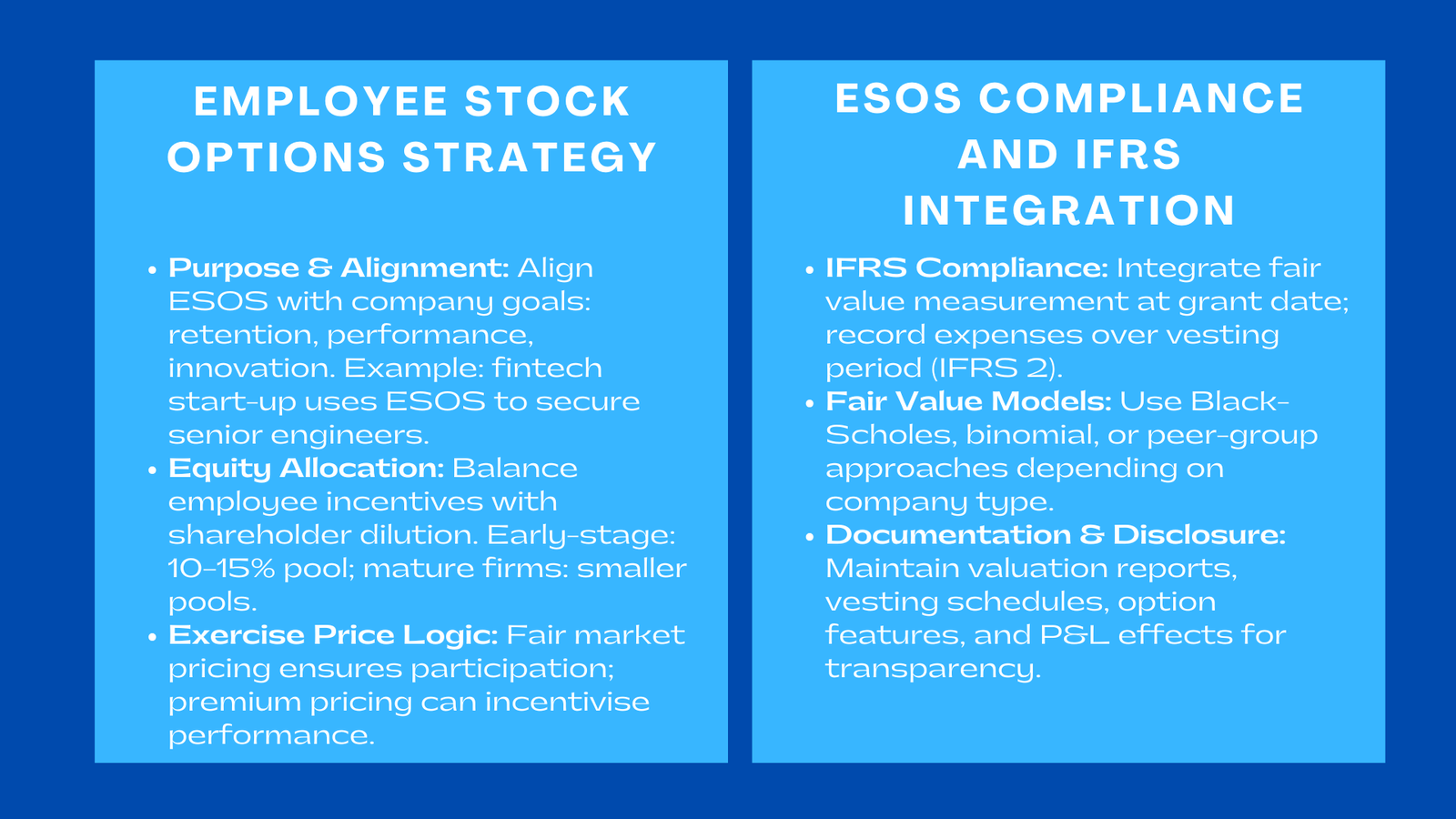
A good stock option plan starts with a clear start. The objective of offering options should be determined by the company whether aiming to retain, reward leadership performance, or incentivise innovation, companies would need to define what they expect to receive by offering options. As an illustration, a fintech start-up entering a new geographical area may use the stock options as a method of gaining long-term dedication of its senior engineers. In the meantime, an established business that aims at increasing sales performance can implement an ESOS based on performance related to revenue targets.
The strategic alignment eliminates the wrong distribution of equity, promotes internal equity, and enhances the long-term value creation.
1.2 Deciding on the Right Equity Allocation.
The amount of equity to be allocated to ESOS has to take into consideration two opposing sides: the danger of shareholder dilution and the power of employees as an incentive. Early/young companies could invest 10-15 percent of capital structures on the stock options, but the more developed corporations usually reserve low-value stakes. The size is not the only thing but it is the rationale. An example of this is that a firm that is in a digital transformation process will have a bigger pool that it will specifically use to hire its digital talent which they cannot get by simply paying them in cash.
Strategically sized pool is a guarantee of sustainability, continuity, and competitiveness in a highly changing labour market.
2. Planning ESOS to Achieve Long-term Success.
2.1 Creating Vesting Schedules that Aid Retention.
The process of implementing strategic intent is through the use of vesting schedules. Time-based vesting is usually used by firms to promote retention. Performance-based vesting has however become a trend with organisations being able to tie compensation based on a measurable KPI. As an example, a local logistics company may provide performance-based services associated with fleet optimisation goals or cost-cutting goals. Both methods are effective in assurance of the nature of business and the role involved.
The trick is to make sure that the vesting schedule is not purely based on the contributions of the employees alone, but also the cycles of business and the growth periods.
2.2 Adding the Exercise Price Logic to the Plan.
The economic attractiveness of an ESOS depends on the price of the exercise. Excessively high would deter participation, but excessively low would cause risk-sharing to be inaccurate or risk-compensation to be overstated. The majority of companies price the exercise at fair market at the date of grant, but companies with a high growth prospective can set the options at premium prices to strengthen the culture of performance.
A carefully planned, well-balanced exercise price can guarantee that the plan is effective to both the employees and the shareholders.
2.3 Securing Customer Interaction and Comprehension.
The most carefully created ESOS may break down in case employees are not aware of its functionality. Effective communication, in the form of onboarding briefs, written instructions, or simulation, serves to make employees value their choices. As a case in point, firms that are about to conduct an IPO usually organize employee educational seminars to clarify the liquidity plans, taxation and exercises. This improves engagement, value generated and alignment in the organisations.
3. Integrating IFRS Compliance in ESOS Strategy.
3.1 Accounting Requirement Design into Plan Design.
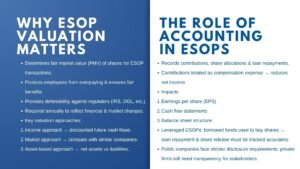
Compliance is no longer a possibility. Under IFRS 2, the fair value of the stock options is to be measured at the date of grant and the expense is to be recorded during the period of vesting. This implies that the valuation, the state of vesting, projected life, volatility assumptions, and policy of modification will have to be taken into account when drawing up the plan. Companies that fail to consider these aspects often have contradictions during the audit cycles resulting in restatements or adjustment.
Integrating compliance at the very beginning guarantees efficiency and financial precision of operations.
3.2 Fair Value Models Consistent with IFRS.
One of the most technical issues of ESOS design is valuation. Using IFRS, companies are required to employ the appropriate option-pricing models, including Black-Scholes or binomial modelling. The model used will be determined by the nature of the option, availability of market data and the maturity of the company. An unlisted start up can use peer-group volatility, but a listed corporation can use its own.
It is also at this stage that firms tend to seek the assistance of professional valuation experts especially in the event of complex features like performance conditions or market-based vesting.
3.3 Disclosures and Documentations Management.
According to IFRS, there is a lot of disclosure necessitating transparency. These are fair value approaches, options features, vesting, and profit loss effects. Firms that have many ESOS cycles have to uphold strict paperwork. It is here that organisations enjoy a systematic compliance procedure, with a level of internal control processes and special purpose reporting templates.
Companies that follow a detailed Employee stock options strategy IFRS framework can integrate compliance seamlessly into their broader HR and financial reporting systems. Similarly, a robust Share-based payment compliance guide helps ensure consistency across cycles, especially when modifications, repricing, or new grants occur
4. Real-World Applications of ESOS Strategy and Compliance
4.1 High-Growth Technology Companies
Tech scale-ups are interested in ESOS as a means of recruiting specialised talent. To illustrate, a machine-learning start-up in Singapore could exercise options based on performance and be deferred to product development achievements. The company will use binomial modelling and enlist valuation experts to each grant to set compliance and update the expectation of forfeiture rates on an annual basis. Such a combined method enhances the audit readiness and increases investor confidence.
4.2 Traditional Businesses being transformed.
ESOS is gaining acceptance by non-tech industries to retain talent in the course of transformation journeys. A production firm that is moving to automation might present an ESOS plan to the digital innovation team only. Valuation based on IFRS standards, enhanced disclosures, and effective grant documentation guarantee that the initiative will survive regulatory examination and help in reinventing the business.
4.3 Pre-IPO Listing Aspirants
The firms that are about to issue IPO are required to exhibit good governance measures such as proper and transparent ESOS accounting. The pre-IPO audits usually indicate historical misjudgments on the valuations of grants or expenses. Early adoption of the IFRS, especially in equity-settled awards, makes companies undergo due diligence more easily and be more likely to attract the interest of underwriters and investors.
Conclusion to Employee Stock Options Strategy and Compliance
To be competitive in talent; align the organisation and be financially transparent, a strategic and competitive employee stock options programme must be developed. With the growing adoption of equity compensation in Singapore and throughout the region, firms should make certain that their ESOS frameworks reflect strategic purpose and strict compliance with the IFRS standards. The ones that incorporate the valuation accuracy, the uniformity of reporting and the clarity of communication into their ESOS approach will be at an advantage of attracting talent, sustaining the levels of governance and developing long-term enterprise value.
Should you wish you will have the next–on valuation, disclosure requirements, ESOP governance, or IFRS modifications–no trouble at all.