How To Master ESOP Taxation Singapore
Understanding ESOP Taxation in Singapore: A Comprehensive Guide to ESOP Tax Rate Singapore and Valuation Rules Under the Income Tax Act
Introduction to How To Master ESOP Taxation Singapore
Equity-based reward is steadily rising in international markets and Singapore is also rated as one of the more advanced jurisdictions in which to design employee share schemes. Employee Stock Option Plans (ESOPs) have come to play a significant part in compensation design as firms look to have a competitive edge in terms of rewarding and retaining talent. The clarity of esop tax rate singapore, regulatory rules of valuation and compliance requirements are crucial to both the employer and employee though. The knowledge of the Income Tax Act that regulates the ESOPs is the key to proper reporting, clear valuation, and sound financial planning.
This paper describes the concept of esop valuation income tax act, the reasons for using structured valuation and how organisations manoeuvre valuation of esop under income tax act provisions. It also identifies the use of esop e tax guide, which is one of significant resources published to aid in the appropriate interpretation of ESOP related tax requirements.
Proper knowledge of esop as per regulation of income tax act will make all parties concerned, that is, the employees, corporate finance team, auditors and regulator operate under the same system of valuation, reporting and taxation. Taxation rules are one of the important areas of concern as ESOPs keep being adopted in the start ups, growth stage companies and multinational companies that operate in Singapore.
Understanding the ESOP Tax Environment in Singapore
The equity compensation framework in Singapore is premised on predictability and clarity. The basis of it is the reference point of esop tax rate singapore, which defines the time when taxable income is obtained by the employees and the calculation of The tax. Taxable gains usually occur under the Income Tax Act when the share options or share awards are exercised, vested or assigned value when the plan is structured differently. Such taxable gains are viewed as employment benefits and are included in the assessable income of the employee during the year of assessment.
The interpretation of esop under income tax act presupposes the knowledge of how the equity-based compensation is differentiated compared to cash compensation. The tax liability is determined on the basis of realisation or events of vesting when transfer of measurable economic benefits takes place instead of receiving income at the time when a grant is received. This implies that the process of valuation including that of esop valuation income tax act framework is in the centre stage to establish the exact figure that should be taxed.
Valuation Under the Income Tax Act: How ESOP Value is Determined
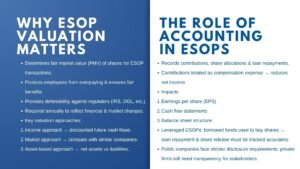
Proper valuation of equity compensation forms the key of valuation of esop under income tax act. The taxable benefit is calculated as the difference between the market value of the shares at such time when the employee exercises or gets vested and the amount paid to the employee, in case any. In the case of an unlisted company or start-up, it is more complicated to identify this market value, and it is necessary to follow accepted principles of valuation.
The income tax act framework on esop valuation provides standardisation and equity since it places a requirement that the valuations should be done using generally accepted methodologies. The methods will normally involve discounted cash flow, market comparables, and net asset value evaluation. It aims at establishing the fair market value of the share of the company in the market in order to indicate the amount of income which will be subject to taxation as the appreciation of the economic value realized by the employee.
Under these conditions, the valuation professionals apply principles of auditing, financial modelling, industry analysis to come up with a justifiable valuation. The regulatory framework is given by the Income Tax Act, but the professionalism and analytical force of the valuation professionals makes ESOP valuations comply with regulatory requirements.
The Role of the ESOP e-Tax Guide
The Inland Revenue Authority of Singapore has gone into a lot of detail in the form of the esop e tax guide where employers and employees are guided in their reporting requirements, valuation and procedures required in reporting their affairs. The guide provides the documentation requirements, taxable event catalysts, the responsibility of the employers concerning the documentation and valuation expectation. It also makes the edge cases clear like cross-border employment, deferred compensation structure and long term incentive plans that span more than one jurisdiction.
In the case of the companies that issue the ESOPs in various countries, the esop e tax guide is the guide that can not be avoided and which will help to interpret and follow the Singapore tax obligations. It also helps financial controllers and HR teams to prepare employee communication materials, as well as, to be transparent about the conditions of vesting and tax implications.
Learning about the guide is one of the basic steps to be taken towards enhancing compliance under esop under income tax act and get both the companies and the employees secured against reporting errors.
Taxation Mechanisms and ESOP Reporting Requirements
The calculation of the taxable income in case of ESOP is what lures the area of concentration to esop tax rate singapore which operates under the umbrella tax system of the progressive taxation. After the taxable value of the ESOP benefit is ascertained, it is subjected to addition with other types of employment earnings and is then taxed at regular rates of Singapore residents or non-residents.
When employers have complicated ESOP structures, they have to submit certain documentation to the tax authorities to insist on proper reporting. Accuracy of valuation cannot be overemphasized in esop valuation income tax act since there is risk of under-reporting or over-reporting of taxable income due to inconsistencies in the valuation. The income tax act provides that the employers should have an upholding record which consists of valuation reports, grant letters, vesting plans, and confirmation of exercises.
To the employees, the information about the computation of taxable benefits when valuing esop under the income tax act assists in avoiding the unwanted tax liabilities. Professional advice is in general considered to be obtained when employees own substantial shares of the equity or in situations when ESOPs are a major component of total compensation.
ESOPs in Private Companies: Addressing Valuation Challenges
The situation is further complicated to the private companies as they do not list their shares in the stock market. This renders the use of esop as a crucial and technical undertaking as per income tax act. The price of shares under the fair market value must be determined through well developed financial procedures taking into consideration the expected earnings, risk variables, future growth, and the capital structure.
Proper valuation strategy implies objectivity to the employees and proves that the Income Tax Act is observed. When the value of ESOPs has substantial financial effects, companies will usually seek advice from third-party valuation experts in order to assure credibility. Open valuation processes eventually enhance a greater compensation culture and employee trust.
ESOPs in High-Growth and Start-Up Environments
ESOPs are also used by start-ups and technology companies with high growth to attract and keep talent. In such settings, the comprehension of esop tax rate singapore and the implications of the esop valuation income tax act rules will be all the more important. The values of early-stage enterprises are highly dynamic, and workers should be knowledgeable about the impact of both vesting plans and liquidity events on taxable income.
Even the fast-growing companies that fall under the requirement of the valuation of esop under income tax act guarantee consistency in determining the market value. It is very essential in cases where funding, acquisitions, or IPO planning are required, as over a period of a few days valuations can change drastically.
The tax system of Singapore is one that is geared to take care of such cases by offering orderly guidelines as further explained in the esop e tax guide.
Alignment with Global Best Practices
The regulatory practice of ESOPs in Singapore is based on the idea of esop under income tax act, which is in line with international tax standards whereby transparency, fair reporting and accurate valuation of ESOPs are of priority. Due to the fact that companies are operating in different jurisdictions, the necessity to harmonize the regulations of Singapore with international best practices grows even greater.
Regulatory risk of both employers and employees is mitigated by the consistent application of valuation standards and integrity of compensation strategies is ensured.
Conclusion
The employee share plans are inseparable elements of the contemporary compensation systems and it is crucial to be familiar with the regulatory landscape surrounding them. Good understanding of esop tax rate Singapore, coupled with the proper analysis in the esop valuation income tax act, will help the companies remain compliant and the employees to have the knowledge on what they are expected to pay in terms of tax. Accuracy, transparency, and fairness are facilitated by the application of the valuation of esop using the methods of Income tax act and the guidelines outlined by the esop e tax guide.
With the rise in the use of ESOP in industries, firms that know how to administer esop appropriately in line with the requirements of the income tax act will have a greater opportunity to control compensation strategy, regulatory reporting, and long term employee involvement.