Implementing ESOP: Step-by-Step Approach
Introduction to Implementing ESOP Step-by-Step Approach
Employee Share Ownership Plans (ESOPs) are now a hallmark of current-day compensation structure, particularly in high growth firms, professional services firms and organisations that are vying after specialised talent. Although the advantages of ESOPs, including improved retention, closer alignment to the performance of the company and ameliorated organisational culture are mostly acknowledged, the actual problem lies in the fact that the execution of ESOPs is a challenging task, making it essential to engage ESOP valuation Singapore expert services.
An inadequately executed ESOP may mislead the employees, negatively impact on financial reporting, or even lead to compliance risks in IFRS. Conversely, any structured and step-by-step approach enables companies to access motivational and financial benefits and guarantees accuracy, transparency, and sustainability over the long term.
The article is dedicated to one critical aspect, which is the way of how to implement an ESOP in a rigorous, methodical framework, which would correspond to the international standards and organisational strategy.
1. Setting the Strategic Foundation.
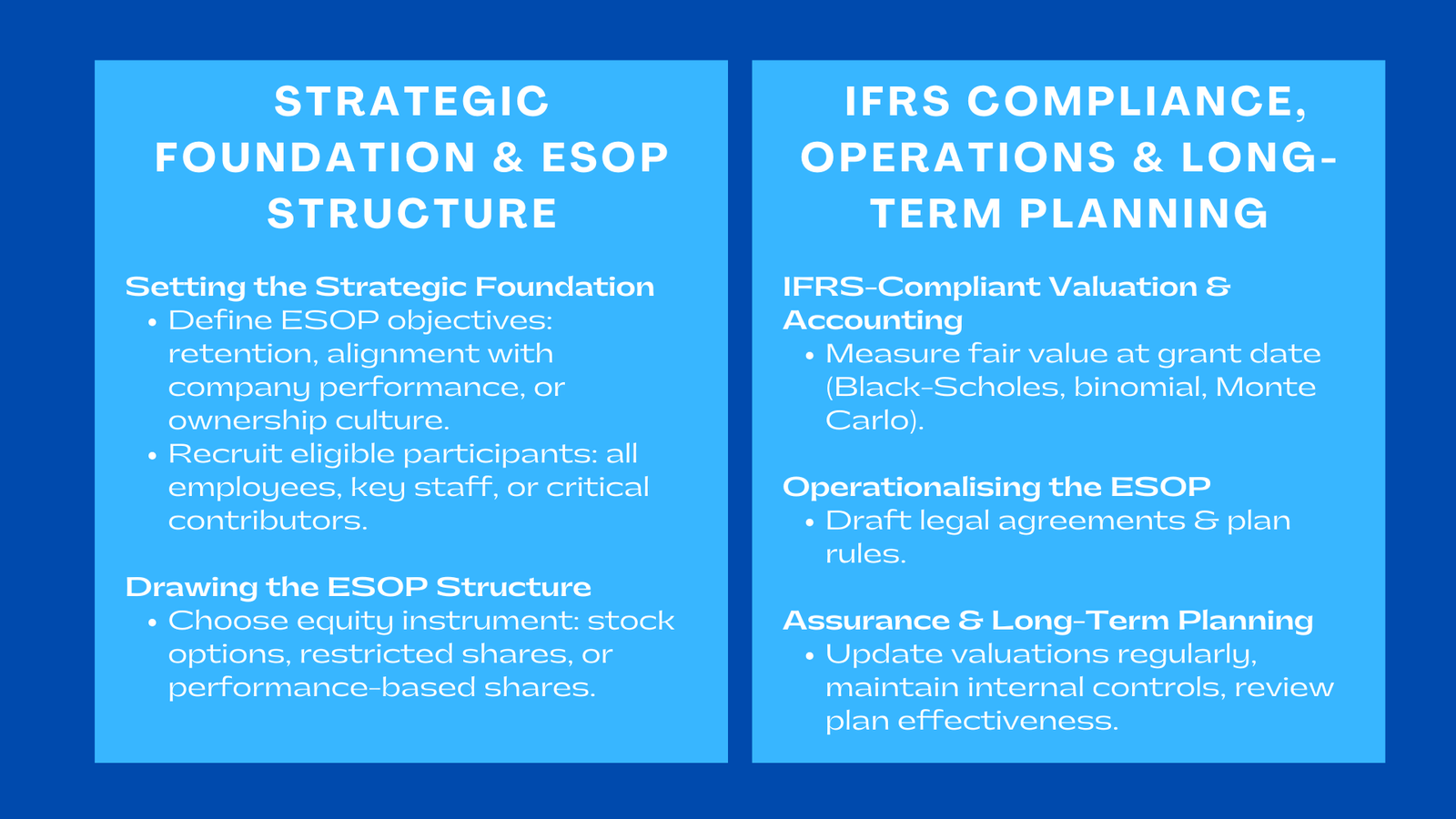
1.1 Defining ESOP Objectives
Any successful ESOP is strategic in nature. The first thing that companies need to do is to identify the intent of introducing equity ownership. Others seek to hire talent in competitive markets and others reward long term employees or inculcate a sense of ownership among teams.
An example of a technology start-up is to structure its ESOP in such a manner that it lowers cash pressure on salaries and retains technical employees on a three to four year vesting schedule. At the same time, a firm in the professional services can employ ESOP grants as a component of its partner-track system. Clarity helps in setting clear objectives that help in directing the further design decisions and hence alignment with organisational goals.
1.2 Recruiting the Eligible Participants.
The chosen objectives must be in line with the eligibility criteria. The companies will be required to make a choice on whether to offer the ESOP to all employees, key management staff or critical contributors.
An example is an ESOP offered by a regional logistics company to senior managers only so that in case of expansion, there is continuity of leadership. The participation of who it is will make the plan value-based and sensitive.
1.3 Obtaining Board and Shareholder Approval.
Corporate governance requirements should be fulfilled before proceeding. Issuing of new shares usually requires the approval of shareholders in listed companies whereas the constitutions of a private company may have to be updated. The structural problems are averted at an early stage of the law.
2. Drawing the ESOP Structure.
2.1 The selection of the type of equity instrument depends on how much risk is required and the extent of leverage required.
Firms have to decide on tools like stock options, restricted share awards, or performance based shares. Decision making is based on risk appetite, likes and dislikes of the employees and strategic results over the long term.
Stock options have upside potential and entrepreneurial incentive. The limited shares present a more predictable, assured type of equity advantage. Performance share: It is the reward scheme that enables companies to match the rewards to the financial or operational milestones.
2.2 Establishing Vesting Conditions and Schedules.
The behaviour of employees is determined by vesting structures. The reason why time-based vesting is very popular is due to its simplicity and retention emphasis. Performance-based vesting ties incentive with company performance (i.e. revenue, EBITDA or other operational KPIs).
An instance is that a biotech start-up could have their vesting based on successful trial of the product, so that there is congruence between science accomplishment and reward to the staff.
2.3 Deciding Pool Size and Grant Levels.
The other error that is usually committed by companies is to over-assess or under-assign ESOP pools. The comparison to the market standards will assist the companies to come up with the right pool size which in most cases is between 5 and 15 percent of the share capital depending on the industry and the stage of growth.
3. Developing IFRS-Compliant Valuation and Accounting Framework.
3.1 Measuring Fair Value at Grant Date
The company should measure fair value at the grant date, i.e. assessing the value of an obtained asset or liability at a certain time point.
Under IFRS 2, fair value measurement at the date of grant, with the assistance of approved valuation methods, are to be done. In the case of stock options, the companies mostly base on Black-Scholes or binomial models. Greater plans involving market-based vesting could involve Monte Carlo simulations.
To be consistent and defensible, most companies have independent valuers so as to help in modelling assumptions like, volatility, expected life, as well as risk free interest rates.
3.2 Expense Over Vesting Period Recognition.
The expenses of the ESOP grants should be charged as a cost in the period of the vesting process so that the financial statements would give an account of the services which the employee had served. This recognition process aligns closely with ESOP implementation best practices and strengthens transparency for investors and auditors.
3.3 Documenting IFRS Compliance
Accurate documentation is essential. This includes valuation reports, grant resolutions, vesting schedules, and accounting workpapers. Proper documentation forms the foundation of an IFRS compliant ESOP guide and prevents disputes during audit cycles.
4. Operationalising the ESOP
4.1 Drafting Legal Agreements and Plan Rules
The ESOP terms must be well laid out in legal agreements, the vesting, exercise terms, resignation, and termination provisions. Ambiguities may cause employee conflicts or falsification of finances.
One of the fintech companies with a high growth rate experienced serious difficulties when the initial ESOP did not have the right rules concerning the conditions of leavers, and thus, the treatment was unequal among workforce. Such issues are avoided through strong documentation.
4.2 Construction of Administrative Processes.
The administration of ESOP involves the cooperation of HR, finance, legal and external advisors. Companies are supposed to have mechanisms of managing employee eligibility, revising vesting schedules, exercising and keeping proper share registers.
These tasks are capable of being automated by technology platforms improving internal controls and eliminating errors.
4.3 Employee Education and Communication.
The employees should be aware of the way the ESOP operates. Most of the firms underestimate the role of communication and hence, lower perceived value. The activities such as running onboarding sessions, handing out guides and giving employee digital ESOP dashboards can help in engaging the employee significantly.
5. Assurance of Compliance by Surveillance and inspection.
5.1 Making Updates of Valuations on a regular basis.
Although grant-date fair value is the same as equity-settled awards, cash-settled instruments, and re-evaluation of the expected number of options to vest must be done by the company. The modification of employee turnover or performance status might need re-estimation of the expenses.
5.2. Sustaining Well-Developed Internal Controls.
Mechans of review ought to be segregation of duties, periodic reconciliation of duties and annual internal audits. The nature of these controls ensures the integrity of the ESOP records and eliminates any errors that may affect the financial statements.
5.3 Scrutinizing the Plan Productivity.
ESOP ought to keep up with the requirements of the organisation. Participation rates, retention impact and corporation performance alignment are to be reviewed periodically in companies. The observations that are made after these reviews are used to streamline the future grant cycles.
6. Planning Corporate Future and Growth.
6.1 ESOPs in Fundraising or IPO.
ESOPs are under close examination by investors when they are raising funds or preparing an IPO. Defensible valuations, clean documentation, and clean accounting are useful in reducing transaction friction and enhancing investor confidence.
6.2 controlling Dilution and Shareholder Expectations.
The issue of dilution is of interest to shareholders. Clear communication, forward modelling, and pool management are the key to balanced interests of the stakeholders.
6.3 Inclusion of ESOPs in Long-Term Talent Strategy.
ESOPs must also be part of a larger reward philosophy as the organisation grows and include performance rewards, leadership reward, and succession planning.
Conclusion
An effective ESOP is a strategic incentive as well as a governance accomplishment. Equity program can be built by companies that pursue a rigorous, step-wise plan, backed by proper valuation, good documentation, and reports that are aligned to the IFRS, which motivates the employees, pleases investors, and long-term corporate expansion.
Through the appropriate structure, controls and communication strategies, an ESOP becomes quite more than a compensation mechanism; an effective driver, into organisational commitment and sustainable enterprise value.