Master Employee Share Scheme Taxation
Employee Share Scheme Capital Gains Tax Example: Understanding Calculations, Reporting, and Income Tax Treatment
Guide to Master Employee Share Scheme Taxation
Employee share schemes have become an increasingly common component of remuneration structures across organizations of all sizes. They are designed to align employee interests with long-term business performance by offering equity-based participation. However, from a taxation perspective, employee share schemes introduce complexity that many employees and employers underestimate. Understanding how gains are calculated, how they are reported, and how they interact with income taxation is essential for compliance and financial planning.
This article provides a comprehensive explanation using an employee share scheme capital gains tax example, clarifies the logic behind an employee share scheme capital gains tax calculator, and explains how an employee share scheme on tax return should be handled, including its interaction with the employee share scheme income tax return.
1. Conceptual Foundations of Employee Share Scheme Taxation
1.1 What an Employee Share Scheme Represents Economically
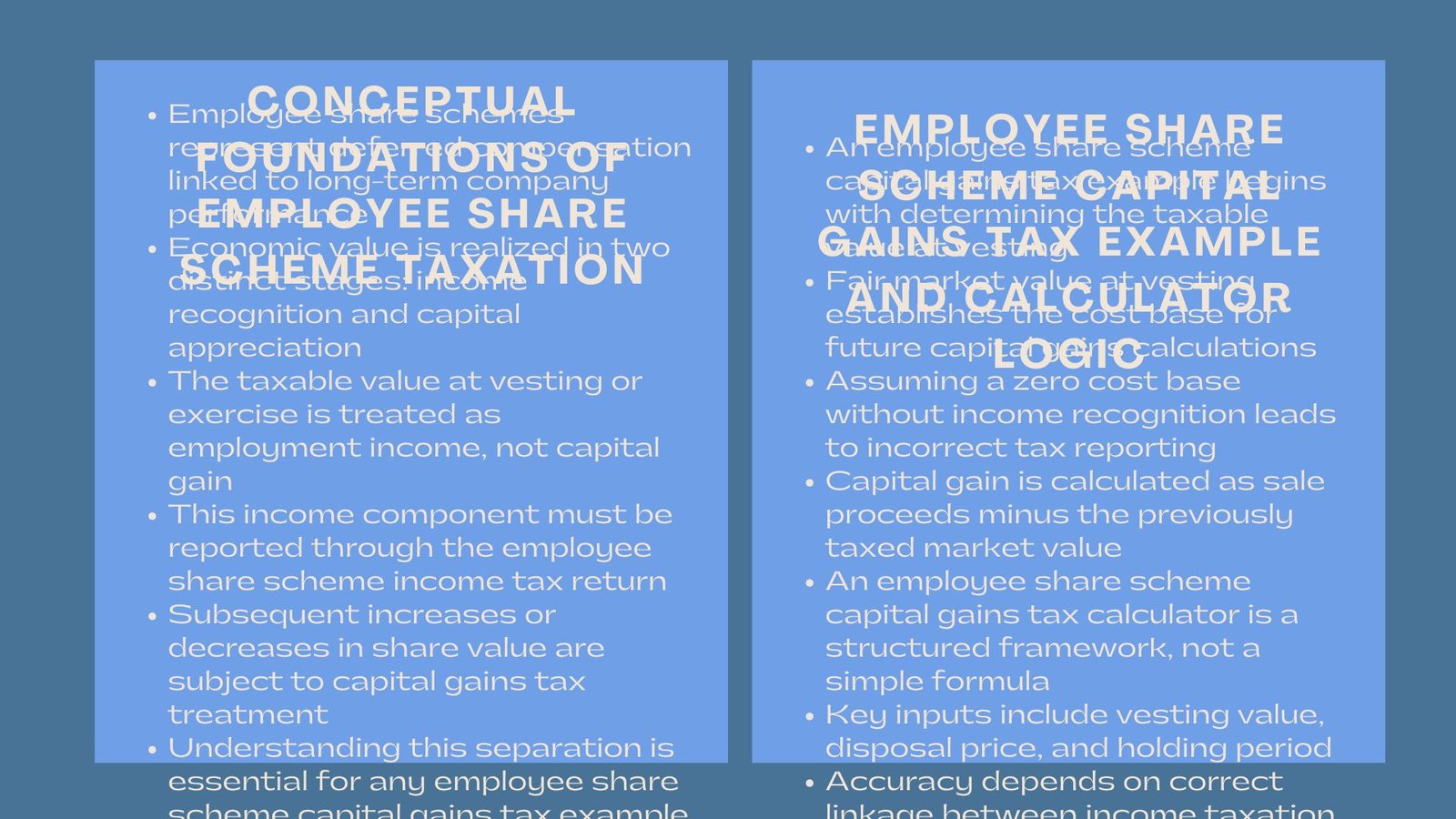
An employee share scheme is one of the types of compensation in which an employee is awarded shares or other rights of a share. These instruments are economically deferred value based on the performance of the company as opposed to direct cash income. This arrangement forms two different types of tax moments, one based on the recognition of income and the other based on the capital appreciation. This separation is a fundamental understanding of the capital gains tax example of any employee share scheme.
1.2 Income Recognition Versus Capital Appreciation
Logically, when it comes to taxation, the value that an employee is able to receive when the shares become accessible or transferable is considered income. The value of the stock later on can be considered as capital gain or loss. That difference justifies the fact that an employee share scheme income tax return and calculations of capital gains do not displace each other; instead they co-exist.
2. Employee Share Scheme Capital Gains Tax Example Explained
2.1 Establishing the Initial Taxable Value
On the example of a clear employee share scheme, the capital gains tax commences with the determination of the value that is taxable at the income recognition level. Suppose the scheme is a no cost share scheme of shares to an employee. On the day those shares become unrestricted or are vested, they are subjected to taxation on the fair market value of the same on those days as employment income. This value is added to the taxable income of the employee and communicated using the employee share scheme income tax return.
This is an important step since it sets the cost base on which future capital gains tax is to be paid. In the absence of this step, employees usually tend to believe that the cost base is zero and therefore will present wrong reporting.
2.2 Calculating the Capital Gain on Disposal
Still on the same employee share scheme Capital gains tax example, suppose that the employee later sells the shares at a higher price. The capital gain is determined as the difference between the proceeds of sale and the market value that has been taxed before. This gain is the economic gain that results following the event of income taxation and is liable to capital gains tax provisions.
This is a case in point that explains why income taxation and capital gains taxation act in a series of employee share schemes as opposed to acting simultaneously.
3. Understanding the Logic Behind an Employee Share Scheme Capital Gains Tax Calculator
3.1 Why a Calculator Is a Framework, Not a Tool
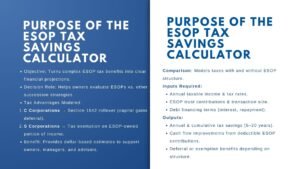
When people are looking to find an employee share scheme capital gains tax calculator they are looking to get something convenient and easy to use online. As a matter of fact, the calculation device is not a formula, but a systematic approach. It takes into account a number of inputs among which is the taxable amount at the time of vesting, the actual price at which the property is disposed of, and the time frame between the two instances.
The precision of any share scheme capital gains tax calculator relies on the proper recognition of the following inputs, by any employee. The errors that normally occur include the omission of the part of the income tax by the employees or the fact that the employees do not identify the cost base.
3.2 Variables That Influence Capital Gains Outcomes
A good employee share scheme capital gains tax calculator would be required to take into account time-based aspects. The period of time of shares ownership following recognition of income can influence the treatment of gains. Also, the tax can considerably change depending on whether the shares are disposed of or held due to any strategic purpose. Knowing such variables enables the employees to be informed about the time and disposal plan.
4. Reporting an Employee Share Scheme on Tax Return
4.1 Separation of Income and Capital Components
When reporting an employee share scheme on tax return, it is necessary to segregate amounts of income related and capital related. The values identified upon vesting or exercise are regarded as employment income and those are indicated in the corresponding section of the income. This is unlike the capital gain or loss which occurs when the shares are sold.
Failure to segregate these parts may result in the possibility of duplication of counts or underreporting. Effective reporting would mean that employee share scheme income tax return would fully represent the compensation as well as investment returns.
4.2 Documentation and Record-Keeping Discipline
Documentation is very important to report an employee share scheme on tax return. The employees should keep accounts of valuation at the point of recognition of income, date of the transactions and sale proceeds. These records facilitate the calculation of both income tax as well as the capital gains and also aid in the clarity in case of review or audit.
5. Employee Share Scheme Income Tax Return Considerations
5.1 Timing of Income Recognition
The income tax return on employee share schemes shows the taxable value of stock upon the availability of the stock to the employee. This timing may not necessarily be similar to the date of grant. Rather, it is a manifestation of the lapse of restrictions or the exercise of rights. Knowledge of such timing will avoid early or late reporting of the income.
5.2 Interaction With Other Forms of Compensation
The income of the employee share scheme is subject to other types of remuneration in terms of income tax. It combines with salary, bonuses and benefits. This concentration can affect marginal tax results and explains the reason why employees are to take into consideration the greater effect of share-based compensation on the overall tax status.
6. Common Misunderstandings in Employee Share Scheme Taxation
6.1 Confusing Grant Value With Taxable Value
The misconception of the grant value and taxable value is the most common mistake in analyzing the example of employee share scheme capital gains tax. Issued shares at nominal or zero price are not tax free. The taxable amount is calculated at the time that an economic ownership is attained rather than allowing the promise of shares to be given.
6.2 Assuming Capital Gains Replace Income Tax
The other myth is capital gains tax, which is used in place of income tax. The fact is that there is income taxation followed by capital gains taxation. This chronological processing is the key to the concept of employee share schemes and should be reflected in the capital gains reporting and employee share scheme income tax return accordingly.
7. Strategic Planning Using Capital Gains Calculations
7.1 Timing Decisions and Financial Outcomes
Workers who are familiar with the nature of employee share scheme capital gains tax calculator can be able to make proper decisions as concerns when to sell shares. Keeping stocks in a portfolio can lead to a greater risk of market risk, and it can also enhance net returns when under specific regulations and personal financial situations.
7.2 Aligning Share Disposal With Financial Goals
A planning tool that can be used is to use Structured employee share scheme capital gains tax example so that employees can match the share disposals with significant financial milestones. Funding education, buying assets, or diversifying investments, it is better to comprehend the impact of taxes to make the right financial choice.
8. The Role of Professional Advice and Systems
With increasing professional support, employee share schemes are getting more complex which means that proper reporting and calculation is difficult without professional assistance. Clear internal systems are also beneficial to organizations in that it gives the employees data on valuation and reporting directions. This minimizes the mistake in employee share schemes on tax returns reporting, and transparency is improved.
Share-based compensation experts know that there is a subtle association between acknowledgment and capital gains. They provide expertise that assists in making sure that the filing of employee share scheme income taxes returns and capital gains are both accurate and justifiable.
Conclusion
Employee share schemes not only provide valuable wealth creation opportunities, they also create a stratified tax liability. A good example of a capital gains taxation and income taxation sequence is a well-constituted employee share scheme capital gains tax example, which shows how the two taxes interact with one another instead of being independent. The knowledge of the logic of an employee share scheme capital gains tax calculator enables employees to plan well and determine the results accurately.
It is also important to report an employee share plan properly in tax return and make sure that income elements and capital gains are well separated. Employee share scheme income tax return forms a basis on the cost base on future gains and should be treated with care. Through creating a clear insight on these principles, organizations and employees can handle share-based compensation in a confident, compliant and strategic manner.