Valuation Methods for Employee Stock Options
Introduction to Valuation Methods for Employee Stock Options
The most technically and strategically significant and important part of share-based compensation is valuing employee stock options (ESOs). These valuations do not only help to recognize the compensation expenses in the financial statements but to communicate the fair and transparent value to the employees, investors and regulators. Having become increasingly popular as a compensation system in both privately and publicly owned companies, valuation techniques must now be mastered by both leaders in the field of finance, auditors, and human resource members. Companies in Singapore can also leverage employee stock option benefits and structuring Singapore ValueTeam to ensure compliance, optimize incentive design, and align with strategic business goals.
This paper specifically highlights valuation techniques used to value the staff stock options based on the modern accounting principles. It provides reasons why various models are employed, the impact of their assumptions and how business organizations can instigate credible and defensible valuations that can stand audit examination and scrutiny by investors.
1. The Principals of Stock Option Valuation between Employees.
1.1 Fair Value Measurement is Necessary.
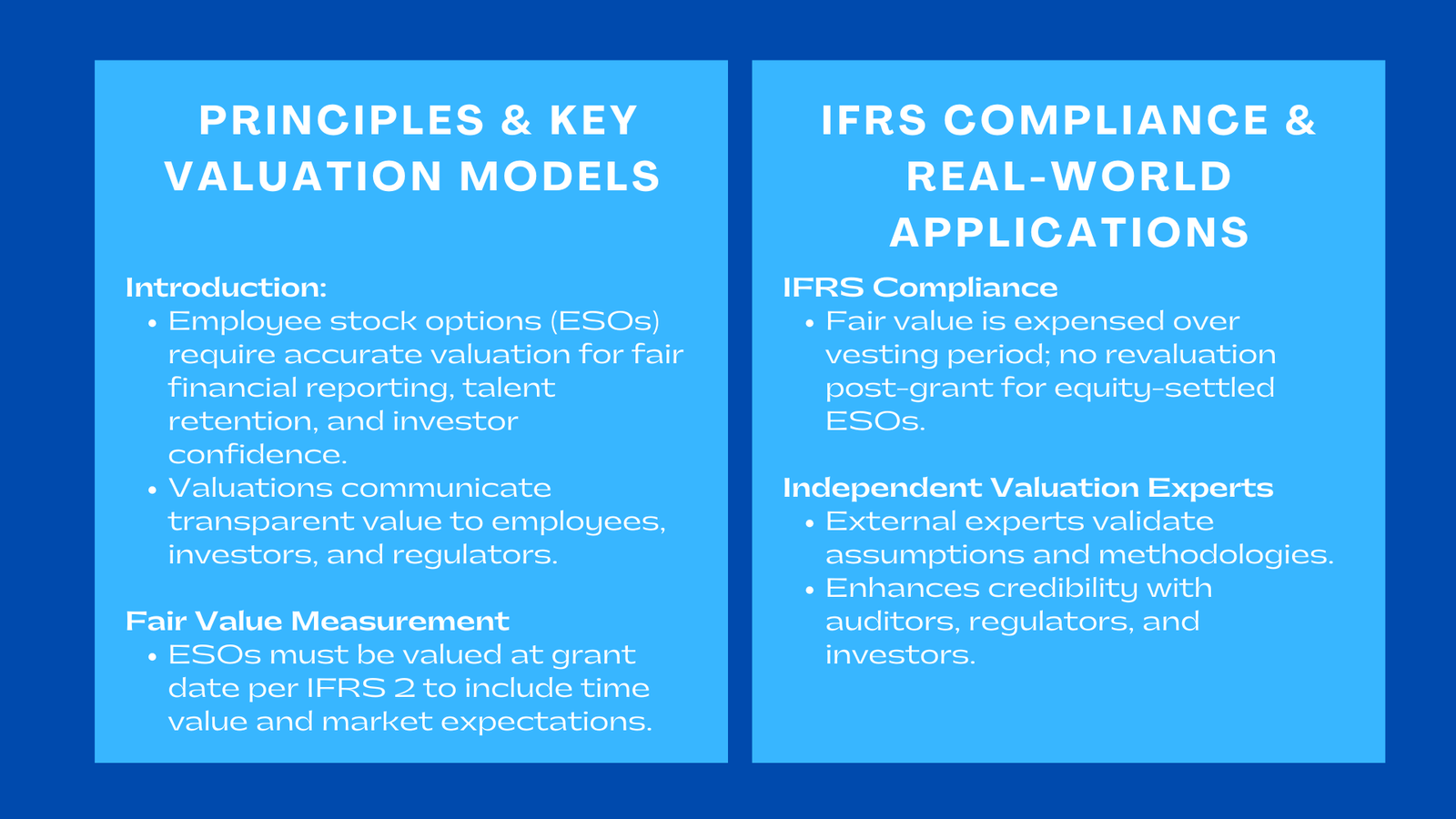
The stock options of employees cannot be determined at their intrinsic value (the price of options in the market minus the exercise price) since it is subject to uncertainty in the future. Share-Based Payment, under the IFRS 2, the fair value of the stock options must be determined at the grant date to include the time value and market expectations.
The fair value approach provides that the cost of compensation is of the economic reality of what is paid to workers. Inclusion or exclusion of volatility, any type of vesting, or life expectation expectations always would understate or overstate compensation expenditure which is going to distort earnings and hamper comparability among companies.
1.2 The issues that are common in ESO Valuation are as follows:
The value of the ESOs is not equivalent to that of market-traded options due to the fact that they are not transferable, they are usually vested and are lost when employees depart. These limitations imply that exchange standard prices of options cannot be directly used. It is upon companies to turn to financial models that include behavioral adjustments and structural adjustments namely estimating such aspects as employee exercise behavior, forfeiture rates, and likely tenure.
2. The Black-Scholes Model: The Industry Leader.
2.1 Model Overview
The Black-Scholes model has been the most popular model of stock options valuation of employees. It calculates the fair value of an option using six inputs that include the current share price, exercise price, maturity period, the risk-free interest rate, the anticipated volatility, and the anticipated dividends.
The beauty of the model is that it is not complicated, and it is also not contradictory, since it offers a uniform structure that is easily acceptable by auditors and regulators. Nonetheless, its fundamental postulation that options can be freely traded and exercised at any time is less true in the case of employee stock options which are typically vested and subject to exercise limitations.
2.2 Modifying the Black-Scholes to employee conditions.
In order to employ the Black-Scholes model to ESOs, the companies modify it to accommodate expected life, rather than the contractual term, in the light of how frequently the employees are likely to exercise in accordance with the past trends. Much the same, forfeiture rates lower the amount of options that should be vested.
An example is the case where a technology company may take employees to assume options three years after their vesting, though the contract term is ten years. This modified expected life is fed into the Black-Scholes formula and it gives a fair value that is more economic in nature.
3. The Binomial Model and Monte Carlo Model.
3.1 Modeling The model to be used is the binomial model when the greater flexibility is needed.
The binomial model (also called the lattice model) is an improvement on the Black-Scholes model, which can be used to value the option at several time points. It simulates the possible directions of the stock price and option value is calculated at each node, how volatility and early exercise vary.
The binomial model is also especially adaptable to ESOs whose performance conditions or non-linear terms of vesting are challenging. Take the case of an industrial organization that bases vesting on profitability-related criteria. In that case, a binomial method can generate a variety of profit and share-price results.
3.2 Monte Carlo Simulation for Market Conditions
When ESOs are tied to market-based performance conditions (e.g., share price exceeding an index), the Monte Carlo simulation becomes the preferred method. It involves thousands of random price paths in an attempt to estimate the probability of these targets being met and hence finds out the fair value of the options.
Monte Carlo models are computationally expensive, but offer the best ability to model real-world uncertainty. They are frequently used by listed entities where the regulatory expectations require an excellent clear modeling framework.
4. Key Inputs and Assumptions
4.1 Expected Volatility
The most sensitive variable of the ESO valuation is volatility. In cases where trading history is not adequate, companies tend to estimate it by historical volatility of their shares or other listed peer companies. High volatility is an option value enhancer as it increases the chances of positive price changes.
In the case of the private companies, volatility can be a matter of judgment. Similar company analysis and modified market indices are the proxies in situations when data that can be observed is not available.
4.2 Life and Behavior of the Employee Expected.
Expected life refers to the duration of time the employees will have the option to exercise. This is based on the behavioral factors like the risk appetite, liquidity requirement, and performance of the company. The rates of employees leaving also affect fair value as the forfeited options are not considered to be part of the expense.
A well-supported expected life estimate is critical for compliance with employee stock options valuation under IFRS guidelines, as it directly affects expense recognition and disclosure.
4.3 Dividend Yield and Risk-Free Rate
Dividend yield decreases option value because dividends are not obtained before the actual ownership of the shares. In the meantime, the future cash flows are discounted to present value by the risk-free rate, which is usually determined using government bonds of a similar maturity.
The difference between the reported expenses can be significantly changed by minor errors in these assumptions, which is why it is necessary to have a clear record and to review them regularly.
5. Pragmatic IFRS Compliance.
5.1 Bringing Valuation to Accounting Recognition.
Under the IFRS 2, after fair value at grant date, the fair value is charged against the vesting period in the proportion of the services rendered. Equity-settled ESOs do not permit revaluations after grant date, with an exception of any change in estimations of options that are to be vested.
Appropriate match between valuation and accounting treatment will guarantee a compliance as well as consistency in financial reporting. The valuation procedure adopted must hence be justifiable, repeatable and documented in the audit files.
5.2 Having Independent Valuation Experts.
In order to offer credibility, a lot of companies hire independent valuation companies to conduct or review ESO valuations. This gives confidence to the auditors and regulators that the models, assumptions and methodologies are suitable. Bringing in experienced professionals is also a powerful tool in enhancing governance and minimizing the possible conflict of searching equity or brightness with stakeholders.
A growing number of firms in Asia and Europe now engage certified appraisers for IFRS reporting for employee stock options, ensuring their valuations meet both local regulatory expectations and international investor standards.
6. Real-World Applications and Case Insights
6.1 Startups and Private Firms
The difficulty that private companies are subjected to is the inability to value ESOs because these are not publicly traded. They normally base their share value estimations on independent appraisals or latest funding rounds. An example is a fintech venture-funded in Singapore whose valuation can be pegged to the recent round of funding and use a volatility assumption based on listed counterparts.
These methods should be well explained because auditors tend to question the reasonableness of valuation inputs based on the growth level and capital structure of the company.
6.2 Listed Companies
Traded publicly, companies tend to possess a stronger data, and volatility is derived by the history of their share prices. Nonetheless, market-based conditions of vesting are complex and demanding advanced modelling like Monte Carlo simulations. The strictness of valuation does not only affect the financial statements but also investor belief especially when preparing IPOs or raising funds.
Conclusion
Fair financial reporting, talent retention, and investor confidence rely on accurate and crystal clear valuation of stock options among employees. Since fair value measurement is still a central part of IFRS, companies need to choose models, which describe the economic attributes of ESOs in the most appropriate manner and ensure that they align with accounting recognition.
Through strict valuation practices, assumption testing, and use of outside professional help where justified, firms can be assured of the reporting will pass the audit test and market test. In the dynamic environment of equity-based compensation, those companies that perfect ESO valuation acquire the confidence of regulators, as well as competitive advantage in recruiting and keeping talented employees.