ESOP Valuation Requirements for IFRS and Financial Reporting in Singapore
Introduction to ESOP Valuation Requirements
Significance of ESOP Valuation towards Compliance
Employee Share ownership plans, often abbreviated as ESOPS, has gained prominence as a part of talents strategy among Singaporean firms at all levels of their development – starting as options that are offered to founding engineers in a small startup company, and as the stock options to top executives in a stock market company. With the proliferation and increased economic importance of these programmes has come the requirement to correctly value, account and disclose them in accordance with the international accounting standards, and has become one of the technically challenging areas of corporate financial reporting in Singapore. ESOP valuation Singapore is not a peripheral valuation accounting practice. The fair value of the share-based awards that are treated as an expense under the IFRS 2 has a direct influence on the reported earnings of the company, the successful compensation cost incurred, and the reported assumptions of the anticipated volatility, the behaviour patterns of employees, and risk-free rates. In the case of SGX-listed companies and multinationals that have Singapore entities, audit risk, regulatory risk, and a skewed view of actual compensation costs to investors and analysts are caused by errors or oversimplifications in valuing ESOPs. The meeting of diverse share-based payment structures in use (share options, performance shares, restricted stock units, phantom shares, and hybrid instruments); the technicalities of option pricing models (Black-Scholes, binomial lattice, Monte Carlo simulation); the need to estimate unobservable inputs (again especially in relation to private companies with no liquid market to sell their shares); and the increasing rigour with which ESOP accounting is examined by auditors and regulators are the reasons why ESOP valuation Singapore practice is a complex area of practice.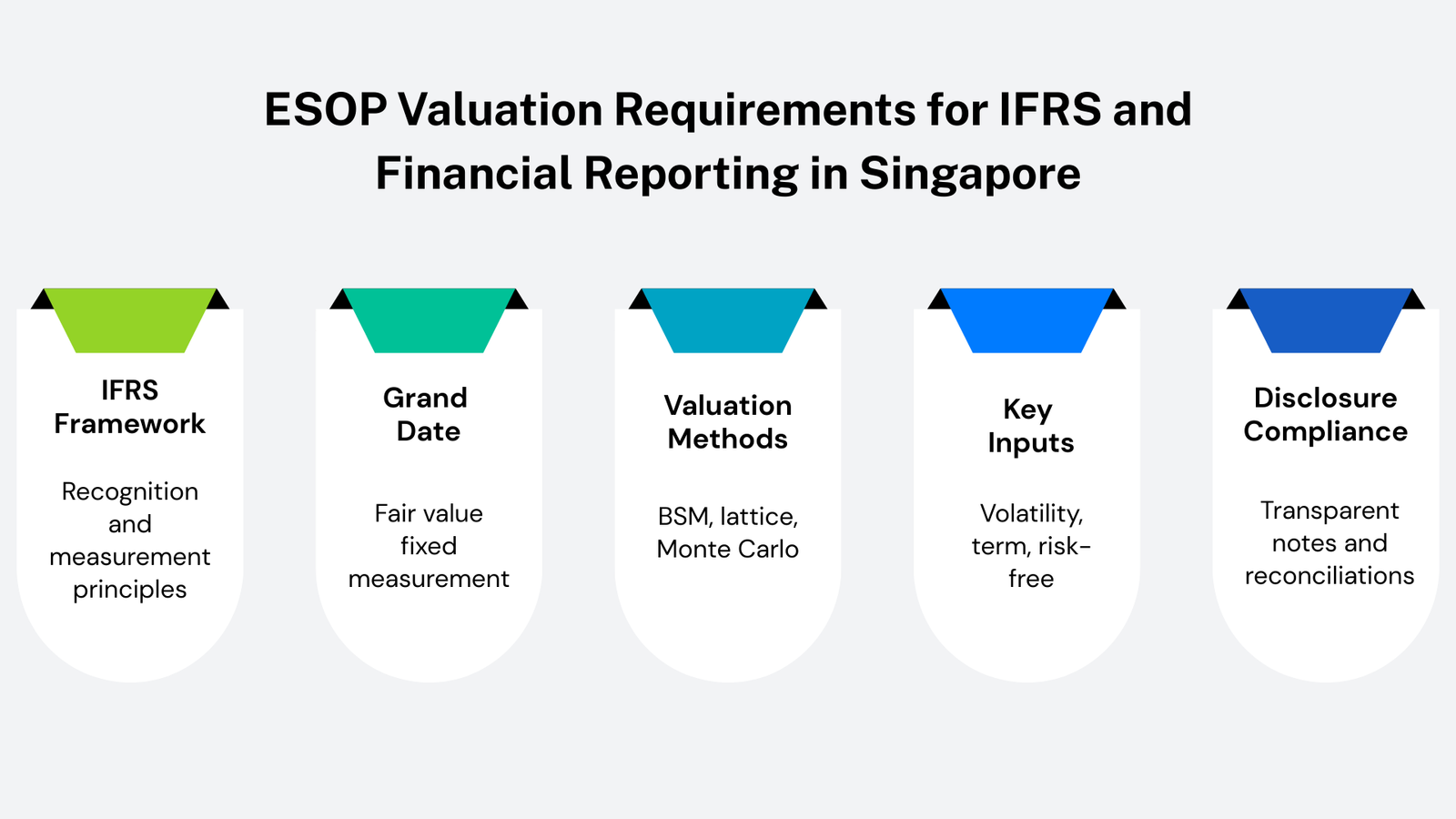
IFRS and Singapore Reporting Environment
The obligations of IFRS ESOP valuation in Singapore are mainly as a result of IFRS 2 Share-Based Payment adopted in Singapore as SFRS(I) 2 that is a regulation that recognizes, measures, and discloses all the share-based payment transactions. SFRS(I) 2 has a substantive similarity with IFRS 2 as stipulated by the International Accounting Standards Board (IASB), that is, Singapore companies that use SFRS(I) have the same valuation requirements as companies that are rated using IFRS around the world. In the case of Singapore-listed companies, it is obligatory to comply with SFRS(I) 2. In the case of private companies that practice full SFRS(I) or as smaller entities that prefer to apply SFRS, there are also share-based payment valuation requirements, and in private companies, there are extra difficulties in estimating the fair value of their own equity which is the underlying asset in most ESOP valuations. ESOP accounting quality is also regulated by the Accounting and Corporate Regulatory Authority (ACRA) and the Singapore Exchange (SGX) as a subset of their overall regulation of the integrity of financial reporting.Primer of ESOP (Employee Share Ownership Plans)
Definition and Common-Use-Cases in Singapore
Employee Share Ownership Plan (ESOP) is an organized scheme by which an organization provides its workers with the power to own the stock of a firm either at a reduced rate, as part of salary, or as a result of fulfilling the performance requirements. E-SOP In Singapore the term ESOP is widely used to describe a family of equity incentive instruments, which have varying economic properties and accounting treatment: Employee Share options (ESOs): The right to buy shares in a company at a certain exercise price (strike price) over a specified time usually after a fixed number of years (vesting period) has elapsed. The option is valuable when the price of shares in the market is higher than the strike price. Restricted share units (RSUs): Commits to grant shares (or cash equivalent of value of share) on vesting, usually on the condition of continued employment and/or performance. RSUs possess intrinsic value, unlike options which may be granted at-the-money. Performance shares (PSPs): Shares that are granted upon meeting performance objectives – total shareholder-return (TSR), or increase in earnings per share, or return on equity – over a predetermined measurement period. Typical among SGX-listed company long-term incentive plans (LTIPs). Employee share purchase plans (ESPPs): These are schemes under which employees can purchase company shares, usually at a lower price than the market price, in regular payroll installments. The discount element is the share-based compensation which is to be recognised in accordance with IFRS ESOP valuation. Phantom share plans Cash-settled plans PHCs: Plans that reflect the economic risk of owning equity, but do not convey ownership of shares. The amount of settlement is pegged on the share price performance of the company and the liability is remeasured at every reporting date.Business Reason why ESOPs
ESOPs implemented by Singapore establishments are used in similar strategic purposes that present the greater human resource concerns of the market. Talent retention is the major driver: the equity provided by the vesting schedule that takes two or four years is a potent incentive to keep the workers with the organisation in critical developmental periods, especially in Singapore where it is highly competitive in the labour market and mobile professionals have the ability to work in any country they choose. The ESOPs also have an alignment role as they connect the financial performance of employees to the performance and shareholder value creation of the company. Early-stage startups Equity grants offer a competitive talent acquisition mechanism whereby cash compensation can be below market rates, but its attractiveness is due to the upside potential that can be promoted to reflect the growth ambitions of the company. In the case of listed companies, where performance based equity compensation is employed, the management compensation is precisely aligned with the most important metrics to shareholders; earnings growth, return on capital and total shareholder return. Capital efficiency In the ESOP case, the companies have an opportunity to replace equity compensation with cash compensation and maintain liquidity to invest in its operations without sacrificing its ability to provide competitive total compensation packages. This is especially useful in the case of growth-stage firms in the technology and financial services industries of Singapore, where high costs on talent and the strategic focus on cash preservation can be observed.ESOP Valuation under the IFRS Requirments
IFRS 2 Share-Based Payment
All share-based payment transactions are governed by fair value IFRS 2, which obliges companies to include the fair value of share-based awards in the income statement (with an offsetting credit to equity of awards settled in equity and a credit to liability awards settled in cash). The standard is applied to transaction where the consideration of the share-based instruments is in the form of goods or services, including employee services. The essence of the fair value postulate of the IFRS 2 is that the expense of providing employee services in connection with awarding share-based awards ought to be gauged at the fair value of such awards on the day of grant and recorded as an expense throughout the vesting period. This recognition of expenses reflects the utilisation of services of the employees: the company acknowledges the compensation cost as they provide service that results in awarding of equity to employees. There are three share-based payment transactions, distinguished by IFRS 2 that require different measurement: Share-based payments settled in equity: Fair value is determined at the time of grant, and is not afterwards remeasured (with an exception of modification or cancellation, where fair value is again assessed). The cost is accrued during the vesting period depending on the number of awards that are bound to vest. Cash-settled share-based payments: The settlement of share-based payments is recorded as a liability and remeasured at fair value at each reporting date and changes in fair value has been identified in profit or loss. Share-based payments of cash equivalents: Transactions where the company or the employee may opt to settle in equity or cash, or otherwise, that need to evaluate which party makes the decision, and the accounting treatment, which should be used to make that decision.Measurement Principles- Fair Value
Valuation of share-based payments on IFRS 2 basis entails the fair value of equity instruments granted to be determined by employing a valuation methodology that is congruent with the general accepted valuation methodologies used to price financial instruments, and that adheres to all factors and assumptions that a knowledgeable, willing market participant would take into account in determining the valuation. The fair value of such share options and like instruments should be based on the intrinsic value (the difference between the price and the exercise price of the share) and the time value (the extra value due to the probability that the price of the share will appreciate above the exercise price before the option expires). In the case of performance-based awards, the fair value should also include the likelihood of the performance conditions being met, either as an input to the valuation model (where performance conditions (market conditions) targeted at a TSR, etc.), or as a modification to the amount of awards that will go to waste (where performance conditions (non-market conditions) targeted at an EPS growth).The IFRS 2 Reporting of ESOP
These operational requirements of IFRS ESOP valuation under IFRS 2 impose a systematic framework of accounting and disclosure requirements which are required to be complied with, at the grant date, at each reporting date within the vesting period and at settlement:| Stage | IFRS 2 Requirement | Valuation Impact |
| Grant date | Measure fair value of equity instrument granted; establish number of awards expected to vest | Requires option pricing model (BSM, lattice, Monte Carlo); inputs fixed at grant date for equity-settled awards |
| Each reporting date (vesting period) | Update estimate of awards expected to vest for non-market conditions; recognise cumulative expense to date | No remeasurement of fair value for equity-settled awards; only quantity adjustment for expected forfeitures |
| Vesting date | True-up expense for actual vesting; recognise full cumulative expense for vested awards | Finalise quantity of vested awards; no further remeasurement of per-unit fair value |
| Modification date | Remeasure incremental fair value for beneficial modifications; continue recognising at minimum original fair value | New valuation required at modification date; incremental value recognised over remaining vesting period |
| Cash-settled: each reporting date | Remeasure liability at fair value; recognise change in profit or loss | Full fair value remeasurement required at each period end; ongoing model updates required |
Where the ESOP Valuation is necessary
Initial Grant Date Valuation
The first grant date valuation is the most significant employee share scheme valuation event. Under the IFRS 2, awards that are settled in equity are valued on a single basis at grant date and this value is used to compute the expenses during the period of vesting. It is not measured again, so the grant data valuation becomes the most effective measurement throughout the ESIP accountancy cycle. The grant date share price is observable in the case of SGX-listed companies that have actively trading shares. Nevertheless, the inputs of the option pricing model, especially expected volatility and expected term, are to be estimated and judgemental with regard to listed companies. In the case of private companies, the grant date valuation involves one extra step, which is to estimate the fair value of the underlying shares themselves as no market price is observable. The valuation of the grant date has to be fulfilled and recorded prior to or immediately upon the granting of the grant and not retrospectively. The retrospective valuations such as those that seem to have been influenced by the awareness of future changes in share prices will be viewed with suspicion and will attract extra attention on the part of the auditors. This is among the most frequent compliance failures in an ESOP valuation Singapore practice: the companies that do not do the valuation till audit time are pressured to reverse engineer the necessary result, which damages the quality of the measurement.Changes and Performance Conditions
The fair value IFRS 2 also provides that when the conditions of the current share-based award are changed, such as the reduction of the exercise price, the extension of the vesting period, or a change in performance targets, the company must measure the incremental fair value of the changed award. An entity should take the difference between the fair value of the modified award and the fair value of the original award which must be measured immediately before the modification and immediately after the modification. The incremental fair value is classified as an extra expenditure over the remaining vesting period (or as soon as the modification in any case vests the awards immediately). Assuming that the modification, e.g. increase in the exercise price, is not beneficial to the employee, then the company has to keep recognizing the expense on the fair value of the grant date, as though that modification was not made. Performance conditions which are inherent in share-based awards have to be keenly differentiated between market and non-market conditions within the IFRS ESOP valuation standards. Market conditions -related targets (like total shareholder return (TSR) targets, which are calculated against a peer group) are directly included in the grant date fair value through the use of a Monte Carlo simulation or other such model. The fair value does not reflect non-market conditions: growth in EPS, revenue goals or internal return levels, but rather reflects the likelihood of actual achievement of such conditions by adjusting the number of awards set to vest at each reporting date.Measurement of Each Reporting Date
In the case of equity-settled awards, the valuation of employee shares scheme is not remeasured at each reporting date. Nevertheless, the cumulative cost should be re-calculated at an end of each period on the new estimate of the number of awards that will come to be vested. Assuming that a company initially anticipated that 5 per cent of employees would forfeit their options (and thus not to be vested), when the actual attrition is exceeding this, the number of expected vesting awards would be adjusted downwards and the cumulative cost would be lower and the previously recognised charges could be reversed. In the case of cash-settled awards, the liability should be remeasured at fair value at all reporting dates. This involves replacing the input in the option pricing model (or other suitable model) with the new inputs at the end of the period, namely, the current share price, new volatility, new expected term. The resulting liability fair value adjustment is reported in profit or loss, which results in the volatility in income statement that does not exist in equity settled award accounting.Valuation Inputs and Viable Facts
Market price considerations: There are always price considerations in the marketplace concerning products that consumers must acquire and those they want to acquire but cannot afford. Any ESOP valuation Singapore exercise would have its starting point in the current fair value of underlying shares. In the case of SGX-listed companies, this is simply a matter of a single input; on the grant date, the closing share price (or the volume-weighted average price (VWAP) over a given period, in case the plan regulations stipulate that the reference price is this) gives a directly observable input. In the case of private companies – a significant and increasing proportion of the ESOP issuing universe of Singapore, comprising of pre-IPO technology companies, private equity-funded companies, and family-owned businesses the underlying share value will have to be estimated separately. This provides additional complexity to share-based payment valuation which is not the case in listed company grants. The estimated share value of the privately traded companies is generally a mixture of DCF analysis of projected cash flows, comparative company trade multiples and evidence of recent transactions with a marketability discount charged to reflect the illiquidity of the privately held company shares.Volatility, Dividend Yields and Risk-Free Rates
In addition to the share price, the three most significant quantitative inputs to IFRS ESOP valuation models are anticipated to include the expected volatility, dividend yield and the risk-free rate. Each will need special estimation procedures: Expected volatility: This is a measurement of how much the company share price will change within the expected time of the option. In the case of listed companies, the volatility of the past (based on time series of past share returns) is the main basis that is often determined over the time period similar to the expectation of the option duration. Implied volatility in the traded options on the shares of the company (where available) may also be referred to. In the case of a private company, volatility has to be based on similar listed company data, with the adjustments due to leverage, scale, and business mix. Dividend yield: The anticipated annual dividend yield during the option period, which is normally determined using historical dividend policy of the company and declared dividend policies. Dividends lower the future value of the share prices, lowering the option value. In the case of pre-dividend startups, zero dividend yield is normally applied. Risk-free rate: The risk-free rate or rate at which the option is expected to mature based on the yield of Singapore Government Securities (SGS), based on Singapore-dollar awards, or the corresponding government bond curve on foreign currency awards. In the case of a 4-year anticipated term, the applicable SGS yield on the grant date would give the right reference.Assumptions on Exit and Forfeiture of Employees
The forfeiture rate (the rate of awards that will go unvested in the event of an employee leaving the firm) is one of the most commonly ignored inputs in employee share scheme appraisal. Under IFRS 2, the forfeiture rate (or the complement thereof, the expected vesting rate) will not be reflected in the fair value of individual awards, rather it will be applied to change the number of awards expected to vest and will be revised at each reporting date. The anticipated forfeitures are to be estimated with references to the historical data on employee turnover in the company, taking into account any potential changes in the workforce composition or employee retention. Whilst in Singapore high-turnover businesses, including technology and financial services, the cumulative adjustments to errors in estimation can be substantial, so the forfeiture rates can be substantial. Also, the anticipated term of the option, the years between grant date and the anticipated exercise date, is affected by employee exercise behaviour, which in turn is affected by forfeiture patterns, anticipated share price increase, and behavioural predisposition of employees. In case of listed firms and history of option plans, actual exercise arrangements give the most accurate grounds of anticipated term estimation. In new plans or in the case of a private company, simplified expected term assumptions (like taking the midpoint of the vesting period and the expiry of the option) are frequently a convenient approximation.Valuation Methods that are most popular
Black-Scholes Model
The Black-Scholes-Merton (BSM) model is the most popular analytical equation of ESOP valuation Singapore and any other part of the world. The BSM model was originally designed to be applied to European style options (exerciseable on expiry), but can be used to model employee share options by the adoption of an expected term assumption that models the behaviour of early exercising options (essentially, a longer-dated option acts like a shorter-dated European option with the same term as the expected exercise date). BSM model takes six inputs, namely, current share price (S), the exercise price (K), the expected term (T), the expected volatility (), the risk-free rate (r) and the dividend yield (q). With such inputs, the formula will give an option fair value which considers the intrinsic and time values. The model is computationally simple, formulaic (not requiring the use of simulation), and is accessible and transparent, and simple to explain to auditors and management. The main weakness of BSM model in its share-based payment valuation is that it assumes continuous exercise opportunity and constant volatility. The normal limits of employee options are vesting (when the options cannot be exercised), blackout (when the exercise is mandatory as in the case of listed companies, according to SGX insider trading rules), and other limitations that are not directly represented by BSM. BSM is usually regarded as adequate in IFRS 2 in the presence of awards whose vesting requirements are not performance-based and may have no performance requirements. Lattice or simulation models are more suitable with more complex awards.Binomial / Lattice Models
The binomial lattice model (also called the Cox-Ross-Rubinstein model) is a versatile, numerically computed option pricing method which is a lattice of discrete time steps in which possible paths of the underlying share price are modeled. The model also allows the exercise option, the vesting terms, employee attrition rates among other attributes of the options that cannot be addressed by BSM. The binomial model is specifically useful in IFRS ESOP valuation where the award contains non-standard exercise patterns, a variety of tranches of vests, reloading, or other structural conditions that influenced the timing and probability of exercise. The model is also more appropriate than BSM in long-term awards and high dividend yield, where constant volatility is more likely to give significant errors. The binomial model is more computationally expensive than BSM but gives a more refined and precise value of complex award structure. The binomial model is commonly used as the valuation exercise of employee share schemes in the listed company ESOP environment in Singapore, where LTIPs are commonly charged on a time-basis and performance-basis as well as multi-exercise-window basis.Simulation of Performance Conditions Monte Carlo
Fair value Monte Carlo simulation is necessary under IFRS 2 fair value of awards which have market-based performance conditions most frequently, total shareholder return (TSR) conditions that compare the performance of the company shares over the measurement period with a peer group or index. Since the value of an award based on TSR is determined by the trajectory of several correlated share prices, neither BSM nor the binomial model can be used to derive the correct valuation and Monte Carlo simulation is the only useful one. Monte Carlo simulation runs a thousand potential future price scenarios of the company and its peer group, and uses the performance condition rules at the conclusion of each simulated scenario to know whether the award would vest at what level. The average present value of the payoffs in the simulated paths is then estimated to be the fair value. It needs a large number of simulations (usually 100,000 or more) in order to get a stable and reliable estimate. In the ESOP valuation Singapore practice, Monte Carlo simulation is the standard methodology to use in the case of Singapore listed companies with relative conditions of TSR performance, especially with very large cap companies. The correlation system amongst the share returns of the company and the peer group companies should be estimated with great care as it has a substantial influence on the results of the simulation.Disclosure Requirement under IFRS 2
To Financial Statements Notes
The IFRS ESOP valuation as follows under IFRS 2 would have imposed a wide-ranging disclosure requirements which are aimed at allowing the financial statement users to have a sense of the nature and magnitude of the counsel of share-based payment arrangements, how the methodology has been used to measure their fair value and the impact on the income statement and the balance sheet. Such disclosures are not an optional added explanation, but an obligatory aspect of IFRS 2 compliance, and the quality of such disclosures is examined by auditors, SGX Regulation and ACRA. The most significant disclosure categories demanded by the IFRS 2 are: Description of arrangements: A description of the general terms and conditions of each of the classes of share-based payment arrangement, including the vesting conditions, the option life, and the settlement method (equity or cash). Number and weighted average exercise prices: A reconciliation of option movements between the period, including grants, exercises, forfeitures, lapses, and balance of the balance at the end of the period, weighted average exercise price per movement. Fair value of options granted: The weighted average fair value at grant date and valuation technique applied with the key model inputs. Expense recognised: The amount of the expense recognized on the share-based payment transactions in the period broken down into equity-settled and cash-settled arrangements. Cash-settled liability: The amount to which the liability is carried of cash settled arrangements and the intrinsic value of vested but unexercised awards at period end.Most Significant Assumptions and Sensitivity Disclosures
The quantitative inputs to the valuation model are the most analytically important disclosures in fair value IFRS 2. In the notes to each grant, it should be disclosed that:| Input | Description | Disclosure Standard |
| Expected volatility | Annualised standard deviation of share returns over the expected term | Disclose the basis (historical volatility, implied volatility, peer comparables); percentage rate applied |
| Expected term | Expected period from grant date to exercise, reflecting early exercise and forfeiture behaviour | Disclose years; describe methodology (historical behaviour, simplified assumption, or model-based) |
| Risk-free rate | Zero-coupon government bond yield for the currency of the award at the term equal to expected term | Disclose percentage rate; reference to SGS yield curve (for SGD awards) |
| Dividend yield | Expected annual dividend as a percentage of share price over the option’s life | Disclose percentage rate; describe basis (historical yield, management projection, zero for pre-dividend companies) |
| Share price at grant | For listed companies, the observed market price; for private companies, the independently estimated fair value | Disclose the price; for private companies, describe the methodology used to estimate underlying share value |
| Performance condition assumptions | For Monte Carlo simulation: correlation assumptions, peer group, simulation count | Disclose peer group composition, correlation methodology, and number of simulations run |