ESOP vs ESOS: Key Differences and Benefits
It may be both thrilling and at the same time intimidating when you enter a company and you come across such terms as ESOP vs ESOS difference in your offer letter or in the process of contractual negotiations. These forms of equity compensation are becoming more popular among not only technology companies and startups but their well-established multinational corporations. To a junior or middle-level professional, it can mean the difference between letting a lot of value go to waste, or making a well-informed choice regarding your career and financial situation.
At the fundamental level, both plans are meant to make employees have a share in the business they are working in. An ESOP or Employee Stock Ownership Plan and an ESOS or Employee Stock Option Scheme are both designed with one common objective; the goal of aligning the interests of the employees with that of the company. Nevertheless, they have significant differences in terms of their structures, tax treatment, risks, and practical implication. The knowledge of these variations can guide professionals in all levels to consider employment opportunities, strategize their financial prospects, and be more actively involved in negotiations with the HR division, finance departments, and top management.
This paper takes you through the basics of each plan, juxtaposes them and uses real-life examples to show how these plans are put into skills in practice. You are either considering your initial equity award, or just need to know how the approach your employer is going to take already, and you will find straightforward and practical advice.
Table 1: Quick Comparison of ESOP vs ESOS
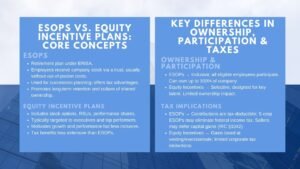
| Feature | ESOP (Employee Stock Ownership Plan) | ESOS (Employee Stock Option Scheme) |
| Ownership | Direct share ownership | Right to buy shares in future |
| Upfront Cost | Company funds the purchase | Employee pays exercise price |
| Risk Level | Moderate — tied to share value | Lower — option not obligated |
| Vesting | Gradual vesting schedule | Vesting before exercise right |
| Common In | US-listed companies, large firms | Startups, listed companies, MNCs |
| Voting Rights | Yes — employee is shareholder | No — until option is exercised |
| Tax Event | At allocation/distribution | At exercise of option |
What Is an Employee Stock Ownership Plan and How Does It Work?
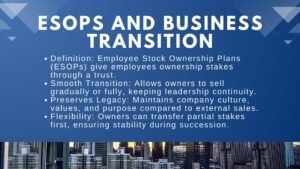
An Employee Stock Ownership Plan is a benefit plan is a form of equality plan that vests employees with ownership interest in the company, usually in the form of shares at a trust in their interest. An ESOP is designed to be a wealth-building instrument, as opposed to a bonus, or even a mere increase in salary. The firm establishes an ESOP trust, includes shares or cash to acquire shares and assign them to employees as they go through a vesting schedule. These shares are not purchased or paid by the employees directly, the acquisition is funded by the plan itself.
An ESOP is one of the few plans that are defined as ensuring retirement and ownership. Take a case of a manufacturing firm in Germany, having approximately 800 workers. When the founding family made a decision of gradually transferring ownership, they established ESOP within a time span of 10 years. Automatic enrollment was done to employees who had been working more than three years in the company. The individual accounts of the employees increased as the trust accumulating shares per annum increased. By the time a few of the senior engineers were able to retire, their ESOP accounts had built up a large amount of money to support a large part of the pension- they were able to retire with a retirement that was much more substantial than would have been received by a regular pension scheme.
Financial gains are not the only employee stock ownership plan benefits in this context. When employees have a share in the business they will be more motivated and more productive and have less chances to leave. This is so especially in sectors where retaining talent is a strategic consideration. The plan however has its own complexities, the retirement savings of the employees are pegged on the financial performance of the company which puts the risk concentrated in a manner that would not be the case with a diversified investment portfolio.
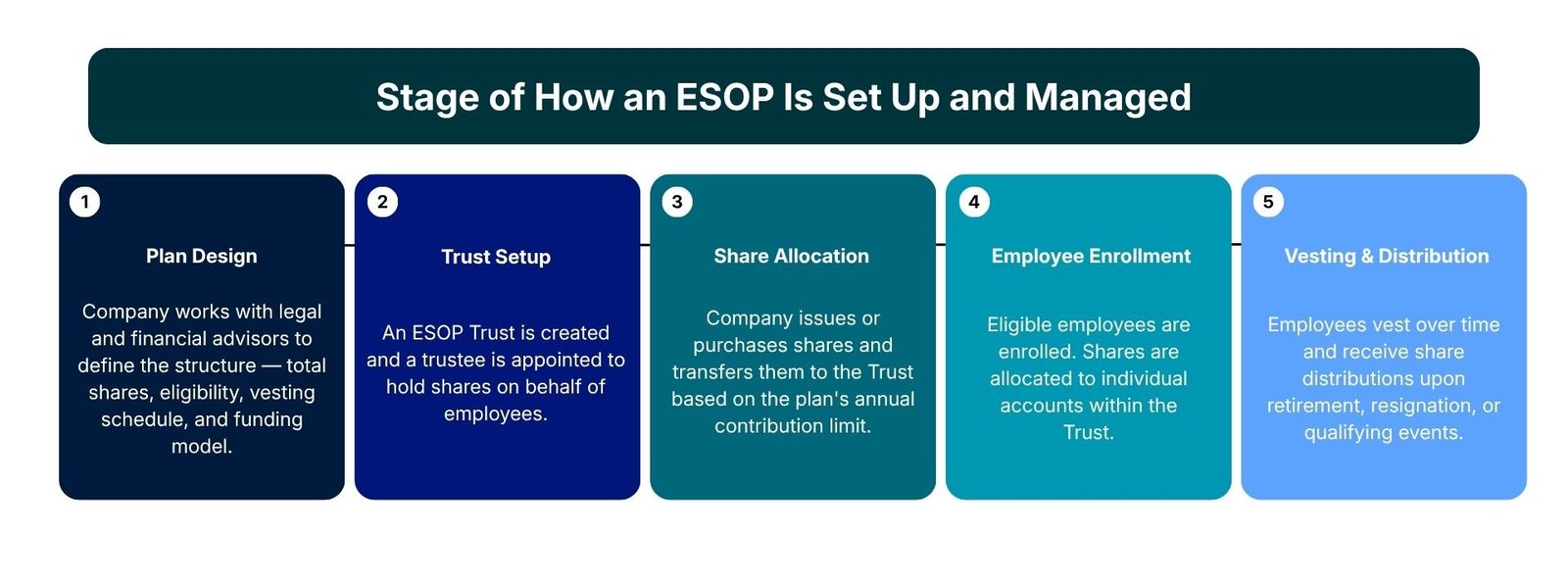
Process Flow 1: How an ESOP Is Set Up and Managed
Understanding the Employee Stock Option Scheme Structure
An employee stock option scheme structure works differently from an ESOP. Instead of having a direct ownership in the shares, a worker is given the right to, but not a mandatory, buy a set amount of shares at a set price, the exercise or strike price, during a certain period of time. This right will only be useful when the market price of the company increases beyond the exercise price and that is where the performance incentive is created. In case the company does well and its share price goes high, the employee exercises the options at the lower strike price and gains the difference.
To bring this into reality, it is possible to address a medium-sized technology company based in the United Kingdom. A software engineer is given options of 10,000 in the company at an exercise price of GB5.00 per share. The options are vested in a period of four years with 25 percent being vested after every year. The stock price of the company has increased to £12.00 two years after she was employed. She executes her 5,000 vested options by paying her 25,000 to get shares into her possession valued at 60,000 in the market, a profit of 35,000 before tax. Her contribution in the growth of the company has been rewarded directly by the ESOS.
The ESOP vs ESOS difference becomes especially clear when examining risk. Under an ESOS, in the event that the price of the share never increases past the exercise price, the employee just does not exercise the options and gains nothing other than the potential upside. This is very contrary to the holding of shares in an ESOP where a drop in the share value automatically reduces the asset value that has been invested directly into the account of the employee. To risk-averse employees, ESOS has the benefit of making employees feel less risky in a company in its early stage or volatile, but it also implies that the reward would be subject to the performance of the company stock.
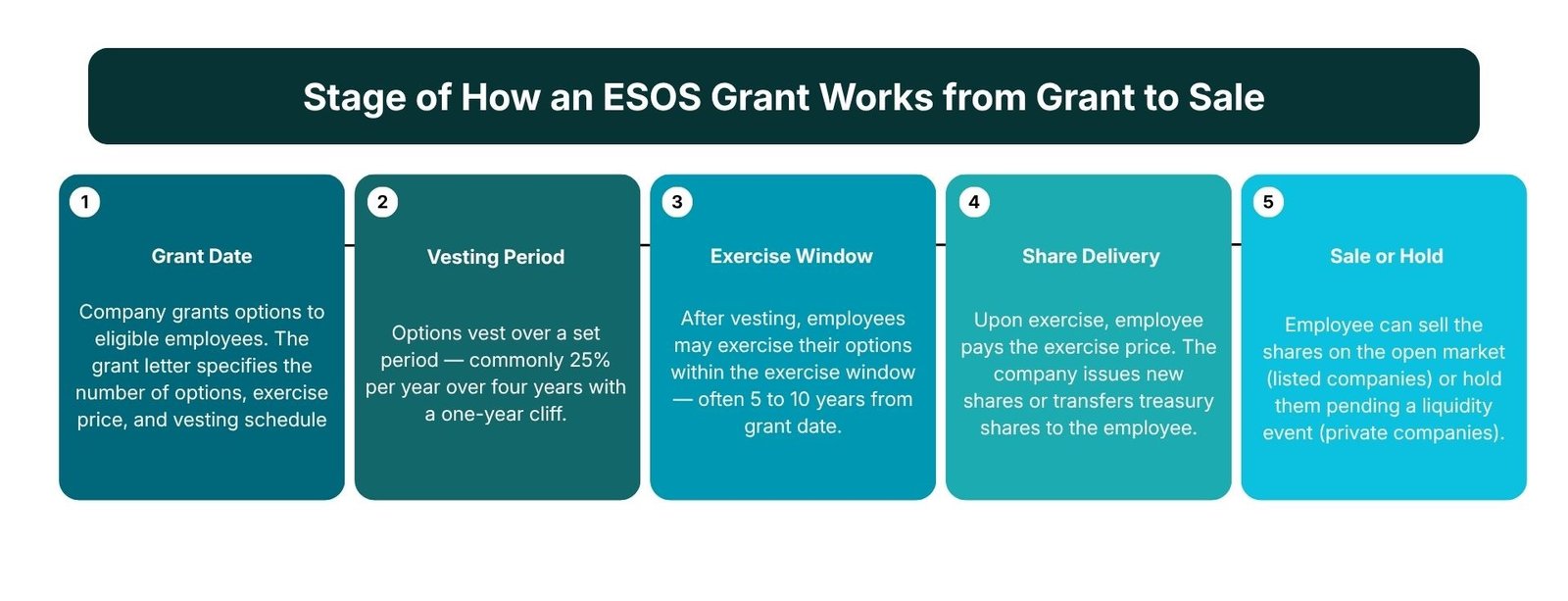
Process Flow 2: How an ESOS Grant Works from Grant to Sale
Five Key Points Every Employee Should Know Before Accepting Equity
A compensation package can include equity compensation and it can be one of the most valuable elements therein, however, you must be aware of what you are getting. Most professionals will sign their offer letters without properly reading the equity provisions and thus find out afterwards that there are limitations in their shares, their option has expired or their tax bill was higher than anticipated. Whenever an equity grant comes your way, there are five fundamental things that you should know.
Table 2: Five Things to Know Before Accepting Equity
| No | Key Point | What It Means for You |
| 1 | Get to Know Your Grant Letter. | Read the agreement from beginning to end – observe the vesting period, exercise price and date of expiry and sign. |
| 2 | Know Your Vesting Timeline | The majority of the plans tend to have a 4-year 1-year cliff vesting. An early exit will result in the loss of unvested options. |
| 3 | Tax Obligations Vary | In the case with ESOS, taxes are usually levied upon exercising options. Exercising large grants before you can do so without consulting a tax advisor. |
| 4 | Market Conditions Matter | When the exercise price is above the market price then you are said to be underwater, no value is created by exercising your options. |
| 5 | Liquidity Is Not Guaranteed | Sale of shares of a private company may be subjected to restrictions. Always check the lock up or transfer restrictions. |
In addition to these five, you would want to request your employer or the HR department to explain to you what would happen to your equity on the event of the acquisition, a merger with another company, or a management buyout. There are also acceleration clauses in most instances, which permit unvested options to be vested as soon as a change of control occurs – however, again, not everywhere. When these questions are asked by the professionals at an early age, they position themselves much better to negotiate the terms and to think about their future financial matters.
Real-World Challenges and Lessons Learned
Despite the many employee stock ownership plan benefits are numerous, and the popularity of equity compensation in general, ESOPs, as well as ESOS plans, have yielded a number of cautionary stories, which practitioners should be aware of. A very documented difficulty is that of companies that highly depend on equity to compensate low wages. One Canadian retail chain even registered all full-time employees in an ESOP in a restructuring. Although the ownership stake was embraced by employees, the performance of the company worsened after a number of years because of disruption in the market. The ESOP accounts which were heavily geared towards the company stock lost a major part of their values. The employees who were about to count on their ESOP disbursements to retire with were left with much less than they expected.
A typical challenge on ESOS side is option dilution. In a case where an Indian technology services company with high growth was issuing options in large volumes as the firm was growing the value of the initial grants was highly diluted in subsequent funding rounds. Even junior employees who had joined the company with their hopes that the company would be transformed found that when the company went public, their effective per share value was a fraction of the price of the option strike. This experience has demonstrated the significance of having knowledge on the number of shares that are totality, how a scheme is diluted, and any anti-dilution provisions that are or are not part of an employee stock option scheme structure.
The moral of the story in both instances is simple; equity does not take the place of sound financial plan. The equity compensation should be viewed as an upside, but not a certain asset by the professionals. Savings diversification, awareness ofvesting schedules, engaging an experienced tax and financial planner, and requesting plan documentation in writing are all measures that secure the employees irrespective of whether their company has an ESOP or ESOS. The most fiscally prudent workers take equity as a single component of an overall compensation system – as something that encompasses base pay, benefits, career management, and personal saving patterns.
How to Evaluate Which Scheme Benefits You More
The issue about which scheme is more useful lies heavily on your own situation, the phase of the company you work in and financial aspirations. To those that have been hired in well-established public companies whose stock prices are stable, ESOP presents a real, and comparatively lower-risk ownership ownership that gradually accumulates over time. The employee stock ownership plan benefits shine in this context: the plan is employer-funded, the allocations are automatic, and the shares receive an established market value. This can be an important addition to wealth-building without any active action on your part in the event that you intend to remain in the company in the long term.
An ESOS can be much more profitable to the participants of startups or high-growth companies in which the share price is expected to soar. The whole concept behind the employee stock option scheme structure is constructed around the notion of future value – what you are being proposed is a portion of future gains at the current price. That is why even employees who joined such companies as Spotify, Grab, or Canva (that issued high amounts of stock options in their initial years) could make an incredible profit after the IPO or acquisition, despite their salaries, at the time of hiring, often being under the market rates.
Finally, the debate between ESOP and ESOS is not the question of which one is better than another but the one that is more associated with your as an employee and as an investor profile. An ESOP is the reward of loyalty and long-term devotion to the well-established business. An ESOS compensates the estimated risk of becoming a member of a firm having a good growth potential. Calculate before accepting any equity offer, consult an expert, and consider carefully the future of the company, your own career strategy, and whether you will be financially stable. Equity plan with maximum knowledge is the best plan.
Conclusion: Turning Equity Knowledge Into Actionable Advantage
It is no longer the prerogative of the financial professionals to comprehend the difference between an ESOP and an ESOS. This knowledge is also emerging as a professional requirement in that more companies in any industry, whether they are a logistics company in Australia or a fintech start-up in the Middle East, are adopting equity compensation as a way to reward employees at all levels. Having the ability to read an equity grant, pose the correct questions and include equity value in your professional choices places you above the majority of your colleagues.
The benefits of the employee stock ownership plan and the structure of the employee stock option scheme each have their own advantages that would suit you best on a case-by-case basis. What they have in common is that they are a sincere proposal to be a part of the money-making of the company that you help create. That is an opportunity to be taken into consideration. Review your grant documents. Inquire of your HR team of the details. Use a financial advisor to exercise large grants of options. And most importantly, do not allow the sophistication of terms of equity to serve as an excuse to abandon one of the most useful elements of your remuneration.
The choice to use ESOP or ESOS difference will depend on your current decisions to determine whether it will be of great impact to your finances. The first step is to comprehend what you have been presented with, and then make a conscious and knowledgeable decision regarding the usage of the same.