
How ESOP Valuation Changes After a Funding Round
How ESOP Valuation Changes After a Funding Round
Employees with stock options think they’ve just got what the headline valuation says they’ve got when a start-up closes a new round. In reality, performance of ESOP valuation after funding round activity is much more complex than just applying the new share price to all the shares. A funding round also restructures the capital, imposes new investor rights and alters a number of the inputs for option pricing, which can have unnoticed effects on the value of the options after the startup’s investment. The most prevalent confusion is that the cost of new investments is presumed to be the fair value of employee options. Unlike ordinary shares a preferred share round price does not necessarily apply, as these shares are protected. Knowing the reason behind this gap will help set expectations and ensure founders report as needed.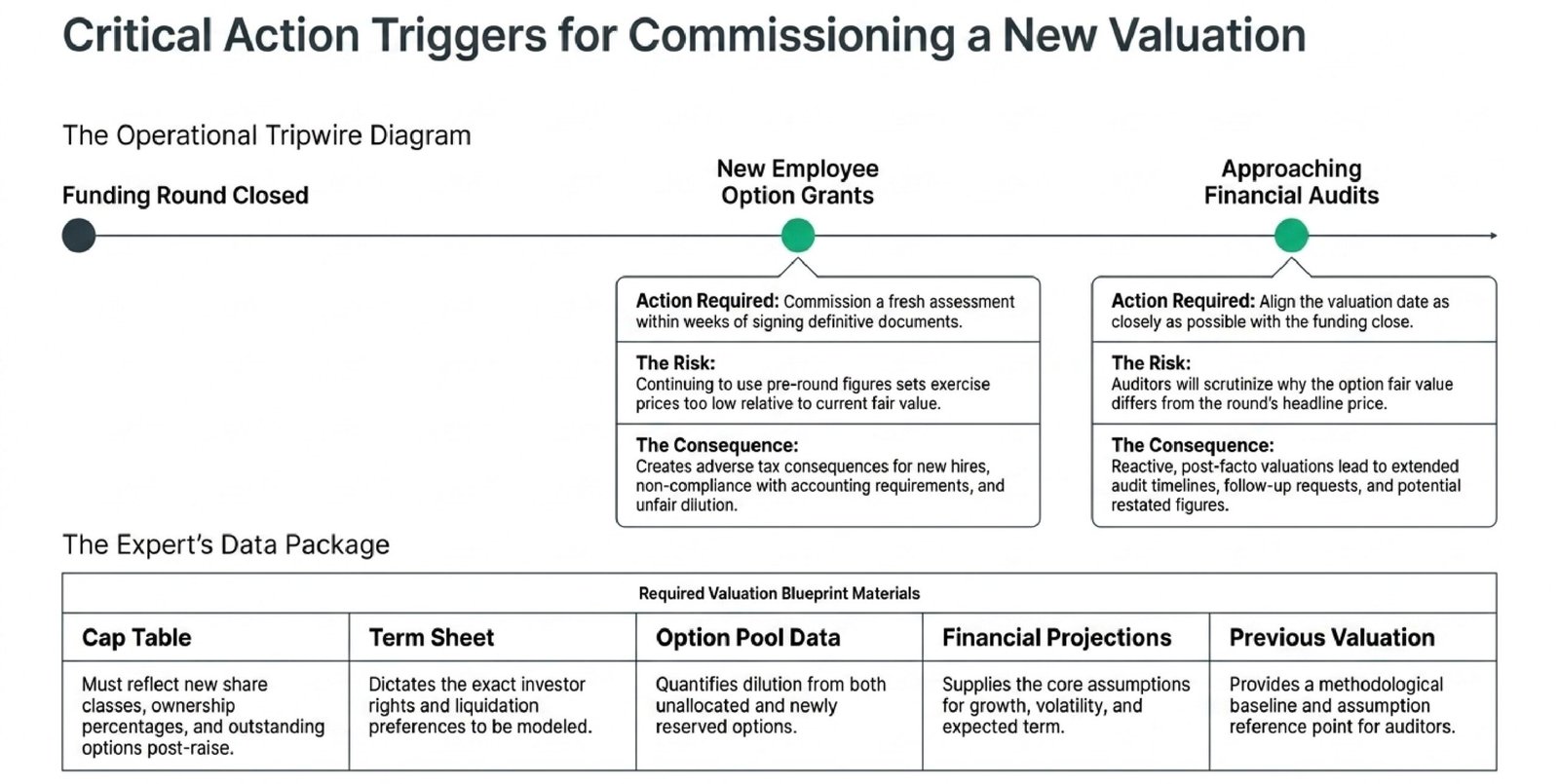
Why a Funding Round Can Change ESOP Value – How ESOP Valuation Changes After a Funding Round
On a high level, there are three forces that impact the valuation of the ESOP after the funding round – the price at which the investors pay, the rights that come with the shares they purchase and the changes in the inputs that go into the option pricing model itself. None of these forces are single either, and a good valuation exercise must consider all three forces and not be able to use one value and assume that the others remain unchanged. For those founders who do grasp this correlation, it helps them have more confidence in discussing equity with their team, because they can confidently explain why the value of the startup after the investment on the payslip or grant letter doesn’t equal the round’s headline number. The sections that follow will examine each of these forces sequentially, beginning with how the rights of investors affect the underlying share priceHow New Investor Pricing Affects the Underlying Share Value
Also, the value of a company’s shares is affected by investor pricing; the price negotiated in a funding round is negotiated specifically for the preferred shares, not the ordinary shares that are usually the basis of employee options. Preferred shares typically offer conversion options, anti-dilution options (downward adjustments on the investor’s price in the event of a future round), and a senior claim to ordinary shares in the event of a liquidation. Ordinary shares are not as protected as preferred shares and therefore are worth less per share than preferred shares despite the fact that both are equity in the same company and both are found on the same capitalisation table. This is the reason why the ESOP valuation after a funding round of activity is different than the simple read-across from the deal price – and it is one of the most misunderstood concepts among employees who read about their company’s most recent raise. It also sheds light on the disconnect that can occur between the number that founders see in the press and the number that their finance team will report on option grants. One of the most obvious Investor Price Effects is liquidation preference. A liquidation preference is a clause that ensures investors will receive a minimum return, typically the amount of their investment, sometimes with a multiplier, before ordinary shareholders receive any proceeds. This preference decreases the value that is available for ordinary shareholders in adverse or moderate situations, thereby decreasing the value of the ordinary shares that the bulk of ESOP grants are based on. These, in addition to the variations in voting rights, board representation, information rights and pro-rata participation rights, make preferred and ordinary shares assets that are not the same. These rights differences have to be explicit when a valuation expert models them, otherwise two companies that are priced at the same headline share price could be very different in terms of the ordinary share value once the particular terms of the individual investors are considered. To put it simply, investor pricing influences a whole lot more than just the number on the term sheet – it changes the rights structure a valuer has to model. So, in practice, it’s advisable for the board and management to anticipate and allocate time for a thorough valuation exercise whenever a new round ends, not as a mere formality to be finished after the fact.How Funding Changes Option Pricing Inputs
In addition to the rights differential, there are a number of other inputs that directly influence the value of options which are impacted by investor pricing. A funding round isn’t only the headline share price; it’s several of the inputs used to calculate startup option value after a round. When a new round is done, its value is changing because it creates a new ground truth for the business, but assumptions about volatility, expected term, risk-free rate, and potential dilution from the new investment can all change simultaneously. The combination of these inputs multiplicatively rather than by adding on in option pricing models like Black-Scholes can materially change the outcome of the pricing calculation, without taking into account the recent share price, in and of itself. That is why, when a raise occurs, an experienced valuer will revisit each assumption, rather than simply dragging the line representing the share price up a few points and leaving the rest of the model unchanged; and that is why two valuation performed within a few months of each other can result in a meaningful difference even if the business in question hasn’t changed much operationally.Table 1: Option Pricing Inputs – How ESOP Valuation Changes After a Funding Round
| Input | What Changes After a Funding Round |
|---|---|
| Share Value | New reference point set by the latest round and updated cap table |
| Volatility | Reassessed based on company stage, sector, and comparable public data |
| Expected Term | May shift with new vesting schedules or a revised expected exit timeline |
| Risk-Free Rate | Updated to reflect prevailing market rates at the new valuation date |
| Potential Dilution | Adjusted for new shares issued and any expanded option pool |
Why the Latest Funding Price Is Not Always the ESOP Value
Another way investor pricing has an impact on perception rather than reality: When a new investor buys a share, they tend to think the price they paid for the share is the new share value, which is a transaction price not a fair value. The transaction price is the price a particular investor agreed to pay for a particular class of shares, with certain rights, at a certain moment in the negotiations, as affected, for instance, not so much by value as by strategic considerations or by competitive tension or pressure, or by timing. Fair value, on the other hand, is a more general valuation based on a methodology that considers the rights differential between the share classes. This is precisely why an ESOP valuation after round exercises is usually an exercise in its own right, not just a simple carry-through of the round price to each share on the cap table, and often is done with an option pricing model or the probability-weighted expected return method. Founders who know this difference also have a better chance of understanding and communicating in simple terms, why their choices and the choice of their employees is not just the number of shares they own times the round price. The difference is made evident in the following hypothetical example. Suppose that a company issues a Series A round with a preferred share price of S$10, which would reflect the valuation based on the total number of shares outstanding before and after the round. But if the preferred shares have a 1x non-participating liquidation preference, together with other standard investor protections, the ordinary shares of the company underlying the employee options may reasonably be valued at S$6 to S$7 (equal to the 1x non-participating liquidation preference) per share, instead of the S$10 preferred share price. In this case, the employee is not being underpaid, as the difference between the two is real. This is a natural and normal aspect of the calculation of fair value of employee options following a raise and is fully acceptable when disclosing this discrepancy to employees when announcing the funding; it will avoid the potential for confusion and disappointment in the future. It’s also important to note that the extent of this discount is not predetermined – it will be entirely contingent on the specific terms that are offered and negotiated in each round, meaning that a company that is tougher on the downside might have a larger discount than a company that was more generous. The same hypothetical also illustrates why one might be misled by the same headline valuation on option values across two companies if one company applied a higher discount to the ordinary shares than the other company did because of the strength of the preferences negotiated by investors in each company.When Should a Company Revalue Its ESOP After Funding?- How ESOP Valuation Changes After a Funding Round
Not every funding round demands an immediate valuation refresh on the day of closing, but there are specific, Some funding rounds require a valuation refresh on the day of closing, but there are specific and predictable timing for a company to order a new employee options valuation. By identifying those trigger points up front instead of in hindsight, a company can make its option grants “defensible” and avoid any nasty surprises in audit. In general, these triggers can be divided into three groups: issuing new grants, nearing audit or report and preparing information for the valuation expert to work on efficiently. They are discussed one at a time below.New Grants After a Funding Round- How ESOP Valuation Changes After a Funding Round
When a company issues option grants after it closes, options should be priced based on the current valuation and not on the pre-funding round valuation. Grant-date valuation is important as the exercise price for new options is generally determined at fair value on the date of the grant and the use of out-of-date figures could result in unfairly dilutive pricing for new hires or, in Singapore and other countries, non-compliant tax and accounting treatment. This is one of the most prevalent reasons for investing and evaluating a startup and then calling for a new option value to be written later in the year when they still hire new employees, and not just for the first few weeks after closing. For hiring managers and HR teams, the timing should be factored into the new grants onboarding process and not based on the old valuation date. Though the company may not have changed in any way since the initial valuation, the time of a funding round can quickly render this original valuation obsolete. Regardless of the timing of the last time the capital was valued, these changes all constitute material changes to the capital, the rights, and the cap table of the company. A pre-round valuation may result in the company setting exercise prices that are too low compared to the tax fair value and could lead to undesirable tax consequences for employees and compliance problems for the company in the event of an audit or exit. By refreshing the valuation immediately after the close of the round, both parties will be shielded from such risks and provide new employees the assurance that their grants are being offered at a defensible and appropriate price. Most companies will value once they sign definitive documents, usually within weeks, not at the normal review time.Funding Before an Audit or Financial Reporting Date – How ESOP Valuation Changes After a Funding Round
If a company completes a funding round, shortly before an audit or a date for financial reporting, it can anticipate that the valuation process will be subject to a higher degree of scrutiny than would otherwise be the case. This is particularly the case where documentation showing the derivation of the ESOP valuation after funding round figure will be important, including all of the assumptions that were made in modelling share value, volatility, expected term and dilution, and how the liquidation preference and rights differential between the share classes were modelled and supported. The time saved in keeping this documentation in order when preparing the valuation is much better compared to having to reconstruct it at the start of the audit. Auditors tend to have probing questions if a valuation date overlaps with a funding round, especially regarding the headliner valuation and its reasons, and whether the valuation process is aligned with the company’s past valuation processes. The ability to review and walk through the methodology and the treatment of preferred rights, as well as data supporting each of the assumptions, helps to quickly identify and address these questions and helps to keep the audit process on schedule. Companies that proactively involve a valuation professional in the process, rather than as an afterthought during fieldwork for an audit, will typically have a more streamlined audit experience, fewer follow-up audit requests, and a reduced risk of restated numbers later in the audit. It also helps to have the valuation date as close to the close of the funding as possible as the end of the funding can be the source of further auditor queries.What Founders Should Give the Valuation Expert – How ESOP Valuation Changes After a Funding Round
A major benefit of the founders is that they can help expedite the valuation process by having the appropriate information ready for the valuation expert, instead of compiling documents as the need arises. A clear and well-structured information package enables the expert to go straight to analyzing the information without having to chase missing pieces, which is especially useful when there is an urgent need to assess a fair value of employee options shortly after the issuance of a funding round and new employees are waiting for their grant paperwork.Table 2: Valuation Expert – How ESOP Valuation Changes After a Funding Round
| Document | Why It Matters |
|---|---|
| Cap Table | Shows share classes, ownership percentages, and outstanding options |
| Term Sheet | Sets out investor rights, preferences, and other round terms |
| Previous Valuation | Provides a baseline, methodology, and assumption reference point |
| Financial Projections | Supports assumptions on growth, volatility, and expected term |
| Option Pool Information | Clarifies dilution from unallocated and newly reserved options |