How ESOP Valuation Changes When a Company Becomes Profitable
How ESOP Valuation Changes When a Company Becomes Profitable
Among the most significant events that can affect the valuation of an employee stock ownership plan is when a company switches from a losing streak to profitable years. Once a company becomes profitable, the way it values the stock and the inputs that affect that valuation all change, and even the tone of the annual valuation report changes, so it’s important to understand how the valuation changes at that time for any active finance professional assisting a private company plan. This transition has varying impacts on different stakeholders involved in the plan: Participants will experience it on their statement of account balances; the sponsoring company will experience it as an increase in a repurchase obligation; and trustees will experience it in greater scrutiny of their annual valuation decisions. This article outlines the points to keep in mind when valuing a company for an ESOP, describes the increase in value of the company that generally occurs as a result of its profitable operations, and outlines the methods of valuation for profit, ESOP pricing changes, and the additional earnings impact considerations that affect the share price that employees receive.
What Happens to ESOP Value Increase Once a Company Becomes Profitable and How ESOP Valuation Changes When a Company Becomes Profitable?
The purpose of an annual valuation by the ESOP’s trustee is to determine a price for stock that is “fair” and “defendable,” and this price is calculated largely as the company’s expected future cash flows and earnings capacity. Yet, with no clear earnings foundation for a company that’s still pre-profit or is just making a minimal profit, a valuers can rely more on revenue multipliers, asset approach, or discounted cash flow (DCF) projections with a long-run horizon before there is any meaningful profit. The trustees who administer these early-stage valuations typically are familiar with and understand this limitation, though the other extreme of applying an earnings-based valuation to a business with a minimal earnings history would lead to a more questionable number than a well-beaten-down asset or revenue-based estimate. Once a company reaches sustainable profitability, the whole valuation process changes focus: Earnings-based valuation techniques, such as capitalized earnings and discounted cash flow valuations based on actual past results and not on some future prediction, take precedence, and the ESOP value increase that usually follows are based on actual earning power rather than a future guess.
This change isn’t just about replacing a larger figure with the same formula. Once profitability is proven, valuers tend to decrease the discount rate on future cash flows because a company with a proven history of profitability has a meaningful amount of execution risk removed from the equation as opposed to a company that is yet to prove its business model. Lower risk and higher earnings combine – that’s why it’s important to consider both sides of the valuation equation – the cash flow or earnings numerator goes up, and the discount rate, reflecting risk, tends to go down, and in combination the effect can be quite large as compared to just an earnings increase. One of the more counterintuitive things about the ESOP valuation process for pros who’ve never seen it before is that a company that is doubling its earnings but also puts itself at less risk of having a problem, in the eyes of a valuer, can end up with a share price increase that is more than twice its earnings increase in a single valuation cycle.
How Does Profitable Company Valuation Differ From Early-Stage ESOP Pricing?
There is a difference between the method and mindset of the process for valuing the company during the early stages and the process for valuing the company for ESOP purposes. Early stage ESOP valuations typically involve a blend of the asset approach (which calculates the company’s value if the tangible assets were sold off) and an input method that heavily weighs down on distant and uncertain income scenarios to reflect true execution risk. After a few years of consistent profits, the value is evaluated based on a valuation method that relies on the profitability as the key driver of value: a capitalized earnings method takes a single multiple to a normalized, sustainable earnings figure, and a discounted cash flow model based on a proven history of accurate past expectations is far more credible with a trustee and the Department of Labor reviewers who diligently review valuations. But this credibility factor is more important in the ESOP context than in many other valuation contexts as the ESOP valuations are subject to more regulatory scrutiny than few other private company valuations on an annual basis. If there should be a dispute with a participant or a regulatory inquiry, the valuation of the business done in the ESOP must be persuasive to those who have been around for years and will be passed muster by the Internal Revenue Service, the government agency in charge of enforcing the rules.If there is a dispute with one of the participants or a regulatory inquiry, the business valuation prepared in the ESOP process will need to withstand years of hindsight testing to be persuasive to the Internal Revenue Service, the government agency responsible for enforcing the regulations.
The attitude change is as important as the technique. The stress test to determine if a company’s business model is feasible is what takes up much of the time of valuers working with an early-stage, or barely profitable company, whereas valuers in an established, profitable company focus on whether the business model is sustainable or cyclical or is dependent upon a set of temporary conditions that may not last. The true difficulty of profitable company valuation lies in separating out one-off gains from repeatable earnings, and only capitalizing in a higher sustained valuation those recurring earnings, because that’s the only thing that is truly sustainable and should be reflected in the valuation; a large contract that is unlikely to be repeated should be treated as a one-off gain rather than a bump that will even out in the next year’s report. Making this judgment, as opposed to simply multiplying the earnings number listed on the current financial statements by some generic number, is probably the most important skill a junior valuation professional can acquire on an ESOP engagement.
Table 1: Profitable Company Valuation Methods Before and After Sustained Profitability – How ESOP Valuation Changes When a Company Becomes Profitable
| Company Stage | Primary Valuation Method | Typical Discount Rate Trend |
|---|---|---|
| Pre-profit or early-stage | Asset approach or heavily discounted income approach | Higher, reflecting execution risk |
| Newly profitable, one to two years | Blended income and market approach | Moderating as evidence accumulates |
| Sustained profitability, three or more years | Capitalized earnings or discounted cash flow | Lower, reflecting demonstrated stability |
What Does Profit Driven Valuation Look Like Inside an ESOP Model?
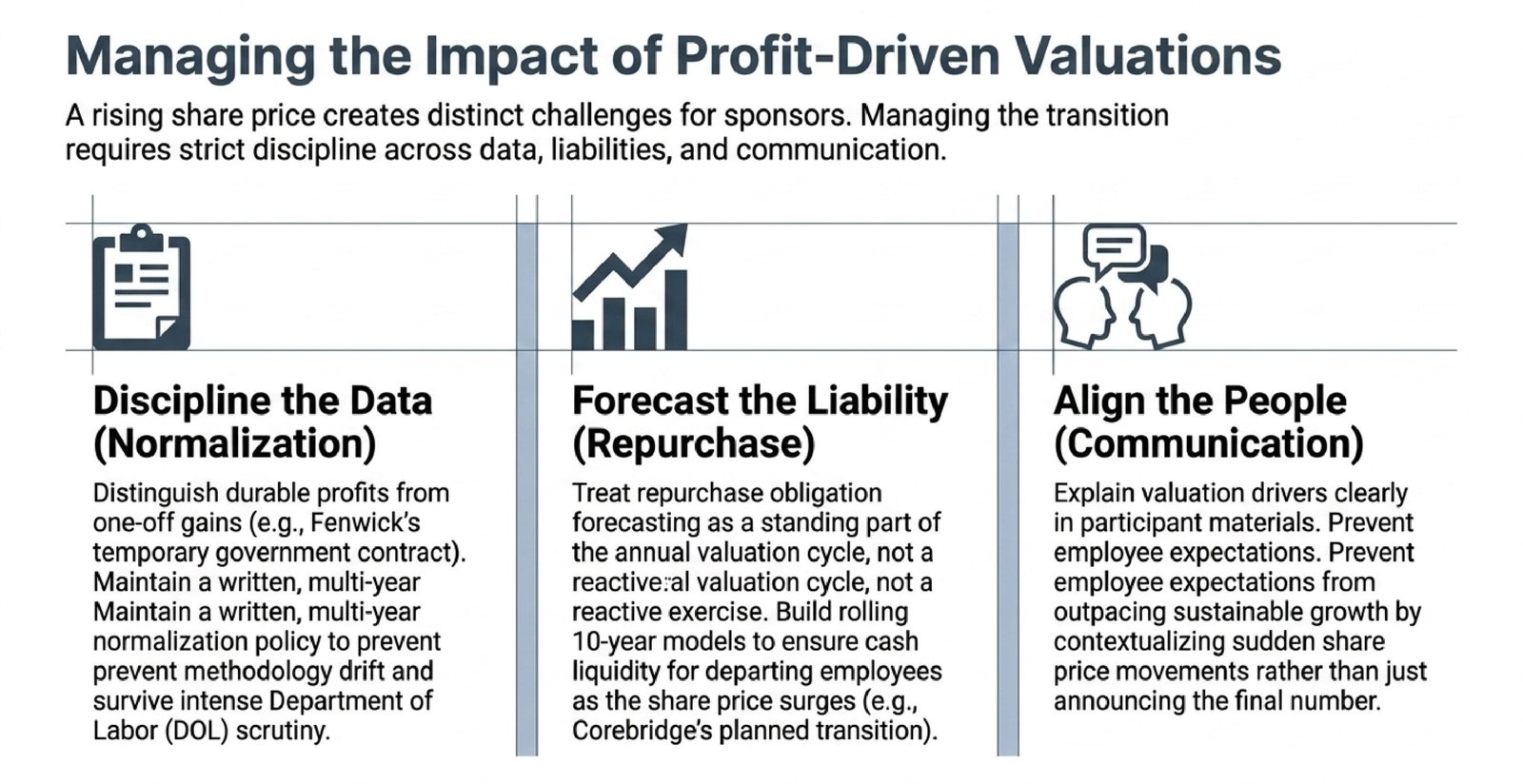
A typical starting point for profit-driven valuation of an ESOP is the normalization of historical earnings, adjustment of the reported earnings to account for one-off items, owner compensation (above or below market rates), and any related-party transactions that would not continue if the company were not owned by the ESOP. ESOP valuation should look at the company’s earning power, not its accounting earnings as reported on the books. This normalisation step, arguably the most important one of any profit-driven valuation, can meaningfully impact the earnings trend that a valuer bases the valuation on if not accounted for in a uniform manner from one year to the next, even if the differences are small. Experienced valuation teams will generally have a written normalization policy to help protect against this kind of drift, and will specify how each category of recurring adjustments will be treated, such as owner compensation which may be higher than market, or legal fees which may have one-off costs but will be treated as a normal adjustment in subsequent cycles. After the normalized earnings are determined, the valuer either uses a capitalization rate, which is the inverse of a P/E ratio for the company after adjusting for risk, or constructs a complete discounted cash flow model with several years of expected earnings. Both approaches depend on the quality and consistency of the earnings trend, so that a company that becomes profitable for the first time will have a relatively smaller valuation increase in its first profitable year as compared to its second or third profitable year because it is reasonable to require a trend before fully rewarding a strong year with a higher valuation. This gradual approach keeps participants and the sponsoring company from getting caught up in a valuation based on scant evidence and having to back down as hard as they had to in the next year when the results are less than expected.
When the ESOP valuation increases, the resulting change in per-share price has a cascading effect throughout the plan that directly affects the participant—such as the price that is used for any new contributions, distributions to departing employees, and the obligation to buy back the plan’s shares. That’s a true funding problem for the company because the more the share price goes up, the more cash the company will have to spend when the workers decide to retire and the valuation will be high enough that the company won’t have to spend it on an investment. As the company grows and is profitable, finance teams know that they can expect to have repurchase obligations each year, and they are beginning to treat this forecast as a permanent part of the annual process of determining the company’s valuation. Some companies prepare a 10-year repurchase plan that is rolled out with each yearly valuation just for the leadership team to view ahead and know if the company’s cash flow and any focused funding source will be able to cover the obligation as more workers retire and more shares vest and are distributed.
What Five Steps Help Manage ESOP Pricing Changes as Profitability Grows?
- Normalize earnings consistently. Restate earnings for any unique items and related party transactions in the same manner for each year, thereby maintaining comparability of earnings from year to year.
- Differentiate between a durable profit and a one-time profit. Capitalize profitability to a higher sustained value instead of relying on repeatable earning power and temporary windfalls.
- Make a conscious effort to go back to the discount rate. Reduce the discount rate only when real evidence of decreased risk comes in, not automatically every year that it is profitable.
- Assess the repurchase liability early. Predict the company’s share repurchase obligations as the value of its shares increases, not when it needs to be repurchased.
- Inform participants of change. If the valuation methodology or trajectory has changed, be sure to communicate to employees why this is happening; unexpected share price fluctuations can cause confusion or distrust.
What Real-World Examples Show How ESOP Valuation Changes When a Company Becomes Profitable?
Take the example of Corebridge Software Solutions, a medium sized software business that has converted to an ESOP plan, but continues to invest heavily in product development and operate at a slight loss. During its first two years as an ESOP, the company’s value was largely based on revenue multiples compared to similar software firms, as profitability had not yet become a reality and earnings-based methods provided little useful guideline. The valuation firm moved to use a discounted cash flow approach based on the growth in earnings, which had become quite reliable, as the company had become profitable in its third year and customer acquisition costs had dropped, resulting in a significant rise in the ESOP value, nearly doubling the per-share price used for the plan valuation in the current year compared to the previous year, based on revenue-multiple valuations. The company’s finance team had already prepared for this change, based on the impacts of the previous two quarters, so this increased liability was not a surprise when the new valuation report was issued.
A second case is a manufacturing company for industrial parts, Fenwick Manufacturing Co., which had been profitable for years, but actually saw an unusually large one-time government order give it a sudden, temporary boost in earning. This was an obvious case for the valuation team to exercise some earnings impact valuation judgment since the earnings that year were unusual and if the company’s value was overstated by capitalizing that year’s earnings at its normal multiple, its true sustainable value would have been considerably understated. In contrast, the team adjusted the contribution of the contract to a level commensurate with the company’s historical baseline, which resulted in a valuation increase in excess of the temporary contract windfall and would otherwise have led to an inflated valuation of the company that would have been unwelcome to the company for repurchase planning and unwelcome to the participants for their expectations of valuation. As one of the first to inform on the value of its ESOP, Corebridge has experienced a genuine value increase from an underlying sustainable earnings trend, while Fenwick’s team was intentional in avoiding a similar increase in valuation due to the underlying quality of the earnings, not just the volume of them. Later, Fenwick admitted that this disciplined normalization would have given a smaller lift in the valuation than a valuation without it, but the company had earned more trust with the plan’s participants with the normalization than it would have had with a larger, less defensible number, as it was able to explain why the contract’s full value had not been reflected in the share price.
What Challenges Come With ESOP Pricing Changes and Earnings Impact Valuation?
A lasting challenge to earnings impact valuation for ESOPs is determining whether the increase in earnings is sustainable or whether it is temporary or cyclical in nature; overstating the sustainability will lead to a higher valuation, and understating it will devalue the participants who have the right to be sure of a fair market value determination. The judgment call can have real ramifications: a judgment call will be subjected to greater scrutiny by the Department of Labor for this type of overstatement, and valuation firms that routinely engage in this overstatement may be subject to regulatory and litigation risk going forward for themselves as well as the sponsoring company. With this examination minded, many valuation firms have made a second, independent review review procedure for years where the pricing movement for the ESOP is significantly higher or lower, which entails a second review of the assumptions behind the pricing movement before the valuation report is completed and submitted to the trustee. Another difficulty is dealing with employee expectations when the ESOP price changes larger and more obvious, because if the ESOP is priced high, participants might expect growth to happen at the same rate going forward, which could lead to disappointment if the growth is at a lesser pace in the following year.
There is a lesson that is clear for all experienced ESOP valuation professionals: consistency of methodology is more important than any one year’s “headline number. When trustees and their participants and regulators can trust a valuation history built on the same normalization environment, the same discipline of distinguishing durable from temporary earnings and the same discipline of making the same changes in the discount rate each year, they will gain a sense of confidence in the valuation process, even when the result for a given year is exceptionally good or bad. Practitioners also discover that communicating with plan participants about the reasons for the valuation change, rather than simply the magnitude, is very beneficial, as employees who grasp the link between the company’s performance and their account balance are more likely to be constructively involved with the plan than those who do not understand the valuation’s meaning. There are some sponsoring companies that now have a short summary of the formal valuation report in plain language, directly for this reason, in order to ensure that the employee, not a specialist who knows the technical language of the valuation, can follow and act on the formal valuation report.
Table 2: Common Challenges in Earnings Impact Valuation and Practical Mitigations – How ESOP Valuation Changes When a Company Becomes Profitable
| Challenge | Practical Mitigation |
|---|---|
| Distinguishing durable profit from one-off gains | Normalize earnings consistently against a multi-year baseline |
| Regulatory scrutiny of large valuation increases | Document the rationale for every material assumption change |
| Rising repurchase obligation liability | Forecast and fund the obligation proactively as value grows |
| Employee expectations outpacing sustainable growth | Communicate valuation drivers clearly in participant materials |
| Inconsistent methodology across valuation cycles | Maintain a documented, repeatable valuation approach year over year |
Conclusion: How ESOP Valuation Changes When a Company Becomes Profitable
When an ESOP company becomes profitable, it becomes one of its most impactful moments in its valuation history, and knowing how this event impacts the value of an ESOP helps finance professionals navigate this transition with confidence and clarity, not confusion, for the benefit of its trustees, sponsoring companies, and participants. Together, knowing the mechanics of a profitable company valuation, predicting potential actual ESOP value increase when it is rightfully earned, using disciplined profit driven valuation techniques, and controlling the pricing changes and other impact valuation considerations that follow from the creation of an ESOP, all make up the defensible and trustworthy valuation history of a plan over time. The real world takeaway for professionals developing proficiency in this area is to look at a company’s valuation reports over multiple years as the company goes from a loss-making to a profitable business, and understand exactly what assumptions changed, and why, in that company and use that pattern to improve their judgment in the next ESOP transaction where profitability is starting to influence the numbers. All of this pattern recognition comes from multiple real engagements and not from theory alone, and that’s what sets competent technicians apart from the true trusted adviser in this field: being able to explain why a specific company’s journey to profitability resulted in a specific valuation outcome.