Can Small Businesses Offer ESOPs?

Can Small Businesses Offer ESOPs?

Though employee stock ownership plans are typically linked to big, publicly traded businesses, they don’t necessarily characterise a large and increasing portion of the picture. While the how and why may be clear, many private business owners may be surprised to discover that there are structural and financial requirements that must be met for a business to qualify for ESOP for SMEs, and that even relatively small businesses can meet them. For junior and mid-level HR, finance and/or business advisory professionals, knowing more about the eligibility of small companies to establish an ESOP is a very handy skill to have, as smaller companies make up a significant percentage of new plan formations annually and may require more assistance and guidance from advisors than larger, better-resourced companies. This article shares how small companies can qualify, what employee ownership benefits look like in practice and what real companies have learned on their journey. 
Can Small Businesses Offer ESOPs?

Can Small Businesses Actually Qualify for ESOP Eligibility?

The answer is “yes,” but there are certain structural and financial requirements that small companies must satisfy to be eligible for an ESOP. An employee stock ownership plan is a qualified retirement benefit that is set up as a trust that holds company stock for the benefit of employees; establishing an ESOP mandates that the sponsoring company be organised in a manner that allows for this structure, most often as a C corporation, because many of the most favourable tax treatment provisions for ESOPS apply only to this entity type. While not necessarily excluded by the structure, these are likely to be harder to implement or have fewer tax benefits, and one of the first structural issues a professional must address with a business owner is whether they are eligible. In addition to the legal framework, the business must also have a consistent cash flow, as the company will eventually be called upon to buy back shares from some of its employees to replace those who depart or retire, and the timing of such repurchases may be difficult for a company that is not regularly profitable. This is often the most common mistake professionals make when getting their first exposure to a small business owner and advising them to invest in an ESOP; they think it is a legal or tax structuring mechanism, when it is often the financial factors of the business that determine whether the plan will work in the long run.

In reality, a small business of fewer than fifty employees can indeed sponsor an ESOP, and many do, but most often it makes sense to have an established pattern of profitability, a definite ownership succession requirement, and sufficient size to warrant the setup and maintenance costs of an ESOP. A startup that hasn’t yet reached the stage of predictability in revenue is typically not a good fit, not necessarily due to the requirement of the size of the ESOP, but because the financial health an ESOP needs simply does not exist yet, and an early ESOP may cause more harm than good for the business andemployeese. For professionals giving advice to smaller companies, this initial step will always be to determine if the financial profile of the company will allow for the continued repurchase commitment before diving into the details of plan design. As an honest result of this assessment, it’s not uncommon for an advisor to discover that a business isn’t ready for an ESOP. This is a very useful result for any advisor to come out with early since the ESOP is destined to become a strain on the company’s finances if the company is not ready to accept the repurchase commitment. 

What Employee Ownership Benefits Do Small Businesses Gain From an ESOP?

There are also many other advantages to employee ownership besides the retirement savings aspect that most consider when considering these plans. An ESOP provides a succession plan that keeps the business independent without selling it to a competitor or a private equity partner that might change management or move jobs, something that a small business owner approaching retirement may find hard to accept after having developed the business from scratch over the years. Ownership can be expected to provide a direct financial connection between individual contribution and company success, leading to increased employee engagement, reduced employee turnover and a greater sense of collaboration among the company’s workforce, according to many small business owners. This effect may be even more pronounced than in smaller organizations as compared to large corporations, because employees at a fifty-person firm may be able to see a much stronger relationship between their own efforts and the firm’s performance than a worker in a large multi-division organisation. The feedback loop of a small manufacturer’s production employee who implements a process improvement that shows up in the annual valuation of the company is much more tangible and easier to see than it is for a smaller individual contributor in a larger organisation.

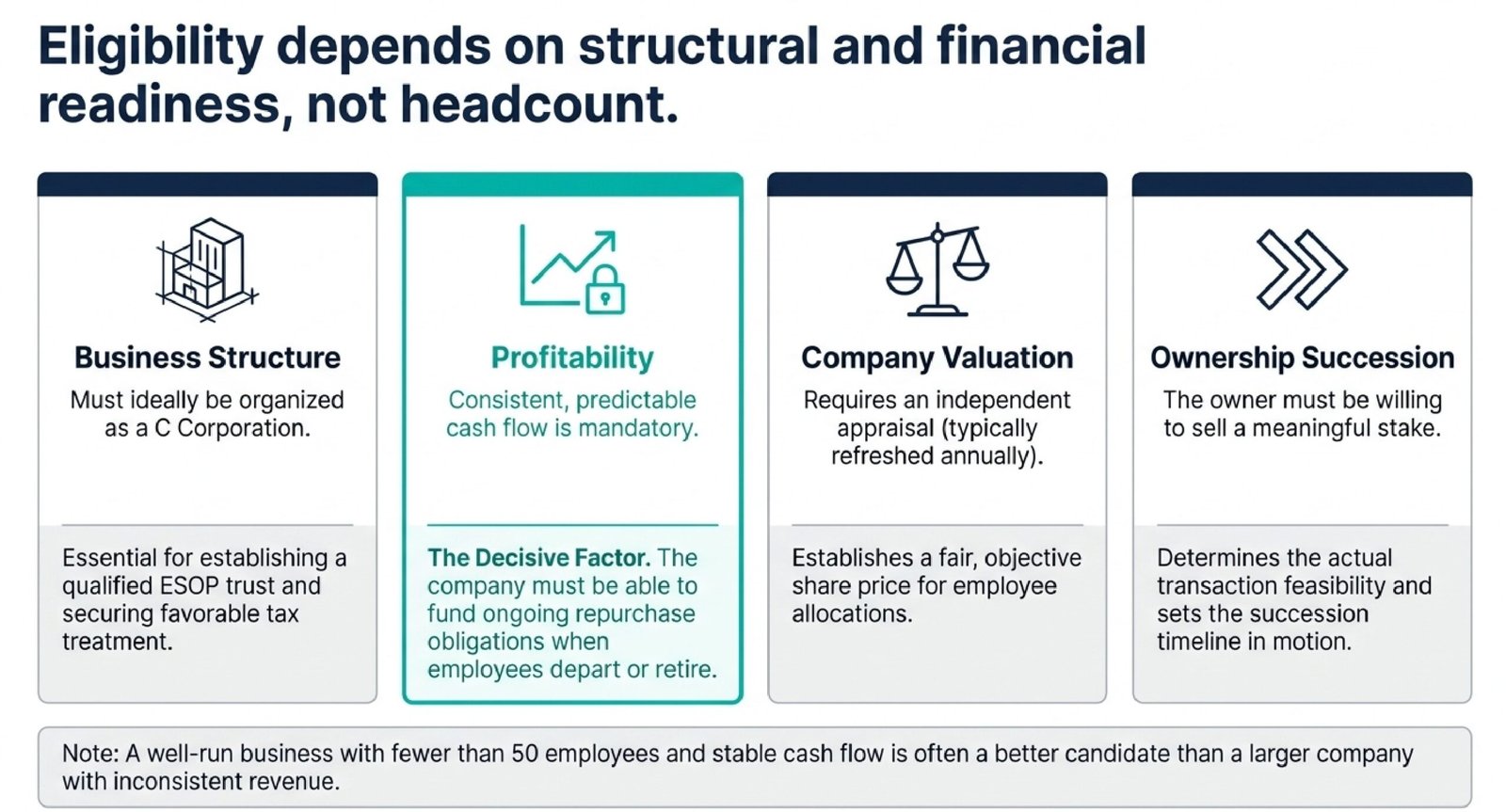
This is a helpful initial checklist for anyone considering an ESOP for the first time, and the following table outlines the key factors that a small business must meet before this option is a viable one. By going through this checklist at the beginning of a discussion with a business owner, the realistic expectations of the time and expenses that will be required are established before enthusiasm for the benefits overshadows a realistic evaluation of the feasibility. For many advisors, it’s helpful to go through this table line by line at the initial consultation to help the business owner self-evaluate before investing time or money in a feasibility study. If owners are able to see these factors, as opposed to just hearing them in a verbal meeting, it also helps them retain the information better and come back to the next conversation with specific questions. 

Table 1: ESOP Eligibility for Small Companies at a Glance – Can Small Businesses Offer ESOPs?
Eligibility Factor Typical Requirement Why It Matters
Business structure Must be a C corporation for a qualified ESOP trust Determines available tax treatment
Profitability Consistent cash flow to fund repurchases Supports the repurchase obligation
Company valuation Independent appraisal, typically annual Sets fa air share price for employees
Ownership succession plan Owner willing to sell a meaningful stake Determines transaction feasibility

While the number of employees is a factor in determining eligibility, the structural and financial preparedness of the business is a more important consideration than the number of employees, as shown in the table (which is often unexpected by small business owners who think that ESOPs won’t be available until their company becomes much larger). A well-managed business that has been profitable for several years, and that has forty or fifty employees is usually in a better position to sustain an ESOP than a much larger company with inconsistent cash flow or large existing debts. 

What Are Five Key Steps to Setting Up ESOP for SMEs?

A small business that is being shepherded through this process by professionals can follow an orderly procedure instead of conceiving plan formation as the one-time filing of the document. The five steps outlined below are a process that an ESOP Advisory team often utilizes when working with a business from start to finish.

First, do a feasibility study to analyse cash flow, company valuation, and owner’s succession plan to test the financial viability of an ESOP before legal efforts start, as this early analysis will determine if an ESOP is feasible. Second, appoint a trustee, either a team member or someone outside the organization, to represent plan members and manage the continued operation of the trust, a role that is far from trivial and should not be taken lightly. Third, hire an independent valuation of the company, because the value of shares owned by employees must be reflective of the company and this will normally need to be updated every year thereafter, so the cost of this needs to be factored into the company’s ongoing budget from the beginning. Fourth, identify the formula and vesting structure for the plan, which are a balance between generosity toward employees and the company’s ability to support the plan on a sustainable long-term basis; a formula that may look good in theory can become unsustainable by simply failing to stress-test the long-term cash flow projections. Fifth, be very clear with employees about the plan; if employees don’t understand what’s occurring, how it affects their retirement savings, and how they canbetters their performance to help increase the value of their shares, then they will not truly feel engaged in the plan’s value. This last communication step is a very common error because, sometimes, business owners think that the financial aspect of the plan will be self-explanatory, but most employees require repeated plain-language explanations before they really grasp the concept of employee ownership. 

What Real-World Examples Show About ESOP for SMEs?

Imagine a professional services company founded by a well-known engineer that’s just starting to hire its 80th employee, whose founder is nearing retirement age and had no obvious successor in the family or among the existing leadership team — which is a reality for many professional services firms that have been established over a single career. Instead, the founder engaged an advisory team to develop an ESOP and, over aseveral-yearr period, transferred his ownership to the people who would become the new owners, allowing both the founder and the staff time to adjust to the new ownership dynamics than a sudden and disruptive shift in leadership. The employees witnessed a marked change in the culture of the workplace since the transition: They were more likely to recognise opportunities for cost savings and were more likely to assume responsibility for client relationships because when they realized they could save the company money, it directly benefited them more through the value of their shares than through an outside person. Later, the firm’s leadership noted that the transition also benefited their recruiting efforts as candidates considering job offers from other companies were drawn to the fact that they had a stake in the company, rather than only a retirement account that does not influence company performance.

In contrast, a small manufacturing firm entered an ESOP primarily as a retention strategy to address a challenging labour market in its area, not as a succession plan. They designed a small initial allocation based on years of tenure and performance, doing the opposite of what many companies would do, that is, making the plan as simple as possible, so as to avoid displacing the administrative burden on their small finance team, which leadership attributed to the fact that they had limited internal resources to handle a more complicated scheme. While the introduction of the plan saw a reduction in turnover of the production staff, there was a significant drop within two years of the plan’s introduction, but leadership also noted that the ongoing valuation and administration costs were greater than they had expected – hence, the importance of obtaining a realistic estimate of the costs of professional fees when considering ESOP for SMEs and not expecting these costs to be low merely because the company is small. Looking back, the company’s finance director said he would have preferred to hire a seasoned ESOP administrator at the outset, instead of attempting to run more of the process in-house to start, which may have prevented the company from going through some of the initial compliance hurdles that resulted in the extra feesin  the first eighteen months of the plan. 

What Are the Benefits and Challenges of Employee Ownership for Small Companies?

The advantages of employee ownership to small businesses are significant. In addition to the succession and retention, there have been numerous reports of companies with an ESOP having improved long-term productivity due to the fact that the employees who are working for the ESOP company think more like long-term owners than short-term workers, and apply that long-term thinking to decisions on equipment maintenance, client relationships, and cost control that a purely wage-based employee might not feel invested in. Tax benefits may also be significant based on the company’s organization and location, and an ESOP sale may be more tax efficient than a sale to another person outside the company. It’s one of the more rewarding forms of advisory work for any professional who is advising a small-business owner on a successful ESOP transition—preserving jobs and local ownership, instead of just brokering a simple third-party sale, and many professionals say it’s one of the most professionally fulfilling work they do in their careers. This is in part because of the highly visible and personal nature of the impact: A successful ESOP conversion directly results in a significant financial transformation for dozens or even hundreds of individual employees, not all of whom would otherwise have had the opportunity to be part of a viable business.

The problems, however, are not to be ignored. The legal, valuation and trustee expense of establishing and operating an ESOP can seem significant when compared to the size of a small company, especially in the initial years of the plan, prior to the accumulation of benefits. The repurchase obligation is a continuing financial burden, and if it is not properly factored into a firm’s cash flow, it can create significant problems, particularly when many of the longer-term employees retire at the same time—a situation that must be planned for, not assumed, by smaller companies. There’s a balance to plan design too—if the allocation formula is generous, then there may be a problem in the future with funding; if the formula is too conservative, there may be a problem with the engagement benefits that the company was looking for. Additionally, smaller finance departments may have a real staffing issue because it might be necessary for them to have support from outside the company, for example a specialist bookkeeper/controller to administer the plan, which increases the overall cost. The lesson for the new professionals in this area is that the ESOP is not a project that can be just set up and filed away, but it is an ongoing process of which the initial setup is merely a first step. Ongoing communication with the client, anda  reputation for a long-term relationship, as opposed to a one-time transactional service, can often make the difference between an advisor who is trusted to keep referring customers and one who is not. 

Can Small Businesses Offer ESOPs? : Conclusion 

Can ESOPs be offered to small businesses? Yes, if the company has the structural and financial requirements that allow for the practical consideration of eligibility for an ESOP by a small company, such as a supportive legal framework, the plan’s rationale for succession or retention and a stable cash flow. The practical lesson for business advisors, HR professionals or corporate finance specialists looking to advance their career in small business conversation is to do this with a ‘feasibility first’ mindset, and to explain to small business clients the true advantages of employee ownership and the long term administration and finance obligations that will need to be taken on before taking the next steps. When done right, an ESOP can be one of the most long-lasting methods for keeping your small business culture alive, paying your employees extra, and ensuring your business’s long term success, and those who can thoughtfully help owners navigate this process will have steady demand as more small and mid-sized businesses turn to it in the years to come. The more this generation of business owners approaches retirement, the more succession planning is becoming a critical focus point, and those who are attuned to the opportunity and the operational realities of employee ownership will be able to play a key role in helping these transitions succeed.
Frequently Asked Questions

Q1. Can small businesses offer ESOPs?

Yes. Small businesses can establish Employee Stock Ownership Plans (ESOPs) if they meet the necessary legal, financial, and administrative requirements. ESOPs can help attract talent, improve employee retention, and support business succession planning.

ESOPs can increase employee engagement, align staff interests with company performance, improve retention, and provide owners with a succession strategy. They may also offer tax advantages depending on the jurisdiction.

Setting up an ESOP typically involves determining eligibility, conducting a business valuation, creating the ESOP trust, drafting plan documents, and ensuring compliance with applicable regulations. Professional legal, financial, and valuation advice is recommended.

Yes. A professional business valuation is generally required to determine the fair market value of company shares. This helps ensure employees receive shares at an appropriate value and supports regulatory compliance.

Not always. An ESOP is most suitable for businesses with stable cash flow, long-term growth objectives, and owners who want to encourage employee ownership or plan for succession. Companies should evaluate their financial and operational readiness before implementing an ESOP.

Can Small Businesses Offer ESOPs?

Though employee stock ownership plans are typically linked to big, publicly traded businesses, they don’t necessarily characterise a large and increasing portion of the picture. While the how and why may be clear, many private business owners may be surprised to discover that there are structural and financial requirements that must be met for a business to qualify for ESOP for SMEs, and that even relatively small businesses can meet them. For junior and mid-level HR, finance and/or business advisory professionals, knowing more about the eligibility of small companies to establish an ESOP is a very handy skill to have, as smaller companies make up a significant percentage of new plan formations annually and may require more assistance and guidance from advisors than larger, better-resourced companies. This article shares how small companies can qualify, what employee ownership benefits look like in practice and what real companies have learned on their journey. 

Can Small Businesses Offer ESOPs?

Can Small Businesses Actually Qualify for ESOP Eligibility?

The answer is “yes,” but there are certain structural and financial requirements that small companies must satisfy to be eligible for an ESOP. An employee stock ownership plan is a qualified retirement benefit that is set up as a trust that holds company stock for the benefit of employees; establishing an ESOP mandates that the sponsoring company be organised in a manner that allows for this structure, most often as a C corporation, because many of the most favourable tax treatment provisions for ESOPS apply only to this entity type. While not necessarily excluded by the structure, these are likely to be harder to implement or have fewer tax benefits, and one of the first structural issues a professional must address with a business owner is whether they are eligible. In addition to the legal framework, the business must also have a consistent cash flow, as the company will eventually be called upon to buy back shares from some of its employees to replace those who depart or retire, and the timing of such repurchases may be difficult for a company that is not regularly profitable. This is often the most common mistake professionals make when getting their first exposure to a small business owner and advising them to invest in an ESOP; they think it is a legal or tax structuring mechanism, when it is often the financial factors of the business that determine whether the plan will work in the long run.

In reality, a small business of fewer than fifty employees can indeed sponsor an ESOP, and many do, but most often it makes sense to have an established pattern of profitability, a definite ownership succession requirement, and sufficient size to warrant the setup and maintenance costs of an ESOP. A startup that hasn’t yet reached the stage of predictability in revenue is typically not a good fit, not necessarily due to the requirement of the size of the ESOP, but because the financial health an ESOP needs simply does not exist yet, and an early ESOP may cause more harm than good for the business andemployeese. For professionals giving advice to smaller companies, this initial step will always be to determine if the financial profile of the company will allow for the continued repurchase commitment before diving into the details of plan design. As an honest result of this assessment, it’s not uncommon for an advisor to discover that a business isn’t ready for an ESOP. This is a very useful result for any advisor to come out with early since the ESOP is destined to become a strain on the company’s finances if the company is not ready to accept the repurchase commitment. 

What Employee Ownership Benefits Do Small Businesses Gain From an ESOP?

There are also many other advantages to employee ownership besides the retirement savings aspect that most consider when considering these plans. An ESOP provides a succession plan that keeps the business independent without selling it to a competitor or a private equity partner that might change management or move jobs, something that a small business owner approaching retirement may find hard to accept after having developed the business from scratch over the years. Ownership can be expected to provide a direct financial connection between individual contribution and company success, leading to increased employee engagement, reduced employee turnover and a greater sense of collaboration among the company’s workforce, according to many small business owners. This effect may be even more pronounced than in smaller organizations as compared to large corporations, because employees at a fifty-person firm may be able to see a much stronger relationship between their own efforts and the firm’s performance than a worker in a large multi-division organisation. The feedback loop of a small manufacturer’s production employee who implements a process improvement that shows up in the annual valuation of the company is much more tangible and easier to see than it is for a smaller individual contributor in a larger organisation.

This is a helpful initial checklist for anyone considering an ESOP for the first time, and the following table outlines the key factors that a small business must meet before this option is a viable one. By going through this checklist at the beginning of a discussion with a business owner, the realistic expectations of the time and expenses that will be required are established before enthusiasm for the benefits overshadows a realistic evaluation of the feasibility. For many advisors, it’s helpful to go through this table line by line at the initial consultation to help the business owner self-evaluate before investing time or money in a feasibility study. If owners are able to see these factors, as opposed to just hearing them in a verbal meeting, it also helps them retain the information better and come back to the next conversation with specific questions. 

Table 1: ESOP Eligibility for Small Companies at a Glance – Can Small Businesses Offer ESOPs?
Eligibility Factor Typical Requirement Why It Matters
Business structure Must be a C corporation for a qualified ESOP trust Determines available tax treatment
Profitability Consistent cash flow to fund repurchases Supports the repurchase obligation
Company valuation Independent appraisal, typically annual Sets fa air share price for employees
Ownership succession plan Owner willing to sell a meaningful stake Determines transaction feasibility

While the number of employees is a factor in determining eligibility, the structural and financial preparedness of the business is a more important consideration than the number of employees, as shown in the table (which is often unexpected by small business owners who think that ESOPs won’t be available until their company becomes much larger). A well-managed business that has been profitable for several years, and that has forty or fifty employees is usually in a better position to sustain an ESOP than a much larger company with inconsistent cash flow or large existing debts. 

What Are Five Key Steps to Setting Up ESOP for SMEs?

A small business that is being shepherded through this process by professionals can follow an orderly procedure instead of conceiving plan formation as the one-time filing of the document. The five steps outlined below are a process that an ESOP Advisory team often utilizes when working with a business from start to finish.

First, do a feasibility study to analyse cash flow, company valuation, and owner’s succession plan to test the financial viability of an ESOP before legal efforts start, as this early analysis will determine if an ESOP is feasible. Second, appoint a trustee, either a team member or someone outside the organization, to represent plan members and manage the continued operation of the trust, a role that is far from trivial and should not be taken lightly. Third, hire an independent valuation of the company, because the value of shares owned by employees must be reflective of the company and this will normally need to be updated every year thereafter, so the cost of this needs to be factored into the company’s ongoing budget from the beginning. Fourth, identify the formula and vesting structure for the plan, which are a balance between generosity toward employees and the company’s ability to support the plan on a sustainable long-term basis; a formula that may look good in theory can become unsustainable by simply failing to stress-test the long-term cash flow projections. Fifth, be very clear with employees about the plan; if employees don’t understand what’s occurring, how it affects their retirement savings, and how they canbetters their performance to help increase the value of their shares, then they will not truly feel engaged in the plan’s value. This last communication step is a very common error because, sometimes, business owners think that the financial aspect of the plan will be self-explanatory, but most employees require repeated plain-language explanations before they really grasp the concept of employee ownership. 

What Real-World Examples Show About ESOP for SMEs?

Imagine a professional services company founded by a well-known engineer that’s just starting to hire its 80th employee, whose founder is nearing retirement age and had no obvious successor in the family or among the existing leadership team — which is a reality for many professional services firms that have been established over a single career. Instead, the founder engaged an advisory team to develop an ESOP and, over aseveral-yearr period, transferred his ownership to the people who would become the new owners, allowing both the founder and the staff time to adjust to the new ownership dynamics than a sudden and disruptive shift in leadership. The employees witnessed a marked change in the culture of the workplace since the transition: They were more likely to recognise opportunities for cost savings and were more likely to assume responsibility for client relationships because when they realized they could save the company money, it directly benefited them more through the value of their shares than through an outside person. Later, the firm’s leadership noted that the transition also benefited their recruiting efforts as candidates considering job offers from other companies were drawn to the fact that they had a stake in the company, rather than only a retirement account that does not influence company performance.

In contrast, a small manufacturing firm entered an ESOP primarily as a retention strategy to address a challenging labour market in its area, not as a succession plan. They designed a small initial allocation based on years of tenure and performance, doing the opposite of what many companies would do, that is, making the plan as simple as possible, so as to avoid displacing the administrative burden on their small finance team, which leadership attributed to the fact that they had limited internal resources to handle a more complicated scheme. While the introduction of the plan saw a reduction in turnover of the production staff, there was a significant drop within two years of the plan’s introduction, but leadership also noted that the ongoing valuation and administration costs were greater than they had expected – hence, the importance of obtaining a realistic estimate of the costs of professional fees when considering ESOP for SMEs and not expecting these costs to be low merely because the company is small. Looking back, the company’s finance director said he would have preferred to hire a seasoned ESOP administrator at the outset, instead of attempting to run more of the process in-house to start, which may have prevented the company from going through some of the initial compliance hurdles that resulted in the extra feesin  the first eighteen months of the plan. 

What Are the Benefits and Challenges of Employee Ownership for Small Companies?

The advantages of employee ownership to small businesses are significant. In addition to the succession and retention, there have been numerous reports of companies with an ESOP having improved long-term productivity due to the fact that the employees who are working for the ESOP company think more like long-term owners than short-term workers, and apply that long-term thinking to decisions on equipment maintenance, client relationships, and cost control that a purely wage-based employee might not feel invested in. Tax benefits may also be significant based on the company’s organization and location, and an ESOP sale may be more tax efficient than a sale to another person outside the company. It’s one of the more rewarding forms of advisory work for any professional who is advising a small-business owner on a successful ESOP transition—preserving jobs and local ownership, instead of just brokering a simple third-party sale, and many professionals say it’s one of the most professionally fulfilling work they do in their careers. This is in part because of the highly visible and personal nature of the impact: A successful ESOP conversion directly results in a significant financial transformation for dozens or even hundreds of individual employees, not all of whom would otherwise have had the opportunity to be part of a viable business.

The problems, however, are not to be ignored. The legal, valuation and trustee expense of establishing and operating an ESOP can seem significant when compared to the size of a small company, especially in the initial years of the plan, prior to the accumulation of benefits. The repurchase obligation is a continuing financial burden, and if it is not properly factored into a firm’s cash flow, it can create significant problems, particularly when many of the longer-term employees retire at the same time—a situation that must be planned for, not assumed, by smaller companies. There’s a balance to plan design too—if the allocation formula is generous, then there may be a problem in the future with funding; if the formula is too conservative, there may be a problem with the engagement benefits that the company was looking for. Additionally, smaller finance departments may have a real staffing issue because it might be necessary for them to have support from outside the company, for example a specialist bookkeeper/controller to administer the plan, which increases the overall cost. The lesson for the new professionals in this area is that the ESOP is not a project that can be just set up and filed away, but it is an ongoing process of which the initial setup is merely a first step. Ongoing communication with the client, anda  reputation for a long-term relationship, as opposed to a one-time transactional service, can often make the difference between an advisor who is trusted to keep referring customers and one who is not. 

Can Small Businesses Offer ESOPs? : Conclusion 

Can ESOPs be offered to small businesses? Yes, if the company has the structural and financial requirements that allow for the practical consideration of eligibility for an ESOP by a small company, such as a supportive legal framework, the plan’s rationale for succession or retention and a stable cash flow. The practical lesson for business advisors, HR professionals or corporate finance specialists looking to advance their career in small business conversation is to do this with a ‘feasibility first’ mindset, and to explain to small business clients the true advantages of employee ownership and the long term administration and finance obligations that will need to be taken on before taking the next steps. When done right, an ESOP can be one of the most long-lasting methods for keeping your small business culture alive, paying your employees extra, and ensuring your business’s long term success, and those who can thoughtfully help owners navigate this process will have steady demand as more small and mid-sized businesses turn to it in the years to come. The more this generation of business owners approaches retirement, the more succession planning is becoming a critical focus point, and those who are attuned to the opportunity and the operational realities of employee ownership will be able to play a key role in helping these transitions succeed.
Frequently Asked Questions

Q1. Can small businesses offer ESOPs?

Yes. Small businesses can establish Employee Stock Ownership Plans (ESOPs) if they meet the necessary legal, financial, and administrative requirements. ESOPs can help attract talent, improve employee retention, and support business succession planning.

ESOPs can increase employee engagement, align staff interests with company performance, improve retention, and provide owners with a succession strategy. They may also offer tax advantages depending on the jurisdiction.

Setting up an ESOP typically involves determining eligibility, conducting a business valuation, creating the ESOP trust, drafting plan documents, and ensuring compliance with applicable regulations. Professional legal, financial, and valuation advice is recommended.

Yes. A professional business valuation is generally required to determine the fair market value of company shares. This helps ensure employees receive shares at an appropriate value and supports regulatory compliance.

Not always. An ESOP is most suitable for businesses with stable cash flow, long-term growth objectives, and owners who want to encourage employee ownership or plan for succession. Companies should evaluate their financial and operational readiness before implementing an ESOP.

Related Posts

Everything You Need to Know About ESOP Valuation with Valueteam

Valueteam provides expert ESOP valuation services to ensure fairness, compliance, and value optimization for employees and shareholders.