How to Structure ESOP Pools for Investors and Funding
Introduction to How to Structure ESOP Pools for Investors and Funding
Equity is the most valuable currency on the table to any startup looking forward to its next round of financing. Of the numerous choices that founders have to make at the initial stages of the business, the ability to design an appropriate ESOP pool structure to startups is, perhaps, the most long-term. An Employee Stock Ownership Plan or ESOP is the structure that allows a company to set aside a share of its stock to entice, compensate and keep the individuals who will literally construct the business. This structure can make the difference between a clean cap table at the time of a Series A raise and the subsequent weeks of messaging the skeptical investors about the lack of a clean cap table.
The ESOP pool is a frequently neglected part, even though it is an important part, and founders will scramble to create the ESOP pool the week before they get a term sheet. Such a reactive means of approach generates unwarranted tension. The pool size and allocation methodology is looked at keenly by investors in due diligence since it directly impacts on their respective ownership percentage after investment. Well designed pool evokes a sense of operational maturity and a disorganized one raises questions of governance and planning.
The article is addressed to junior and mid-level professionals entering the startup ecosystem as an employee, as a future founder, or as a HR or finance practitioner and wish to have a practical, plain-language guide on how ESOP pools work, why they are important to investors and what best practice would be in practice in fundraising situations. These ideas are generalizable to technology startups in any location, whether it is a seed company or a later stage company that is raising subsequent rounds.
Understanding Investor Expectations in ESOP Pool Structuring for Funding Rounds
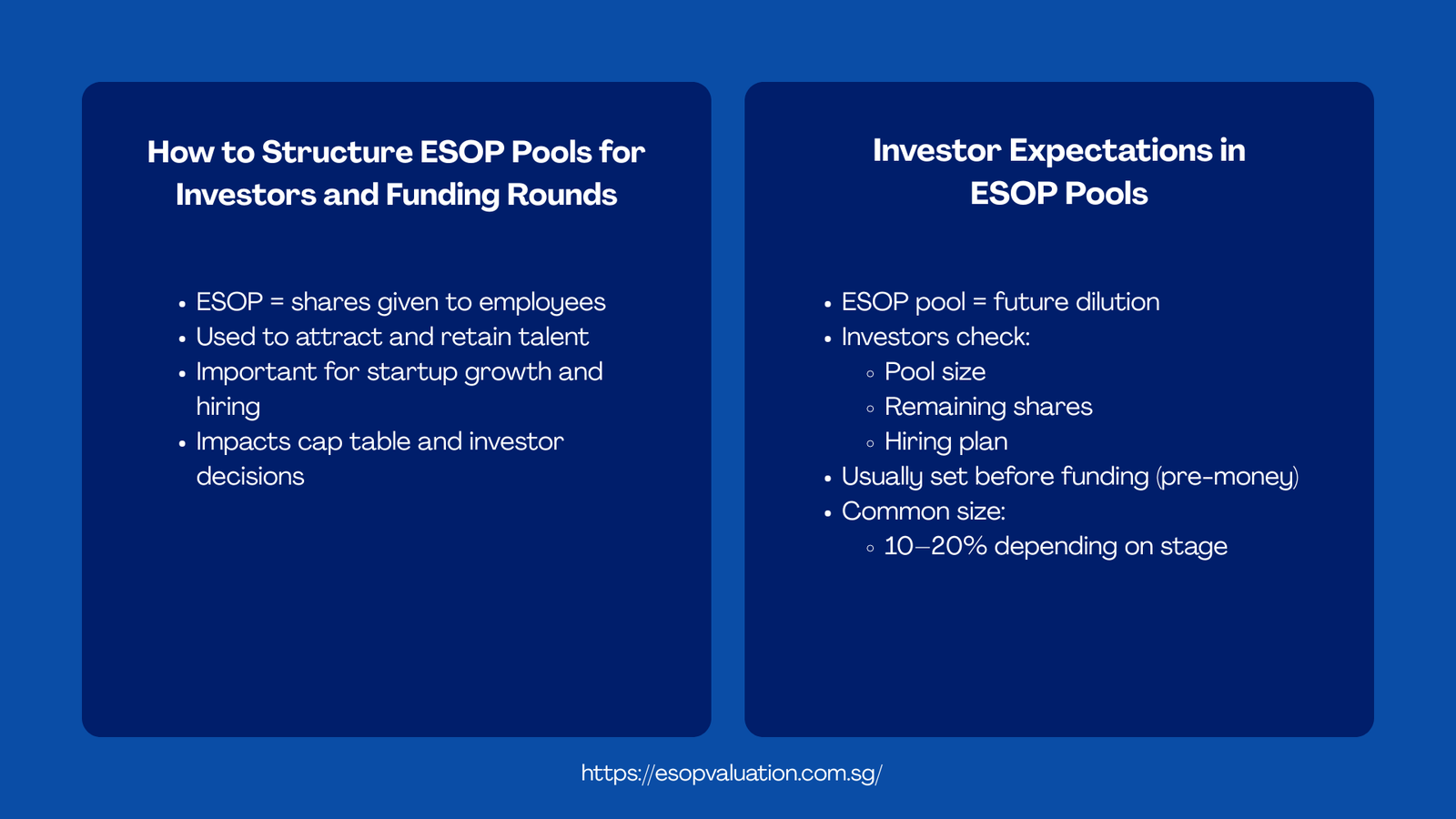
Cap table is among the documents that a venture capital firm will require when assessing a startup. In that cap table, the ESOP pool takes a special place since it is dilution already approved but yet to be issued. Investors would like to know: what is the size of the pool, who has been given options to date and what is the remaining pool size to serve future hires? The responses define their perception of the talent aspiration of the company and its financial discipline.
In this regard the mechanics of ESOP allocation prior to a financing round are of huge importance. Most venture-backed transactions involve the formation or filling up of the ESOP pool on a pre-money basis. It implies that the pool is formed prior to the arrival of new money invested by investors, and thus its dilutive impact is imposed on current sharesholders, mostly the founders, and not new investors. A lead investor demanding a 15 percent post-investment pool is tantamount to requesting founders to absorb all that dilution prior to the round closing. By learning about this dynamic, founders are able to negotiate out of an informed stance as opposed to a confused one.
The pool size contains a strategically encoded signal too. A small pool sends signals to the investors that the company is not able to attract competitively, and may imply that the founders are either underestimating the talent they will require, or are being peculiar with their own equity. Excessively big pool, in contrast, suggests over-dilution without a good hiring justification. The sweet spot, which is normally 10 to 20 percent depending on stage, is an indication that the founders have undertaken the headcount modelling and know what growth of their business will entail.
Table 1 : Typical ESOP Pool Sizes for Investors Across Startup Funding Rounds – How to Structure ESOP Pools for Investors and Funding
| Funding Stage | Typical ESOP Pool Size | Who Holds Most Options | Key Consideration |
| Pre-Seed / Seed | 10%–15% of cap table | Co-founders, early engineers | Keep pool lean; avoid over-dilution |
| Series A | 15%–20% of cap table | Senior hires, key management | Investor top-up likely required |
| Series B and beyond | 10%–15% refresh | Broader team, mid-level staff | Align vesting with retention goals |
A Step-by-Step Guide to Structuring ESOP Pools for Investors
How to design an ESOP pool to investors that actually works, i.e. meets the expectations of investors and at the same time does not sacrifice the upside of a founder or motivate employees, can be subdivided into five main steps.
Step 1: Develop a progressive recruiting strategy. Prior to establishing a pool size, founders ought to sketch out all senior hires they expect to require within the coming 18 to 24 months. This is not merely a headcount exercise but the estimation of the seniority, market rate and equity competitiveness of each position. An engineer who becomes a CTO of a series A company in London or Nairobi will receive quite a different grant than a junior engineer that joins the same company.
Step 2: Predict the effect of dilution. After the hire plan has been prepared, the number of options required must be stated as a percentage of the fully-diluted cap table- all the shares, convertible notes, and warrants issued. This calculation will make sure that founders are certain of the amount of dilution that the pool will cause and can make a convincing argument to investors to accept the size suggested.
Step 3: Select an appropriate ESOP vehicle. The various legal arrangements available, such as employee trusts, direct option plans, phantom equity arrangements, have varying tax, governance, and administrative consequences. Founders must engage the service of qualified lawyers. The Enterprise Management Incentive scheme is an important tax incentive scheme applicable to qualifying startups in markets like the United Kingdom. Incentive Stock Options have their equivalent in the United States, which is a benefit to eligible employees.
Step 4: Early board and investor congruence. Introducing the ESOP structure to current investors prior to a new round of funding and not in the middle of it, minimizes the chances of a last-minute renegotiation. Investors who already agreed on a pool size will be less inclined to ask a new lead investor to make radical changes when he or she comes to the table.
Step 5: Be effective in communicating with employees. Employees with option grants that they do not comprehend are those employees whose retention you have not in fact attained. HR and founders ought to invest in plain-language clarifiers, individually talking about vesting plans and open-ended explanations of what options do in a change-of-control situation.
Process Flow 1 : Step-by-Step Process to Structure ESOP Pools for Investors and Funding Rounds
| Step | Action | Output / Deliverable |
| 1 | Evaluate future 18-24 months recruiting. | Role seniority and headcount model. |
| 2 | Map options needed per role against total cap table Map options required. | Draft ESOP allocation schedule. |
| 3 | Seek legal advice as to ESOP vehicle (trust, direct, phantom). | Document of approved ESOP plans. |
| 4 | Submit proposed pool size to board and current investors to be approved. | Board resolution and revised cap table. |
| 5 | Disseminate plan to staff through grant letters and vesting plans. | Register of Board resolution and revised cap table. ESOP and signed grant agreements. |
ESOP Pool Allocation Strategy for Investors and Funding Rounds
One of the most feasible challenges to founders is timing the ESOP allotment prior to a funding round. The overall rule is simple: do not plan to consider your pool until a term sheet comes. Practically, the ESOP structure must be revisited at two natural points in time – about half a year to go before you intend to raise, and when negotiating the term sheet.
Six months prior to a raise will allow the company time to grant out any senior hires who ought to have been granted them previously, to sort out informal or undocumented pledges of equity, and to harmonize the vesting schedules and cliff periods. During due diligence, investors will demand all grant agreements, and discrepancy in the vesting terms among the various individuals is a popular red flag, which indicates ad hoc decision-making as opposed to principled decision-making.
The most important point of negotiation of a term sheet is whether top-up of the ESOP is post-money or pre-money and who dilutes. An adequately prepared founder will come into this discussion with a clear understanding of how much pool remains, how many months of pools of hiring that will cover, and what to top-up, or not to top-up, is actually necessary.
Table 2 : ESOP Pool Review Timeline for Investors After Funding Rounds
| Phase | Activity | Who Is Involved |
| Pre-term sheet | Assess the present pool utilisation and forecast on future grants required. | CEO, CFO, legal counsel |
| Term sheet negotiation | Concur on ESOP top-up size with lead investor; establish pre- or post-money basis. | Founders, lead investor, legal |
| Due diligence | Complete ESOP register, grant agreements and schedules of vesting. | Legal, investor’s due diligence team |
| Closing | Fix cap table to new pool; grant welcome grants of new employees. | CFO, cap table software provider |
Real-World Examples of How to Structure ESOP Pools for Investors and Funding Rounds
Take the case of a UK-based fintech company that completed a Seed round in 2019 of GBP 1.5 million with an ESOP pool of 10 percent of the cap table. By the time the company reached the point of raising its Series A (two years later) it had exhausted almost 9 percent of that pool to employ a CTO, two senior engineers, and a Head of Product. The other 1 percent was not enough that would draw the commercial and operations hires that the investor would see in post-money projections. The top-up was a 12 percent top-up which was required by the lead investor on a pre-money basis. The founders had not modelled this scenario and were taken by surprise and diluted more than they had envisioned. It was not the lesson that the pool was of wrong size at Seed, but that they never went back to the structure when they engaged in the fundraising process.
Compare to an East African e-commerce start-up, which established its initial ESOP pool at 15 percent in its Seed round and made a formal pool review after six months thereafter. In the event that the company issued a Series A, it would be able to prove to investors that 7 percent of the pool were already vested in 14 employees with a four-year vesting and one-year cliff, and that the remaining 8 percent was enough to fund the hiring plan that was attached to the new round. The top-up needed by the lead investor was not necessary. The clean, documented ESOP structure was mentioned specifically in the term sheet negotiation as one of the reasons why the investor was happy about the general governance of the business.
These two extremes suggest a trend that goes across markets and industries, the companies, which handle their ESOP pool actively, as a living tool, but not a one-time arrangement, invariably have an easier time raising money and with more favorable conditions. ESOP hygiene is construed by investors as a broader indicative of operational discipline.
Vesting Schedules and Common Pitfalls in ESOP Pools for Investors and Funding Rounds
The driver that renders an ESOP pool structure in the context of startups relevant in terms of retention is the vesting schedules. Four years with a one-year cliff is the most popular structure worldwide; when an employee has to stay at the company a minimum of 12 months, then all options are not vested and then monthly or quarterly over the remaining three years is the common structure. This design is equivalent to the employee tenure with the critical initial stages of a company growth and it is a good incentive to remain in an organisation.
Founders do not always stick to conventional vesting, however, in a manner that leads to future issues. Vesting acceleration Accelerated vesting (i.e. all the options are vested after a change of control) is a typical demand by senior hires and, when applied to too many people, can make an acquisition unattractive to buyers. Acquirers value the cost of the retention packages, and a firm in which a significant proportion of key employees have fully-vested options does not have as much inherent retention leverage. Likewise, offering options without a cliff to very early-employees as a form of appreciation and not a plan might leave the company with ex-shareholders that have significant equity but are not contributing meaningfully.
The other common trap in the way to develop an ESOP pool among investors is confusing the date of granting of options with the date of beginning the vesting. When an employee comes on in January, and his grant is not granted officially till June, the vesting clock must theoretically be reset to the true start date, although a board resolution will be needed and is frequently neglected in start-up firms. In due diligence, investors will ensure that there is consistency between the date of employment and the date of vesting, and that any differences are to be explained.
Table 3 : ESOP Vesting Schedules and Structures for Investors and Funding Rounds
|
Vesting Structure |
Typical Tenure | Cliff Period |
Best Suited For |
|
4-year / 1-year cliff |
48 months | 12 months | Engineering, product, ops |
|
3-year / 1-year cliff |
36 months | 12 months | Marketing, sales, BD roles |
|
Back-weighted (25/25/25/25+) |
48+ months | Optional |
Senior leaders, C-suite |
|
Performance-based |
Variable | Milestone-linked |
Sales teams, growth roles |
Conclusion: How to Structure ESOP Pools for Investors and Funding Rounds Successfully
Organizing an ESOP pool is not a single legal activity, it is a continuing strategic activity that cuts across talent, governance, and capital strategy. The basics remain unchanged regardless of whether you are a startup founder that needs to write your first plan or a finance expert that advises a company in the growth stage and needs to prepare its next raise. Herein lies what you are to learn.
Hiring model is a percent, not a start. The right pool size occurs as a result of a realistic perception of whom you must hire and the equity you might need to hire him/her. Founders who peg to some statistic, such as 15 percent, without performing the underlying analysis are either over- or under-reserving, both of which pose problems at the subsequent round.
Know the pre-money and post-money difference and negotiate. Pre-money ESOP allocation prior to a financing round is the norm in most markets, however the dilutive effect on founders is substantial. Non-negotiable preparation involves going into negotiations with information of how much of the pool has been drawn on, what top-up is really required, and what the fully-diluted impact would be to all parties.
Periodically (at least every six months) review your ESOP pool structure in case of startups. Markets shift, staffing strategies evolve and the type of equity package you would have offered to people who would be joining the firm in Month 18 of a financing round might not be the same as what you initially had set. Creating a semi-annual review of your financial calendar does not cost much and does not have to incur the rather costly shocks that crippled term sheet discussions.
Invest in training of employees. An option grant that an employee lacks an understanding of is an option grant that fails to retain an employee. In case you care about the inspirational power of equity, like you must, invest time in describing the mechanics of vesting, exercise options, and how the options may be valuable in different scenarios of exit.
Lastly, regard your ESOP register as a living document and keep it like you would your financial accounts. By establishing an ESOP pool to be looked at by investors you are not merely presenting them with a spreadsheet, you are showing them that your company is being run in a manner that is both disciplined and transparent enough to be worth investing in. The impression, by grant and decision, which that founder has formed, is among the strongest foundations which he can have.