Structuring ESOP Vesting for Employee Retention
Building Equity Programmes That Keep Your Best People
Introduction to Structuring ESOP Vesting for Employee Retention
Employee Stock Ownership Plans (ESOPs) are one of the most effective ways for organisations to build and retain a high-performing team. ESOPs, in essence, provide employees with a chance to become owners in the company – converting the employment relationship into a partnership. However, a successful ESOP is not only determined by the size of the grant, but also by the vesting schedule. So, understanding how to design ESOP vesting schedules for retention is a critical consideration for an organisation’s leadership team when developing a competitive compensation and benefits program.
Vesting is how an employee accrues the right to the shares she is awarded. A good vesting schedule provides a long-term incentive to remain, to work hard, and to concern oneself with long-term company performance. A badly structured one can be a short-term retention policy, but can lead to longer-term disengagement, or worse, encourage people to leave immediately after their cliff date. Getting this right is critical for those involved in workforce strategy and planning, total rewards, and senior remuneration.
This article is for entry- to mid-career HR, financial, legal, or business strategy practitioners who are interested in learning more about ESOP vesting. It explores the fundamentals of designing vesting schedules, the types of schedules available, how it is implemented, examples, and what we can learn from them, and the common pitfalls organisations face. Our aim is to not only impart knowledge but also offer approaches that can be used in the workplace.
Why Vesting Structure Is a Strategic Retention Tool
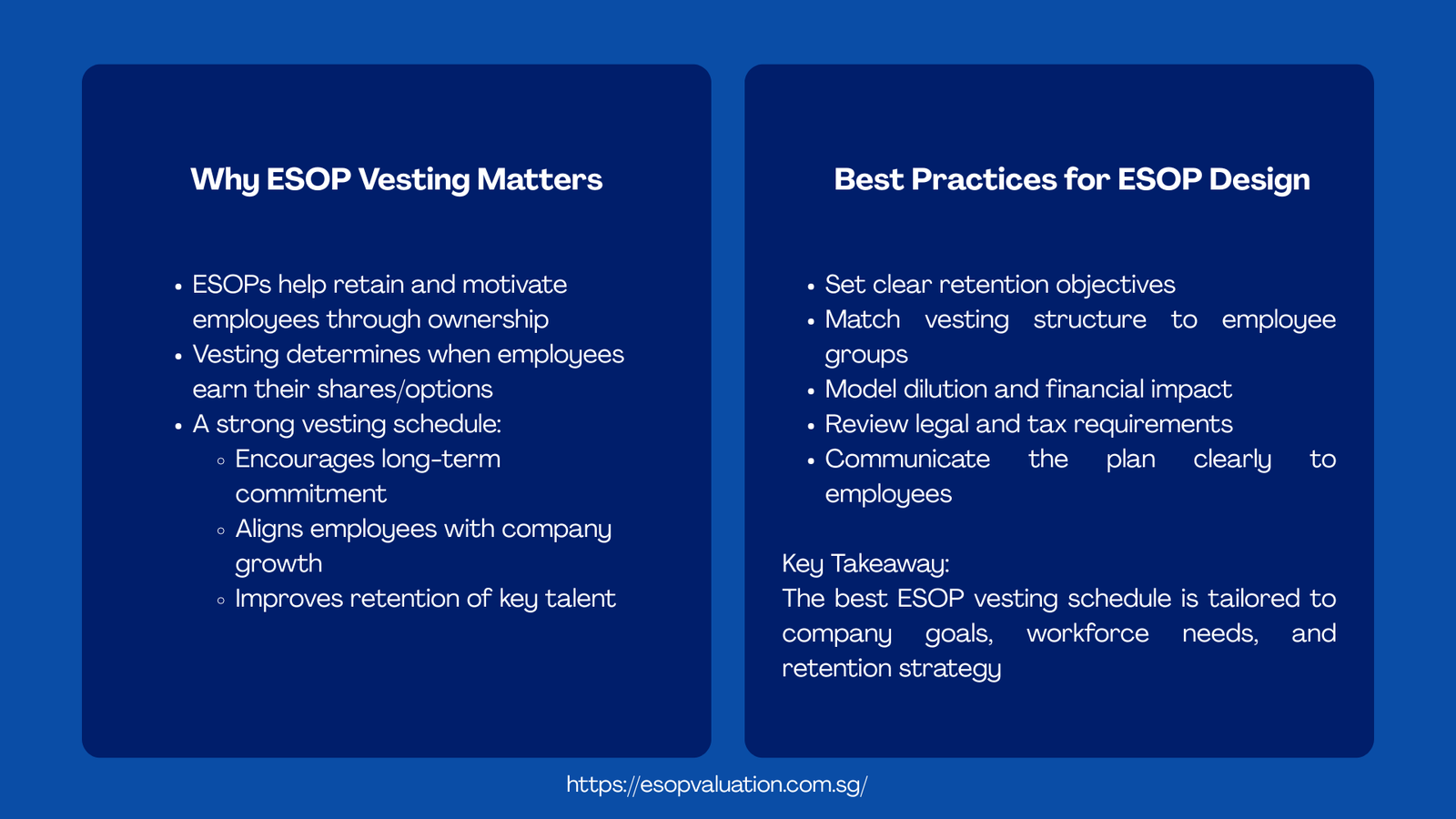
For many people who encounter ESOPs for the first time, the vesting schedule is merely something to be checked off in the contract – a legal formality. But the vesting schedule is the key instrument to deliver retention value in an ESOP. There is no standard best ESOP vesting schedule for retention; it is a conscious design decision based on the company’s retention strategy, phase of growth, and roles they are looking to retain.
The economic principles are simple. When an employee is awarded options with a four-year vesting schedule, the longer she or he stays with the company, the more unvested equity is created. This “golden handcuff” is strongest towards the middle of the vesting period – when a substantial amount has been earned, but some is still to be won. Organisations that recognise this tendency ensure their vesting schedules have the maximum retention effect at the point where the risk of turnover is greatest – usually around 2-3 years, when employees are open to offers from other companies or to re-evaluate their career plans.
Vesting schedules also communicate to employees. An organisation with a four-year vesting period and a one-year cliff is signalling its corporate culture by saying that it wants its employees to stick around. A company that provides immediate vesting may offer flexibility, but at the cost of the retention incentive. These messages are important when the company is hiring, in the induction process, and in employees’ perceptions of their long-term prospects. Vesting structures are, therefore, a matter of values.
Core ESOP Vesting Models and Their Best Use Cases
When businesses are looking at planning for long-term employee retention (such as through an ESOP), they have a number of structural options for vesting, each with its unique advantages and disadvantages. The most popular structures are cliff, graded (or linear), back-loaded, milestone, and hybrid vesting structures.
The simplest approach is cliff vesting: there is no vesting until a certain date, when a large percentage (or all) of the grant becomes vested. Many jurisdictions have a standard one-year cliff (an employee has to work for the company for a year before any options are exercisable). Cliff structures are often used in early-stage start-ups, as the company wants to get a quick read on whether a new employee is going to work out, before granting significant equity. But the danger of the cliff is that it can create an exodus of employees immediately following the time that the cliff vests. That’s why cliff schedules are typically followed by a graded schedule.
Graded (or linear) vesting is a schedule of equal equity releases – such as 25% annually for four years. This provides a steadier pull to stay over the vesting period, as opposed to a single event. Back-loaded vesting is a more aggressive form, in which the early tranches are smaller and later tranches larger to increase the retention pull as time passes. This table outlines these structures, as well as milestone-based and hybrid structures, which are becoming more popular in performance-driven organisations.
| Schedule Type | Typical Structure | Best For | Key Retention Effect |
|---|---|---|---|
| Cliff Vesting | 100% at the end of the cliff (e.g., Year 3) | Start-ups looking for a time commitment | High retention for 3 years; possible cliff exit |
| Graded / Linear Vesting | Sprinkling (e.g., 25% a year for 4 years) | Established companies want steady retention incentives | Motivation over the vesting period |
| Back-Loaded Vesting | Smaller early tranches, larger later (e.g., 10/20/30/40%) | Organisations wanting to keep key/skilled staff longer | Makes later years most attractive; fosters tenure |
| Milestone-Based Vesting | Vesting tied to performance and/or completion of a project | High-performance organisations; pay of CEOs | Performance-based retention; not time-based |
| Hybrid Vesting | Time and performance conditions (in a combined formula) | Companies with retention and performance objectives | Customizable; recognises both tenure and performance |
Table 1: Comparison of ESOP Vesting Structures and Retention Impact
Five-Step Framework for Designing Effective ESOP Vesting
To understand how to structure ESOP vesting for retention, it’s important to take the knowledge from an idea to a design process. The next five steps are the essence of this process, whether you are designing or redesigning an ESOP.
Step 1: Decide on the Retention Goals
The organisation needs to determine the retention issue it is addressing before it determines the type of vesting. Is the retention problem about retaining new hires before they become fully productive? Is it about holding onto the “long-term” employees who have a solid understanding of the company? Or is it about getting a large employee population to have a long-term focus on performance? Use cases drive designs. A company looking to safeguard a group of recently-employed engineers might value a front-loaded cliff to make an immediate commitment signal, whereas a company wanting to retain employees with a long tenure may prefer a back-loaded approach to emphasise the effects of tenure.
Step 2: Classify Employees
Some roles are more challenging to retain and more important to the organisation’s long-term than others. An effective ESOP will have different segments of employees with different vesting arrangements – for example, the CEO may have a more back-loaded vesting period, middle managers a standard four-year graded vesting, and new hires smaller or milestone-based grants. Segmentation also enables the plan to be aligned with market standards for each segment of roles. For tech companies, for instance, four-year vesting with a one-year cliff is a market standard for engineering and product staff – going against this can impact the employer’s talent market position.
Step 3: Scenario the Accounting & Dilution Impact
ESOP design impacts the balance sheet. Vesting and exercise of options will dilute the existing shareholders’ equity. The finance team should model dilution effects (at different take-up and exercise scenarios) before agreeing on the vesting schedule. This should include modelling to ensure the equity pool is able to sustain expected headcount growth and attrition. An unsustainable plan – because it was not modelled with these considerations in mind – will lead to internal tensions and also possible restructuring in the future. Similarly, modelling exercise windows and tax treatment now avoids issues at the time of exercise.
Step 4: Review Legal and Tax in Each Jurisdiction
ESOP laws vary from one jurisdiction to another, and tax treatment of the options (at grant, vesting, and exercise) affects the attractiveness of the plan to employees. In some jurisdictions, for example, favourable tax treatment is only obtained if the plan takes a particular form in terms of the length of the vesting period, the exercise price, and plan administration. It is important to seek input from legal and tax professionals knowledgeable about the specific jurisdiction on plan structure prior to finalising and communicating. This is something that can be overlooked in early-stage companies to their detriment.
Step 5: Effectively Communicate the Programme
No matter how well-designed the vesting structure is, it will not be an effective retention measure if not communicated effectively. Research indicates that, among other problems, many ESOP participants lack a basic understanding of how options work, their current value, and the criteria needed to vest. Simpler documents, regular statements reporting unvested equity balances, modelling tools that enable employees to calculate likely outcomes for various exit approaches, and training for managers, so that they can communicate effectively, are all part of good communication strategies. Companies that take the use of ESOP vesting strategies for long-term employee retention seriously regard education as a long-term rather than one-off process.
ESOP Vesting Design Process
| Define Goals Retention, alignment, culture | ▶ | Segment Roles Senior, mid, and entry-level needs | ▶ | Model Scenarios Cliff, graded, hybrid options | ▶ | Legal & Tax Review Jurisdiction-specific rules | ▶ | Communicate & Launch Education, documentation |
Flowchart 1: ESOP Vesting Design and Implementation Framework
Employee Vesting Journey
| Grant Date Options awarded at the strike price | ▶ | Cliff / Tranche 1 First portion vests; retention lock-in | ▶ | Progressive Vesting Ongoing tranches build ownership stake | ▶ | Full Vest All options exercisable; peak incentive | ▶ | Liquidity Event IPO, acquisition, buyback |
Flowchart 2: Employee Equity Vesting Lifecycle
Case Studies: ESOP Vesting Strategies in Practice
The best lessons for those seeking to understand how to deploy different ESOP vesting strategies for long-term retention come from case studies in how organisations have implemented such strategies. The cases below are based on industry trends and published cases from various industries and organisational life cycles.
The most well-known case of a successful ESOP vesting structure is that adopted by early-stage technology companies in Silicon Valley in the 1990s and 2000s – the four-year graded vesting with a one-year cliff. Structures like Google and Facebook used during their growth periods not only as a retention mechanism but also as a skill signal: the ability to join a company with a significant amount of equity on a vesting schedule sends a clear signal that the company expects to grow substantially and that it is in the business of long-term relationships rather than short-term employment. This design has become the default for technology start-ups around the world – and is so for a reason. In terms of professionals grasping the best ESOP vesting schedule to retain talent in high-growth settings, for the time being, the four-year gradual structure with a one-year cliff is the most tested and proven.
A counterexample is the well-documented phenomenon in the Australian mining industry that saw a number of medium-sized mining services companies experiment with three-year cliff vesting in the early 2010’s – due to a need to retain technical employees for the duration of major mining projects. The early results were promising: there was a significant reduction in attrition during the cliff period. But many individuals left in the three to six-month period following the cliff date (and the vested options). Exit interviews showed that many employees had their departure date “pre-booked” some time before the cliff date. The takeaway was that a cliff-based plan, by itself, addresses the short-term retention challenge, but actually creates an attrition cliff. Today, firms in project-driven industries have switched to a combination of a cliff and a post-cliff graded schedule – a “longer retention pull” of the cliff.
A third, telling example comes from a UK financial services company that added a performance-based vesting component to the senior advisory team in 2018. In addition to time-based vesting, a fraction of each grant was linked to individual retention and revenue targets for their clients. The aim of the design was good – linking equity rewards to the firm’s priorities. However, the performance conditions were seen as less transparent, less controllable, and more frustrating, and ironically, resulted in increased attrition among the very senior individuals that the equity retainer program was aimed at. The take-away from this is that the performance conditions need to be well articulated, within the employee’s control, and subject to review. If employees lack a reasonable belief in the connection between effort and vesting, the retention value of the award is greatly reduced.
Common ESOP Vesting Pitfalls and How to Avoid Them
Despite care being taken with how to structure ESOP vesting for employee retention, there are common issues that organisations face. They can be expected to minimise later redesigns.
A post-cliff attrition problem (described in the case studies above) is the most frequent. It can almost always be avoided by the inclusion of a second form of vesting or a refresh grant option. Refresh grants are new grants of equity given to high-performing employees while they are still in their existing vesting period, and act to reset the unvested equity balance, prolonging the retention pull. These days, many of our large technology clients have annual or biannual refresh cycles, which means that every high performer will always have a substantial amount of unvested equity – making the decision of “should I leave?” skewed in favour of “stay”.
The second problem is the vagueness of the value of private company equity. The lack of a clear price for private company shares (unlike public companies) can make it challenging for employees to value their options. This can diminish the value of the equity grant (especially for those employees not familiar with equity). To overcome this, employers can conduct periodic independent valuations (equivalent to a 409A valuation in the US) and report key financial data that allows employees to make their own assessments of future performance, and explain typical options exit scenarios when employees are initially granted options and at annual performance reviews.
A third issue, most relevant for HR and finance practitioners in expanding firms, is the administrative burden of an ESOP as the number of employees grows. Maintenance of the capitalisation table, option accounting, tax filings, and managing exercises and forfeitures becomes more complex over time. Investing early in equity management software (and training the internal resource to manage it) stops the administration of the ESOP programme from becoming a roadblock to faster grants and maintaining the credibility of the programme. The table below outlines these and other issues and how to address them.
| Challenge | Why It Happens | Practical Mitigation |
|---|---|---|
| Post-cliff attrition | Employees leave at the time of the cliff vesting | Combine the cliff with the second graded or the refresh grant |
| Perceived complexity | Employees don’t grasp how their options work | Provide education and annual reviews (in layman’s terms) |
| Valuation uncertainty | There is no established value of shares in private companies | Offer frequent 409A (or other) valuations and exit options |
| Tax timing mismatch | Taxes are due before options can be exercised | Manage exercise periods; consider cashless exercises |
| Dilution concerns | Current shareholders don’t want to expand the equity pool | Explain the talent return on investment (ROI) of ESOP; model dilution |
Table 1: Key ESOP Vesting Risks and Mitigation Strategies
Effective ESOP Vesting Design
When designing an ESOP to retain talent, it’s important to be disciplined, work across functions, and understand the needs of the people the organisation needs to retain. The optimal ESOP vesting schedule for retention is never a “one size fits all” approach; it is a carefully crafted design that is aligned with the company’s stage of development, employee demographics, the prevailing market conditions, and legal environment.
The best place to start for professionals early in their careers in this field is to understand the key design structures – cliff, graded, back-loaded, milestone-linked, and hybrid – and how the retention needs of each structure apply in different scenarios. This knowledge will equip you to participate in plan design discussions, even if the technical aspects are outsourced to advisers and/or an internal technical team.
For more senior or more advisory roles, the key learning from both research and practice is that communication and education matter. An ESOP that is well understood by employees is a much more valuable instrument to create employee engagement and retention than an otherwise identical plan that employees don’t understand. Well-invested time and money in ongoing education and communication sessions, easy-to-use modelling tools, and manager training is not a cost centre; it is a key part of the return on investment in the plan. This is the nuts and bolts of ESOP vesting strategies for retention: the vesting schedule establishes the financial incentive, but the communication establishes the psychological buy-in and retention.
Finally, revisit and refresh. Investment markets change, hiring market practices change, and your employee composition changes. What was an optimal ESOP three years ago may not be optimal today. To prevent the ESOP from becoming a historical institution that does not fit the organisation, we include a regular review process, either annually or in the lead up to significant headcount events. So, how to design ESOP vesting for employee retention is really an ongoing process.