How ESOP Dilution Affects Existing Shareholders and Company Valuation
A Practical Guide for Finance and Business Professionals
Introduction to How ESOP Dilution Affects Existing Shareholders and Company Valuation
ESOPs or the Employee Stock Option Plans are nowadays one of the most trendy tools that companies employ to attract, retain and motivate talent. ESOPs, by allowing employees to buy shares at a predetermined price in the future, equate individual performance to growth in the company. However, to current shareholders, there is a significant and indeed underreported implication to ESOP dilution on shareholders. It is imperative that anyone dealing with equity management, analysis of investment or career planning in any equity-compensated positions must understand how this works.
Dilution is defined as the issuance of new shares or the reserve to be issued, which results in an increase in the number of shares, and hence the proportional ownership of existing shareholders is diluted. Although a certain level of dilution is a normal aspect of operating a growth-based business, the scope of such dilution and the timing of such dilution is huge. Founders and institutional investors also question the extent to which the cap table is reserved to issue option pools and the responsible approach to issuing them.
This article disaggregates the mechanics of stock option dilution of employees in simple language — it takes a step-by-step walk-through of how the dilution process works, its impact on valuation, what can go wrong and what good governance is. These concepts will guide you towards making better decisions, whether you are a finance analyst, a startup employee in a job offer you are weighing, or a mid-level manager trying to comprehend your equity package.
The Mechanics of ESOP Dilution and Shareholder Ownership
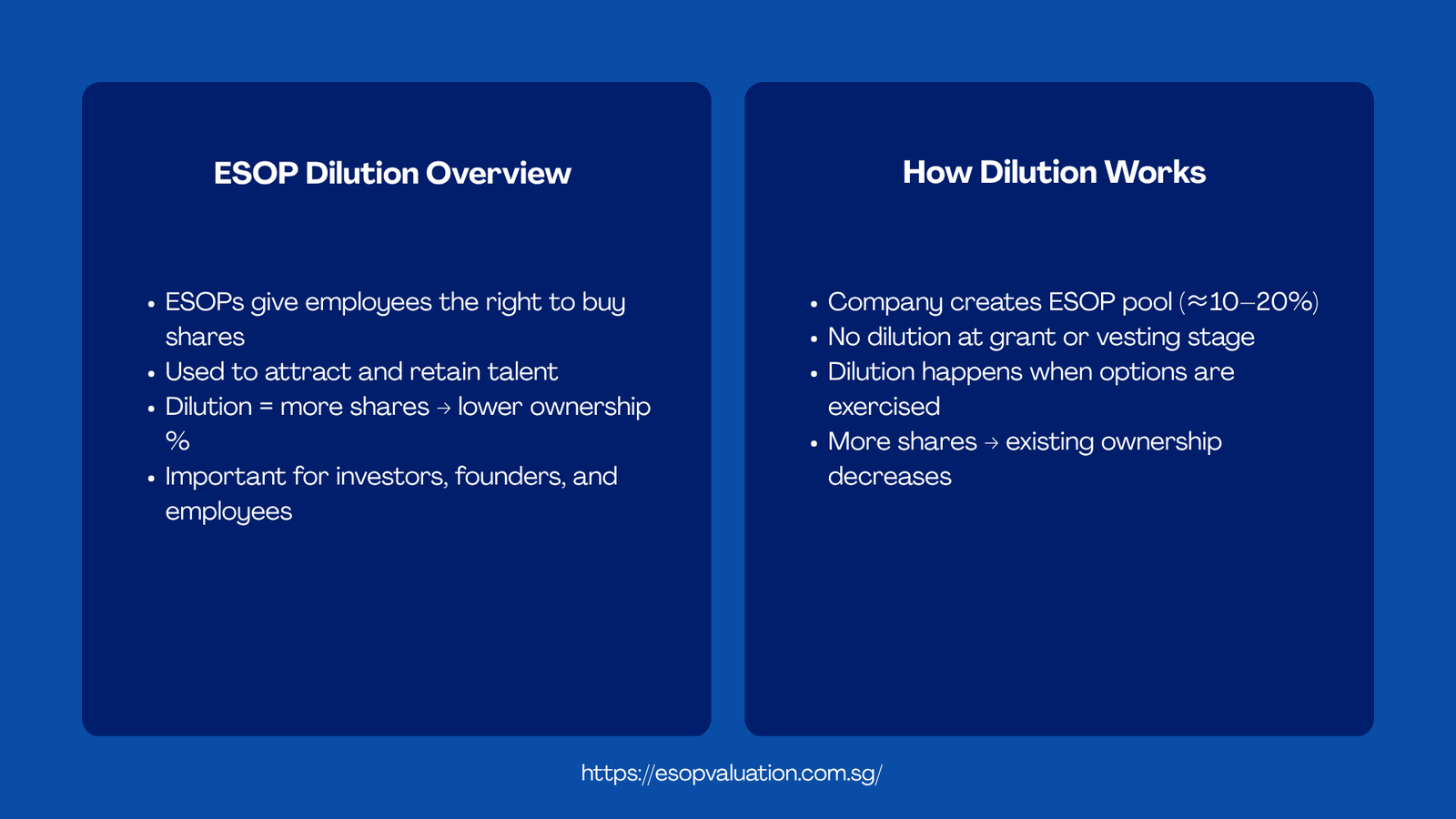
To comprehend dilution, you must comprehend how an ESOP pool is established. In creating an ESOP, a company usually reserves a portion of its total shares (usually 10-20 per cent) in a reserved option pool. Such shares are not yet held by any single person, but the maximum number of options that can be provided to employees in due course. The simple forming of this pool does not automatically dilute shareholders, but it does lower the ownership percentage of each shareholder who owns shares at the time such options are ultimately exercised.
When a worker exercises a stock option, he/she pays the strike price and are given real shares. The number of shares issued at that time goes up, and the percentage stake of the existing shareholders is diluted in proportion. As an example, when a company issues 100,000 new shares of stock by exercising options, the existing shareholders will have a smaller portion of the total outstanding number of shares of the company, even though the total number of shares they hold may not have increased. This is the core of ESOP dilution impact on shareholders.
There is a small yet significant difference between authorised option pools and the fully diluted share counts. Numerous term sheets and valuation negotiations cite the number of fully diluted shares outstanding, the number of shares issued, plus the number of options that may be exercised. In the case of negotiations by investors over pre-money valuations, they usually demand the creation or expansion of the option pool prior to their investment, an often-referred-to practice as the option pool shuffle, which in effect causes the cost of dilution to be passed on to current shareholders instead of new ones.
Table 1: How ESOP Pool Creation Affects Existing Shareholders Before and After Investment
| Scenario | Founder Ownership | Investor Ownership | ESOP Pool | Total Shares |
|---|---|---|---|---|
|
Pre-investment (no pool) |
80% | — | — | 1,000,000 |
|
Pool created pre-investment |
64% | 20% | 16% | 1,000,000 |
|
Pool created post-investment |
72% | 20% | 8% |
1,000,000 |
|
Fully diluted (all options exercised) |
60% | 20% | 20% |
1,250,000 |
How ESOP Dilution Impacts Company Valuation and Share Price
Equity compensation and valuation are interrelated in a subtle way. The impact of ESOP on the valuation of a company is not about the total value of the company divided by the increasing number of shares. Investors and analysts generally consider the value on a per-share basis based on fully diluted share capital, which implies that any increase in the number of options can decrease the implied per-share value. Assuming that a firm is worth USD 10 million and has 1,000,000 shares, then each share would be valued at USD 10. Exercise the ESOP to issue 200,000 additional shares, and the company value per share is decreased to USD 8.33, given that the company value stays the same.
Nevertheless, this calculation is just a part of the story. Properly designed ESOP programmes have the potential to enhance total enterprise value through elevated levels of employee retention, enhanced productivity, and decreased cash cost of compensation. A company which offers salaries lower than market rates but significant equity is in effect, pushing cash payments to the future and aligning employee interests with long-term expansion. When those employees assist the company expand more rapidly, the pie itself grows in size, and current shareholders can end up better off in absolute terms even having a smaller share.
This duality is supported by real-world data. In the 1990s, when the hourly employee equity awards offered by Starbucks were broad-based, in its so-called Bean Stock programme, the firm defended the dilution of existing shareholders by stating that it increased engagement and decreased turnover. The main point is that dilution of stock options in the employees discussed alone lacks the larger picture: the cost of dilution should be the opportunity cost to the business value that talented employees generate.
Process Flow 1: How ESOP Grants Become Shareholder Dilution Over Time
| Stage | Action | Who Is Involved | Dilution Impact |
|---|---|---|---|
| 1. Pool Creation | Board endorses ESOP pool size (e.g., 15% of shares) | Board, Legal, Cap Table Manager | Potential dilution created |
| 2. Grant | Strikes price options (fair market value) are granted to the employee. | HR, Finance, Employee | No immediate dilution |
| 3. Vesting | The option is earned by the employee over a period (e.g., 4-yr / 1-yr cliff). | Employee, HR | No dilution yet |
| 4. Exercise | Strike price paid, actual shares issued to employee. | Employee, Finance, Legal | Dilution occurs here |
| 5. Sale / Liquidity | Sells shares by employee on exit (IPO, M&A, secondary) | All shareholders | Dilution fully realised |
Five Key Considerations for Professionals on ESOP Dilution
Regardless of whether you are considering a job opportunity that is equity-based, a term sheet, or a compensation plan of a company in-service, these five points will help you confidently navigate the impact of ESOP dilution on shareholders.
- Not Dilution, but Destruction of Value. Dilution dilutes your percentage ownership, but when the company grows large enough, the value of the small percentage can be greater than your large stake. Never judge dilution without considering its path in business, not merely share mathematics.
- The Strike Price Is Critical. The strike price of options that are given at a fair market value is the price at which employees have to pay real money to exercise. When the strike price is not determined correctly (too high or too low), it may distort incentives and cause tax issues. Striking a legitimate price requires a formal 409A or independent valuation in most jurisdictions to be obtained by the companies.
- Vesting Schedules safeguard everyone. Four-year vesting with a one-year cliff means that the earned options can be earned over time. This helps safeguard the company against giving a large share of equity to employees who depart in the near future and also safeguards other shareholders against having a lot of shares in the hands of other employees at the same time.
- Anti-Dilution Provisions Matter. Anti-dilution clauses are frequently negotiated with preferred shareholders (especially venture capital investors) to change their share conversion ratios in the event of a down round. These provisions may put a very heavy dilution load on founders and common stockholders, and it is essential to be familiar with the existing defences prior to accepting equity.
- Transparency and Disclosure build Trust. Companies that effectively explain their ESOP policy, the amount of the option pool, the vesting schedule, and the possible scenarios of dilution establish more trust among employees and investors. One of the most typical causes of talent conflicts and investor tension in due diligence is the absence of transparency regarding equity.
Table 2: Common ESOP Vesting Structures and Their Impact on Shareholder Dilution
| Vesting Type | Structure | Best For | Dilution Risk |
|---|---|---|---|
| Standard Cliff | 25% after Year 1, then monthly over 3 yrs | Early-stage startups | Moderate — staggered |
| Straight-Line Monthly | Equal monthly grants over 4 years | Stable growth companies | Low — highly distributed |
| Back-Weighted | Earlier, larger-sized tranches. | Retention-focused plans | High when the employee is long-staying. |
| Performance-Based | Options are vested after KPI or milestone achievement. | Senior executives | Variable – outcome-specific. |
| Cliff + Acceleration | Normal cliff with two-trigger acceleration. | Acquisition targets | Peak in times of liquidity. |
Real-World Examples of ESOP Dilution Affecting Company Valuation
A famous example of managing ESOP dilution is a US e-commerce company that was subjected to several rounds of funding prior to IPO. Its cap table reflected an increasing option pool, which increased from 12 per cent in Series A to almost 22 per cent in Series D, as it aggressively hired engineering talent. The number of shares fully diluted was also prominently reported when the company went public, and certain early institutional investors were surprised to see their percentage ownership reduced so much. Correctly, the company contended that in the absence of that talent, the IPO could not have happened at that valuation. The moral: dilution should be justified by the value created and not defended in hindsight.
This can be contrasted with a mid-size technology company that over-granted options in a growth phase, without basing grants on explicit, clear performance conditions. When the company subsequently experienced stagnant revenues, it was in a sticky situation, a significant portion of in-the-money earlier grants was being exercised, which were flooding the market with shares when investor confidence was already waning. The effect of ESOP dilution on shareholders was very harsh, not due to the poor design of the programme at its inception, but due to the lack of a limit or check mechanism to reduce the issuance rate when the growth objectives were not being achieved.
Another instance of a third case is when the founders of a healthcare start-up issued options to an early advisory board in excessively generous amounts. The aggregate option pool and advisory grants were close to 30 per cent of the fully diluted shares when the company was trying to raise Series B funding. This was noticed by sophisticated investors as soon as it happened, and the company had to pay back some advisory options at cost before the round could close. The experience underscored that the impact of ESOP on valuing a company is not limited only to ordinary employees but to all types of equity compensation – advisors, consultants and board members.
Best Practices for Managing ESOP Dilution and Protecting Shareholder Value
The first step to good ESOP governance is a well-defined policy document that outlines who is eligible to receive a grant, the rate at which the grant is reviewed, the usual terms of vesting, and the disposition of unvested options on employee departure. In the absence of such a framework, equity decisions are more likely to be ad hoc, i.e. inconsistent, subject to legal liability, and in the long term, a cap table that is hard to understand by new shareholders. It should be a shared governance process between HR, Finance and Legal and changes to the option pool size should have board-level approval.
A relevant and up-to-date cap table is one of the most widespread operational issues. The fully diluted number of shares varies continuously as options are granted, exercised, forfeited or expire. Those companies that maintain it in spreadsheets tend to find errors in the due diligence process – an issue that can postpone or kill rounding. Cap table management applications are purpose-built to assist in maintaining a proper, real-time understanding of ownership and dilution situations by all parties involved.
Another best practice that is not taken into consideration by many companies is periodical ESOP audits. Companies ought to periodically, at least once a year, reconsider the option pool utilisation, determine whether the remaining pool will be adequate to meet the future hiring needs, and simulate dilution in the next twelve to twenty-four months. This prospective strategy means that neither the board nor the investors will be surprised by the extent to which employee stock option dilution has already been accommodated into the cap table – and it gives a sensible ground on which they can decide to seek shareholder consent to increase the pool.
Process Flow 2: Annual ESOP Governance Review Process to Manage Shareholder Dilution
| Step | Activity | Owner | Output |
|---|---|---|---|
| 1. Data Collection | Pull all grants, exercises, and forfeitures of the cap table system. | Finance / Legal | Updated cap table snapshot |
| 2. Pool Analysis | Determine remaining pool percentage; compare to hiring plan. | Finance / HR | Pool adequacy assessment |
| 3. Dilution Modelling | Scenarios: up to date, following round of funding, IPO. | Finance / CFO | Dilution scenario report |
| 4. Benchmarking | Compare the pool size with the industry at a similar stage. | HR / Compensation Advisor | Benchmarking summary |
| 5. Board Review | Current results: request permission to modify the pool as necessary. | CEO / CFO / Legal | Board resolution |
| 6. Employee Communication | Inform qualified workers of grant refresh or new grants. | HR | Updated grant letters |
Conclusion : Key Takeaways on How ESOP Dilution Affects Existing Shareholders and Company Valuation
ESOP programmes are a potent and valid medium of creating high-performing teams and harmonising interests throughout a business. They do carry actual costs, however, and they carry those costs, of course, to some extent, on current equity holders. The effect of ESOP dilution to the shareholders is not necessarily bad, but what is important is whether the equity is being awarded in a strategic manner, with transparency and pegged to value creation. When businesses understand these aspects, the business will expand more rapidly than the dilution and all people involved, founders, investors and employees will be better off.
To assess a job opportunity with equity, the trick among professionals is to look beyond the headline number of options and probe: What is the fully diluted number of shares? What was the last valuation? What is the size of the option pool, and how much of it is issued? Vesting terms and acceleration? These questions allow you to know what your equity is actually worth, and what must be done to make it valuable.
The implication is also equally straightforward to the finance and HR professionals who have to deal with the ESOP programmes. Regarding the impact of ESOP on the valuation of a company as a governance matter at the board level, rather than as an HR administration challenge. Proper cap table tooling, regular audit and proactive communication with shareholders. Dilution of employee stock options explained becomes a strategic resource and not a source of confusion or conflict when it is done rigorously and transparently. Those companies that learn to strike this balance will have an easier time in attracting the best talent, closing funding rounds, and establishing the institutional credibility that allows companies to continue growing over the long term.